Let's Not Bring Back The Gatekeepers
Deep Dives
Explore related topics with these Wikipedia articles, rewritten for enjoyable reading:
-
The End of History and the Last Man
12 min read
Linked in the article (13 min read)
-
Spiral of silence
12 min read
Linked in the article (43 min read)
-
Basket of deplorables
10 min read
Linked in the article (8 min read)
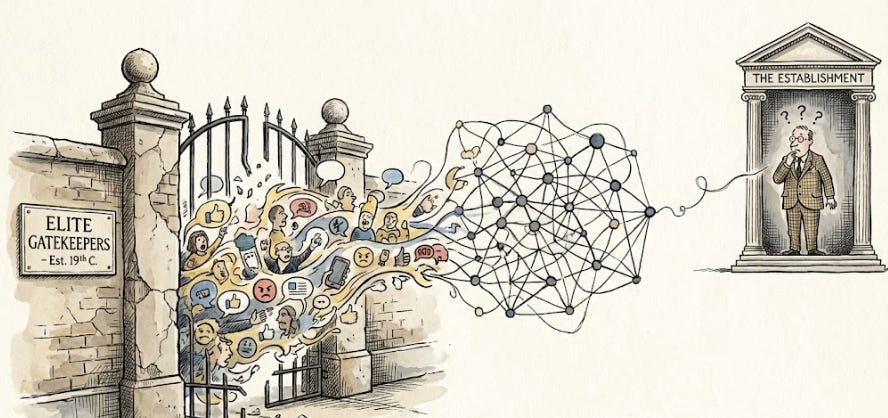
A consensus view holds that social media benefits something called “populism”, an amorphous political force involving anger towards “elites” and “the establishment” on behalf of the more virtuous masses. The evidence for this view consists mainly of the suspicious correlation between social media’s emergence and the worldwide rise of populism, and the undeniable fact that populists seem to perform uniquely well on social media platforms.
Because the establishment in modern liberal democracies is overwhelmingly small-l liberal (universalist, pluralist, procedural), such populist movements are typically illiberal, especially on the populist right (MAGA, Reform UK, Rassemblement National, Alternative für Deutschland, etc). So, social media’s support for populism goes hand in hand with its threat to a reigning liberal order in the West that many thought or at least hoped marked the end of history.
Why does social media have these consequences? And if, like me, you are a liberal who opposes populism, what can be done about it?
This essay has three parts.
Part 1 argues that the main reason social media benefits populism is that it destroys elite gatekeeping, providing a mass media platform for popular ideas historically stigmatised and marginalised by establishment elites.
Part 2 then outlines several reasons why we should nevertheless resist moves for more elite gatekeeping on social media. Not only are such efforts likely to make things worse, but the decline of elite gatekeeping has had many beneficial consequences, and the negative consequences, although real, are often overstated.
Finally, Part 3 argues that many of these negative consequences are not inevitable either. A large part of the blame for them lies in the fact that establishment institutions have failed to adapt to the new pressures and responsibilities of the social media age. Instead, they have clung to a set of habits and norms—most fundamentally, an aversion to engaging with illiberal ideas to avoid “platforming” and “normalising” them—adapted to a world that no longer exists.
Put simply: Once established institutions lost the privilege to control the public conversation, they acquired an obligation to participate within it, which, so far, they have mostly failed to do.
1. Why Social Media Benefits Populism
The most popular theory of why social media benefits populism points the finger at engagement-maximising algorithms. Because tech companies design their platforms to capture user attention, algorithms recommend content that is sensationalist, negative, and polarising—precisely the kind of content that benefits populist demagogues selling cartoonish
...This excerpt is provided for preview purposes. Full article content is available on the original publication.