The Rate of Change: June 24, 2019
Happy solstice! For those of you in the Northern Hemisphere, Friday June 21 marked the summer solstice, or the longest day of the year, while in the Southern Hemisphere, it was the winter solstice, or the shortest day of the year.
Fun fact: If you make a graph of the length of daylight versus the day of the year, you end up with a shape that looks like a sine curve. The summer and winter solstices are the maximum and minimum values of this graph. As Steven Strogatz noted on Twitter, the four special points on this graph — maximum, minimum, and the two times that it passes through the midpoint — mark the start of the four seasons of the year. As you go towards the equator, this graph becomes flatter, and so the effect of seasons becomes less pronounced. If you’re interested in learning more about this relationship, there’s a nice section of Strogatz’s book Infinite Powers that explores this daylight graph.
Graphs of The Week
The chart that defines our warming world
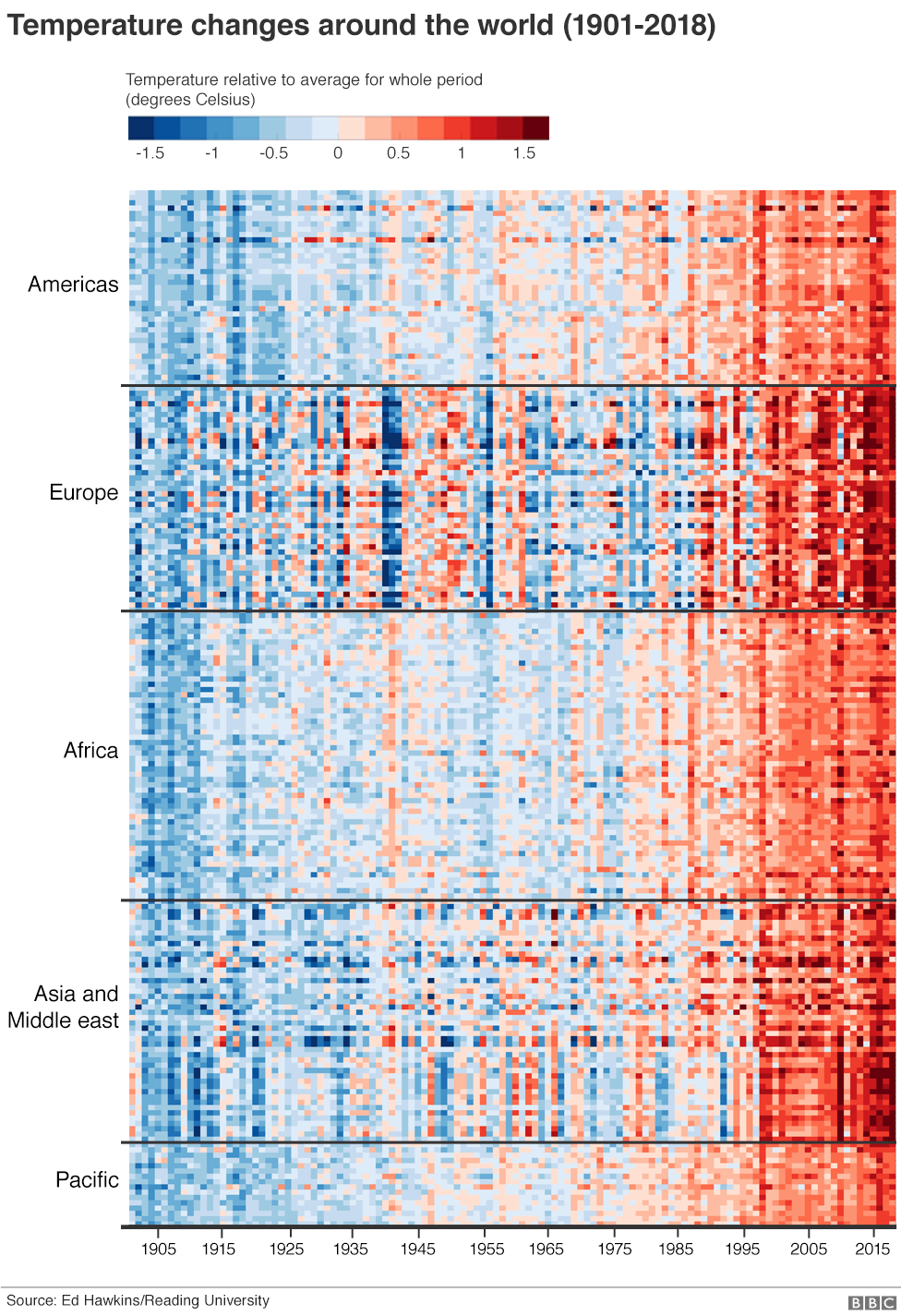
Each line of coloured pixels is the temperature record of an individual nation within its region, stacked one atop the other. Blues are cooler years; the reds are warmer. The far left is 1900; the far right is the present day.
Read more at BBC News. Here’s what the average temperature graph for the entire globe looks like:
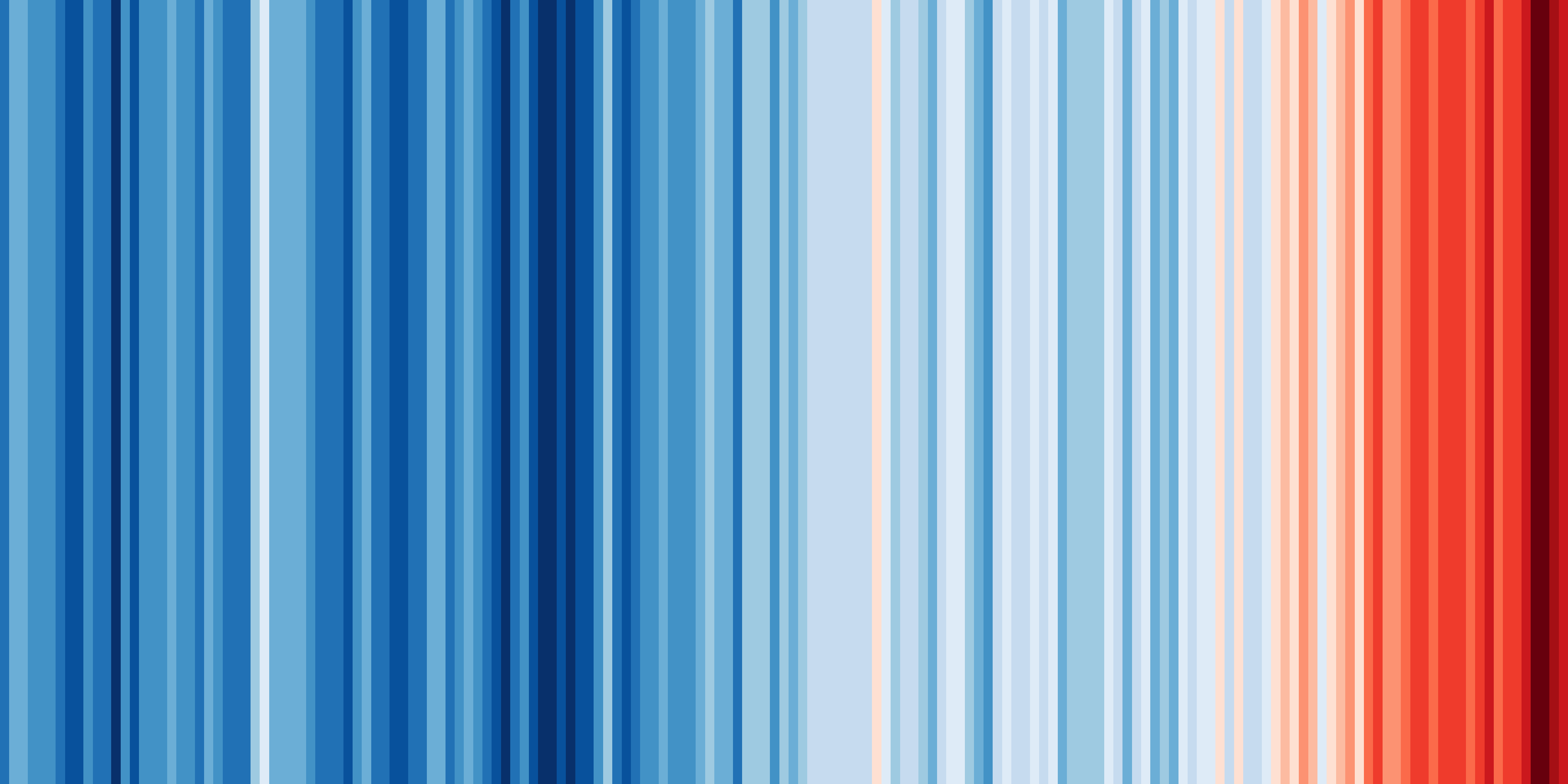
You can download a ‘Climate Stripes’ graphic for your country at Show Your Stripes, developed by Ed Hawkins at the National Centre for Atmospheric Science, University of Reading.
Our Air is Now 0.0415% Carbon Dioxide
In May 2019, we crossed another invisible line in the sand — the concentration of carbon dioxide in our atmosphere surpassed 415 parts per million, or 0.0415%. Prior to the industrial revolution, this number was at 280 parts per million, or 0.028%.
A plot shared by paleoclimatologist Gavin Foster in a tweet and blog post shows us that the last time carbon dioxide levels were this high was nearly 2.5 million years ago.
...
This excerpt is provided for preview purposes. Full article content is available on the original publication.