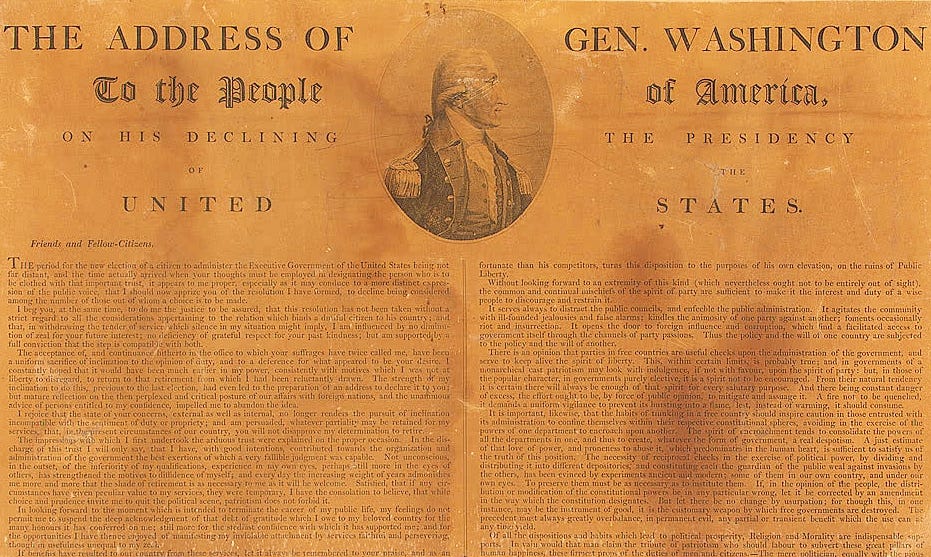
Sunday Pages: "The Address of Gen. Washington to the People of America on His Declining the Presidency of the United States"
Deep Dives
Explore related topics with these Wikipedia articles, rewritten for enjoyable reading:
-
Renfield
13 min read
Linked in the article (12 min read)
-
George Washington's Farewell Address
19 min read
The article extensively discusses this document but readers would benefit from the full historical context, drafting process with Madison and Hamilton, its publication history, and its lasting influence on American political tradition
-
West Florida
11 min read
The article mentions this obscure historical territory that most readers likely don't know existed - its complex colonial history under Spanish rule and eventual incorporation into the US provides fascinating context for understanding early American geography
Dear Reader,
I tend to picture the map of the United States as unchanging—as fixed as the alphabet. Same with the fifty stars on the flag. But of course that was not the case.
Cast your mind back, if you will, 229 years into the past. The year is 1796. The Declaration of Independence is just 20 years old; the Constitution, only seven.
The nation itself is much smaller, in terms of both size and population. Tennessee, the 16th state of the Union, was admitted on the first of June. The Louisiana Purchase is still seven years in the future. There are roughly five million people living in the United States—equivalent to the 2025 population of Alabama.
And Alabama? That wouldn’t become a state until 1819. Part of that piece of real estate was claimed by the state of Georgia; part of it was the eastern swath of Mississippi Territory; and the entire coastline—imagine if the Florida panhandle extended all the way to Louisiana—was something called “West Florida.” West Florida was itself governed by the Viceroyalty of New Spain, a vast expanse south and west of the Red and the Snake Rivers, encompassing significant portions of California, Texas, Arizona, New Mexico, and Nevada. In 1796, in fact, New Spain was larger than the United States!
Our all-time greatest president was also the all-time worst, because to date, only one man has held the job—the general and Revolutionary War hero who, as they say in the theater, originated the role.
It’s hard for me to think of George Washington as a real person. For one thing, he lived before photography, and the Gilbert Stuart portraits don’t help me visualize him as a flesh and blood human, despite the rosy cheeks. And there is a mythology around him. He has been so hero-worshipped as to be an almost legendary figure, more akin to Achilles or King David than, say, Jimmy Carter.
But real he was. And if Washington’s personality was any different—if he were self-aggrandizing instead of humble, immature instead of wise, feckless instead of responsible, selfish instead of empathic, small-minded instead of mindful of his long-term legacy; if, in short, he were more like Donald Trump—the office of “President,” and the very character of the nation itself, would be unrecognizable today.
Because of George Washington, the Chief Executive is addressed as “Mr. President,” and not “His Excellency,” or some other floofy
...This excerpt is provided for preview purposes. Full article content is available on the original publication.