House and Home
There was a time, when I was younger, that I thought I had to ruthlessly block out the side of me that always knows what’s in the pantry in order to get any writing done. Now I think it’s pointless to reject domesticity as a source of creativity. The only way out is through.
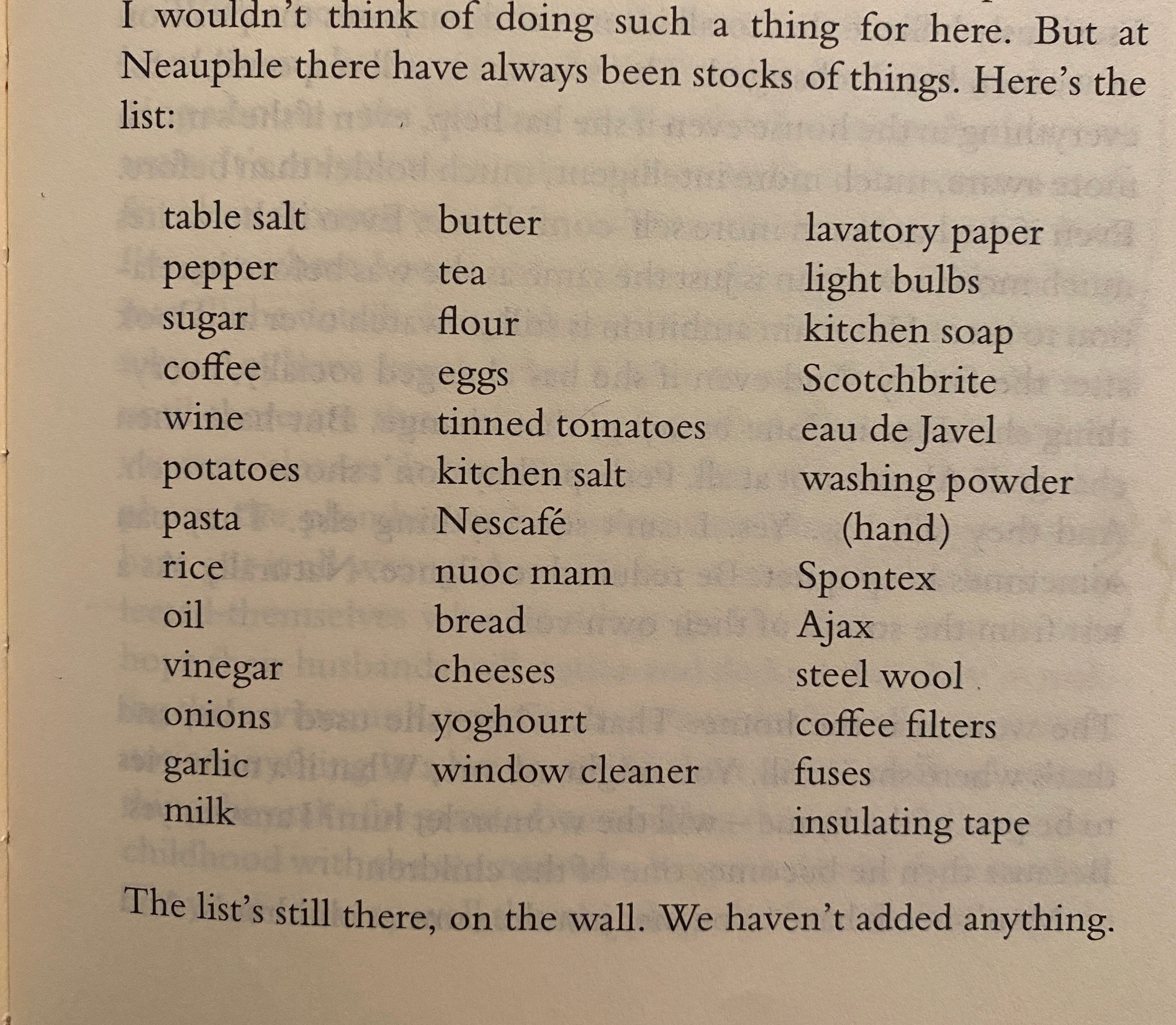
I was thinking about all this while reading Practicalities—a collection of short transcribed conversations with Marguerite Duras. In a chapter called “House and Home,” Duras recites a list of 37 necessities that she kept on the wall of her house in Neauphle-le-Chateau, where she lived and worked in the 1960s and 70s. I loved that she was still talking about this list twenty years later. The list seemed to represent something essential about Duras herself—and I began to wonder what it meant for me as another woman who writes in a house where I live with my family.
Who is Marguerite Duras?
Marguerite Duras (1914-1996) was a French novelist, playwright, and experimental filmmaker. Her most well-known book, The Lover, is a fictionalized account of her sexual relationship, at 15, with an older Chinese man in French-occupied Vietnam (Indochina), where she grew up and lived on and off until her twenties. Duras, which is a pseudonym, is the name of her father’s native village, near the Gascony region of France. As Rachel Kushner writes in the introduction to the Everyman’s Library edition of The Lover, Wartime Notebooks, and Practicalities:
The language of Gascon, from which this practice of a spoken ‘s’ derives, is not considered chic. More educated French people not from the region might be tempted to opt for a silent ‘s’ with a proper name. In English, one hears a lot of Duraaah—especially from Francophiles. Duras herself said Durasss, and that’s the correct, if unrefined way to say it.
Practicalities
Published in 1990, Practicalities (La Vie matérielle) consists of 48 short essays on topics such as “The theatre,” “Animals,” “The last customer at night,” and “Men.” In her seventies, Duras dictated the essays to her son’s friend, Jerome Beaujour, and they edited them together.
If you are the type of person who wants to listen to an older woman speak with authority about what she knows (I am), you might love this book. Unlike some of us, Duras doesn’t seem like she needed to age into her
...This excerpt is provided for preview purposes. Full article content is available on the original publication.