A Case Study in Scientific Coordination
This is a guest post by Hiya Jain, a recent Columbia University graduate with a keen interest in science policy and the history of science. You can find more of her writing on her Substack, Mundane Beauty.
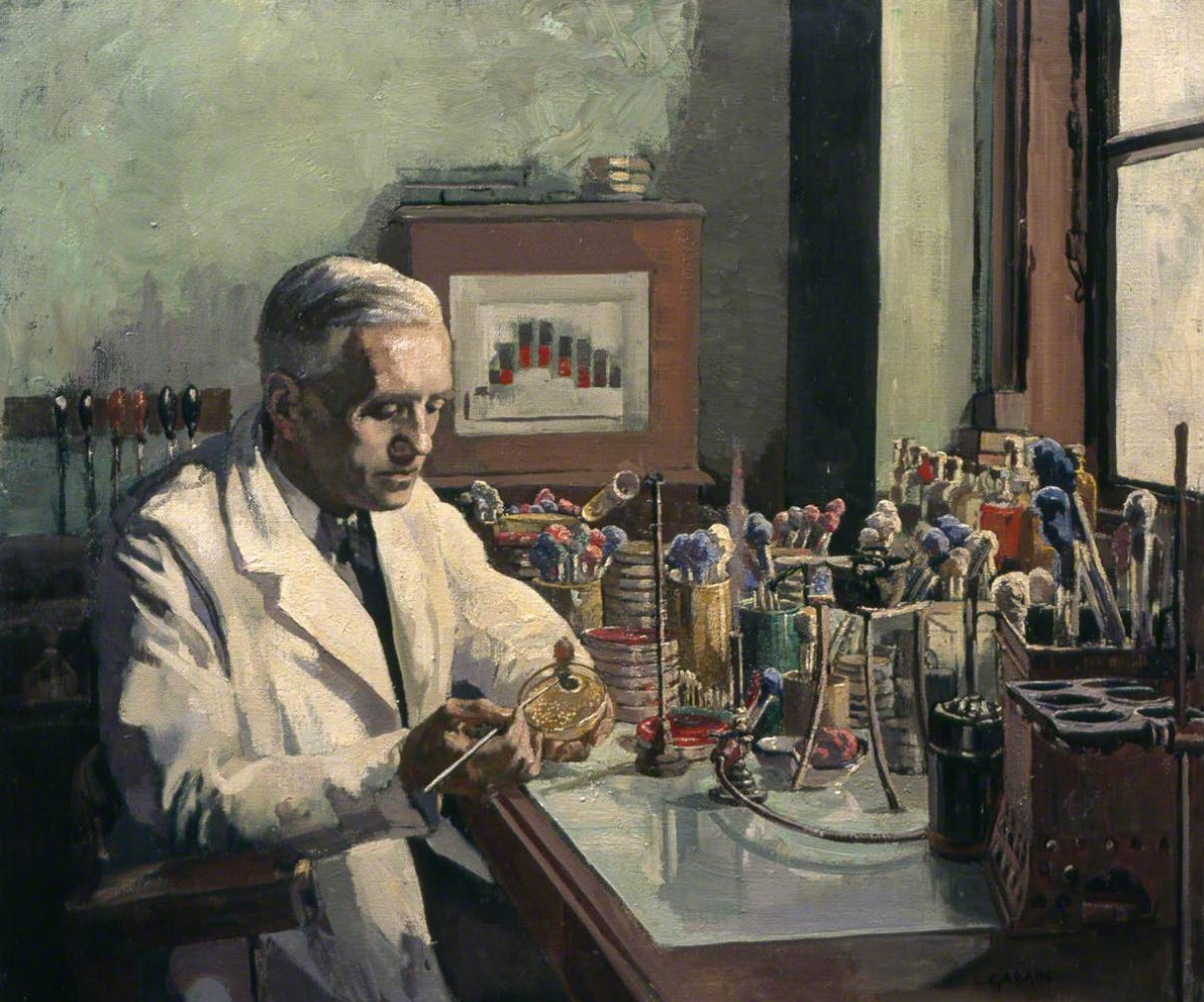
Did penicillin help win WWII? Perhaps not independently, but for the estimated 100,000 Allied soldiers treated between D-Day and German surrender, it must have felt like a miracle. It still remains one, and today penicillin and its derivatives are amongst the most widely prescribed antibiotics globally. However, when we talk about penicillin the wonder drug, we often sidestep the fact that bringing it to market took an incredible amount of effort, and without the immense scientific coordination required to scale it, penicillin may have arrived much too late.
In other words, the story of penicillin is more than a tale of scientific luck; it’s a reminder that breakthroughs depend on how we fund and organize science. In the 1940s, penicillin succeeded not because a lone scientist made a brilliant discovery, but because government, industry, and academia worked together with urgency and coordination. Today, we have few equivalents. The United States spends roughly $50 billion a year through the NIH, but our system often rewards incremental proposals over ambitious ones and buries investigators in administrative overhead. The lesson of penicillin is that scientific miracles may often be accidental in their origins, but the ultimate impact depends on larger systems designed around implementation.
If wartime America could marshal its industrial and scientific capacity to mass-produce a fragile mold, then peacetime America should be able to modernize its research institutions. That means creating space for risk-taking inside the NIH, strengthening programs like ARPA-H that back high-risk, high-reward ideas, and building new pathways – public, private, and philanthropic – that can translate discoveries into real-world impact.
The [penicillin] mold is as temperamental as an opera singer, the yields are low, the isolation murder, the purification invites disaster. Think of the risks!”
Such was the conversation in the Pfizer board room in the early 1940s as the company, a market leader in fermentation, grappled with the longstanding problem of penicillin production. Yet, amidst the turmoil of World War II, they decided to take the gamble anyway. “On March 1, 1944 Pfizer’s penicillin plant opened. It
...This excerpt is provided for preview purposes. Full article content is available on the original publication.