Beijing Highlights Russian Oil Troubles Just Ahead of Israel-Iran Conflict
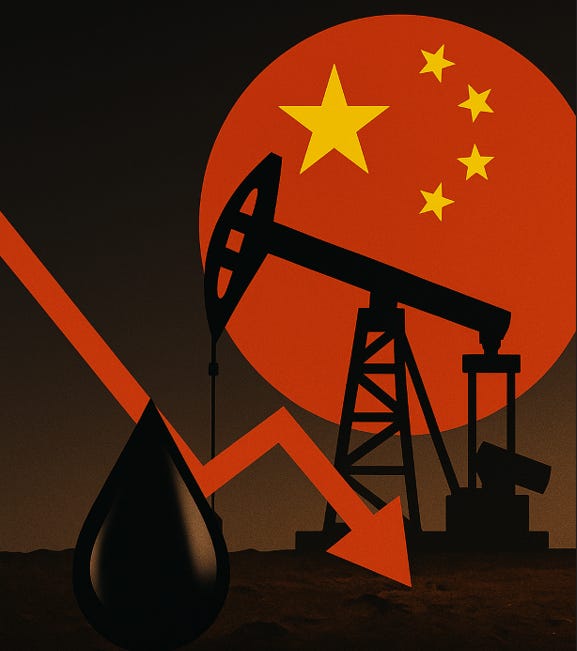
On June 11th, the People’s Daily published a downbeat report on Russia’s oil and gas revenues, quoting Moscow’s Ministry of Finance on weakening energy prices and tapping the National Wealth Fund to plug fiscal holes. The article stood out for its pessimistic tone and prominence—especially for a Chinese state organ that rarely highlights Russia’s economic fragility.
At first glance, the piece seemed to signal quiet unease in Beijing over the war in Ukraine. It echoed past hints that China is preparing for a post-Putin Russia, consistent Xi depersonalizing the relationship during his May 2025 visit —part of a broader recalibration since the Prigozhin mutiny.
The analysis could be read as a subtle warning to Moscow—or a signal to Western observers—that Beijing’s patience with the Kremlin’s war is thinning.
But any signal in the article was quickly overshadowed by Israel’s June 13th strikes on Iranian targets. In this new context, Beijing’s motivations are harder to parse. Was Beijing using the article to hint that a Middle East crisis—by spiking oil prices—might inadvertently empower Russia’s war effort? Was it trying to pressure the West to avoid escalation in Iran for fear of indirectly strengthening Putin?
Much hinges on what Beijing knew in advance. It is generally difficult to conceal military preparations of this scale, Israel reportedly sought U.S. approval for its strikes, and U.S. operational security seems incredibly lax. Beijing likely had advance intelligence, to a degree, although it may not have synthesized the information correctly. Authoritarian regimes’ security services tend to have extremely robust collection programs but weak analytical capabilities. In any event, the Iranian force structures were utterly surprised by the strikes, suggesting Beijing did not share intelligence of an imminent attack, or that the Iranian leadership ignored any warnings.
In sum, Chinese intelligence likely picked up indicators of Israeli military preparations, but whether that intelligence shaped the June 11th article—or whether the article was unrelated —is unknowable for now, and perhaps for much longer.
Ultimately, if Beijing is serious about limiting the war in Ukraine, rhetorical signals and muddled messages aren’t enough. The clearest message would be material: cutting dual-use exports and ending its support for Russia’s defense industrial base.
Russian oil and gas article in the People’s Daily
Russia's oil and gas revenues fell 14.4% year-on-year in the first five months – People’s Daily
...Xinhua News Agency, Moscow, June 10 (Reporter Liu Kai) The Russian Ministry of
This excerpt is provided for preview purposes. Full article content is available on the original publication.