Christine Montalbetti in Conversation with Warren Motte
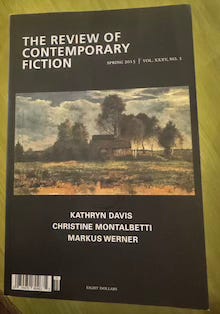
I still have Christine Montalbetti on the brain, so I thought I would share this interview from the Spring 2015 issue of the Review of Contemporary Fiction (Vol. XXXV, No. 1) that she did with Warren Motte—and which goes far beyond anything I wrote about in my piece. She talks about her approach and all of her works that had come out at that time, including the ones that have yet to be translated into English. (But if there is a higher power, then . . . maybe?)
This issue of RCF doesn’t seem to be available online via ProQuest or EBSCO, nor can I find it on Bookshop.org or Amazon . . . which sucks! This is an issue dedicated to Kathryn Davis, Christine Montalbetti, and Markus Werner, and includes pieces by Christine Schutt, Michelle Latiolais, Jean-Philippe Toussaint, Xabi Molia, Michael Hofmann, and Jen Calleja (but no “Book Review” section or “Letters for the Editor,” which, alas), and I know there were boxes of this in the Dalkey basement back in 2020 . . .
I’ll definitely post more pieces from this in the future, as well as from some of the other final issues (and, fingers crossed, unpublished yet finished ones) that might also have fallen through the cracks.
A Conversation with Christine Montalbetti
WARREN MOTTE: Christine Montalbetti, I would like to begin by asking you about your work as a whole, but first, I suppose I should ask you if you can think about “your work as a whole,” that is, if you have a sense of your writings as an oeuvre?
CHRISTINE MONTALBETTI: I can indeed think about my books as a whole (but one that is still open and evolving, I hope!).
Sometimes, there are more or less explicit links between one book and another, for example a character who reappears—as Simon does in Expérience de la campagne, without me specifying whether this is the same Simon as the one in Sa fable achevée, Simon sort dans la bruine (or sometimes, more rarely, there’s the vague homage of a homonym, like a certain Crèvecoeur in Western who echoes the Crèvecoeur in The Origin of Man). Sometimes, too—and here it’s not retrospective but prospective—a sentence or sequence unwittingly announces a novel to come: a paragraph in Sa fable achevée conjures up dreams of “cavemen,” though I had no idea the next novel would
...This excerpt is provided for preview purposes. Full article content is available on the original publication.