China’s E-Commerce Machine and Temu’s Global Reach
Deep Dives
Explore related topics with these Wikipedia articles, rewritten for enjoyable reading:
-
Pinduoduo
10 min read
Temu's parent company - understanding Pinduoduo's business model, origins in China's group-buying phenomenon, and rapid rise to challenging Alibaba provides essential context for why Temu can undercut Western competitors so dramatically
-
Foxconn suicides
12 min read
John Pabon references worker suicides pushing Chinese leaders into action in the early 2010s - this specific incident was a watershed moment that reshaped global attention on Chinese manufacturing labor conditions
A few weeks ago I came across a map that made me stop and stare.
It showed the most downloaded apps in Europe in 2024.
Almost every country had the same conspicous orange: the recoginable branding colour of China’s e-commerce giant TEMU.
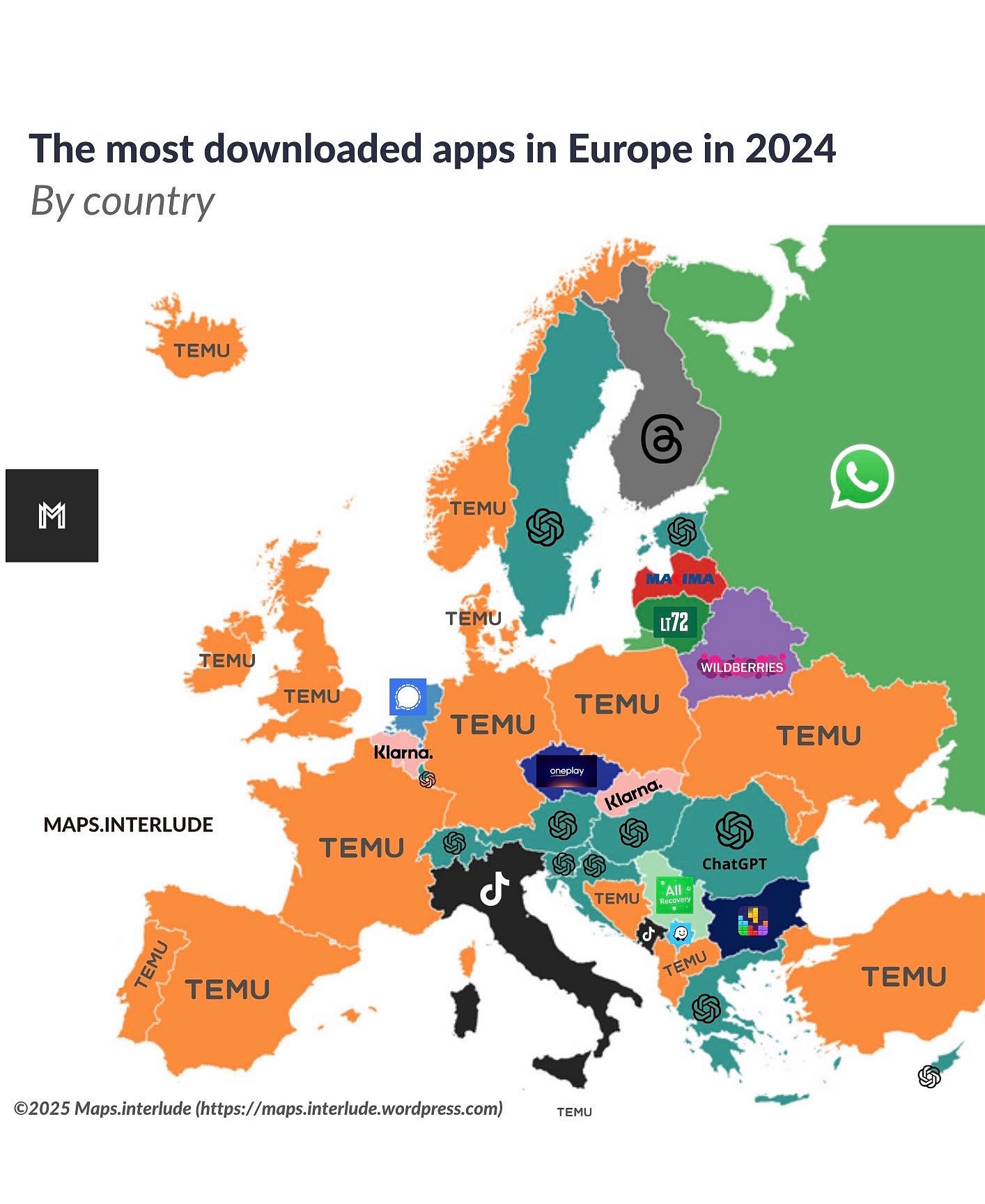
The pattern held across Western Europe, the Nordics, Eastern Europe and the UK. One Chinese app had taken over an entire region. And not quietly.
That map stayed in my head. It said something bigger than “people like cheap stuff”. I wanted to understand what was happening behind the scenes, so I brought back someone who had lived inside that story for ten years.
John Pabon spent a decade in China. He worked inside factories, with big international brands, with local governments and with executives who were trying to understand sustainability long before it became a global talking point.
He saw a version of China that tourists never see.
Our conversation changed the way I see Temu, China and the whole sustainability debate.
What John told me
When John moved to Shanghai in 2009, the country was still carrying the reputation of the old factory era. Growth was everything. Oversight was weak. Preventing pollution was not a priority. Labor abuses made headlines.
But he said this version of China did not last.
Around the early 2010s, the government started to crack down on the worst practices.
Pollution scandals, corruption cases and worker suicides pushed leaders into action.
He told me that China can be slow to change, but once the central government commits to a direction, things shift faster than people expect.
He kept repeating that you do not see this if you fly in for a week.
You only notice the change if you live there year after year.
Why Temu fits into this picture
Temu’s rise is not a simple story of cheap goods.
It is the product of decades of investment in logistics, manufacturing and speed.
John explained that China launches new products faster than any other market. Companies test ideas in real time. The market itself becomes the research.
Add a strong influencer culture and you get the perfect user funnel.
Add a global cost of living crisis and you get scale.
This is why Temu sits at the top of almost every European app chart.
What surprised me most
John told me something I did not expect.
He said that Western companies with
...This excerpt is provided for preview purposes. Full article content is available on the original publication.