The Four Horsemen of the AI Infrastructure Buildout
Deep Dives
Explore related topics with these Wikipedia articles, rewritten for enjoyable reading:
-
TSMC
12 min read
The article centers TSMC as the critical bottleneck for AI chip manufacturing, noting 'all of the world's leading edge chips today are made by TSMC.' Understanding TSMC's monopoly position, history, and geopolitical significance illuminates the supply chain fragility discussed.
-
Logistic function
13 min read
The article uses S-curves as a central framework for understanding how growth naturally slows through feedback mechanisms. The logistic function Wikipedia article explains this mathematical concept that underlies technology adoption cycles and bubble dynamics.
There has been so much talk about the AI bubble bursting that I cannot ignore it anymore and hide my head in the sand always looking at deep tech. I decided to think through some of the ways this bubble can pop and try to find the four horsemen who ride in the dead of night, right into the unsuspecting board rooms of AI companies. It may even be a whole cavalry. This piece is more for fun, and less about rigor. I have no idea what’s coming either. If you disagree, complain in the comments; I welcome your thoughts.
Everybody is skittish right now. Period. People are building dashboards for AI doomsday scenarios, famous economists and bloggers are warning us of the impending apocalypse, and hyperscalers are intertwined in shady, circular deals that makes the skin of anyone with a basic understanding of economics, crawl. Articles are popping up everywhere, each one architecting the downfall of AI in its own way. Now I’m adding to it. I’m sorry.
Nature has a strange ability to enforce “S-curves” on all forms of growth, usually through some feedback mechanism that slows progress and kills exponentials. When this happens, we will experience the pullback that everybody is anticipating so much. Usually these setbacks are short term but the effects that ripple through economies of the world reverberate for decades. Cue fear.
Historically, technology has still marched on but it’s best we try and anticipate what’s coming, even if we (ok, I) get it horribly wrong. In this post, I tried to envision the ways in which AI can go under in the near term: a morbid thought experiment.
Let’s begin.
Edited to add TL;DR image created with 🍌:
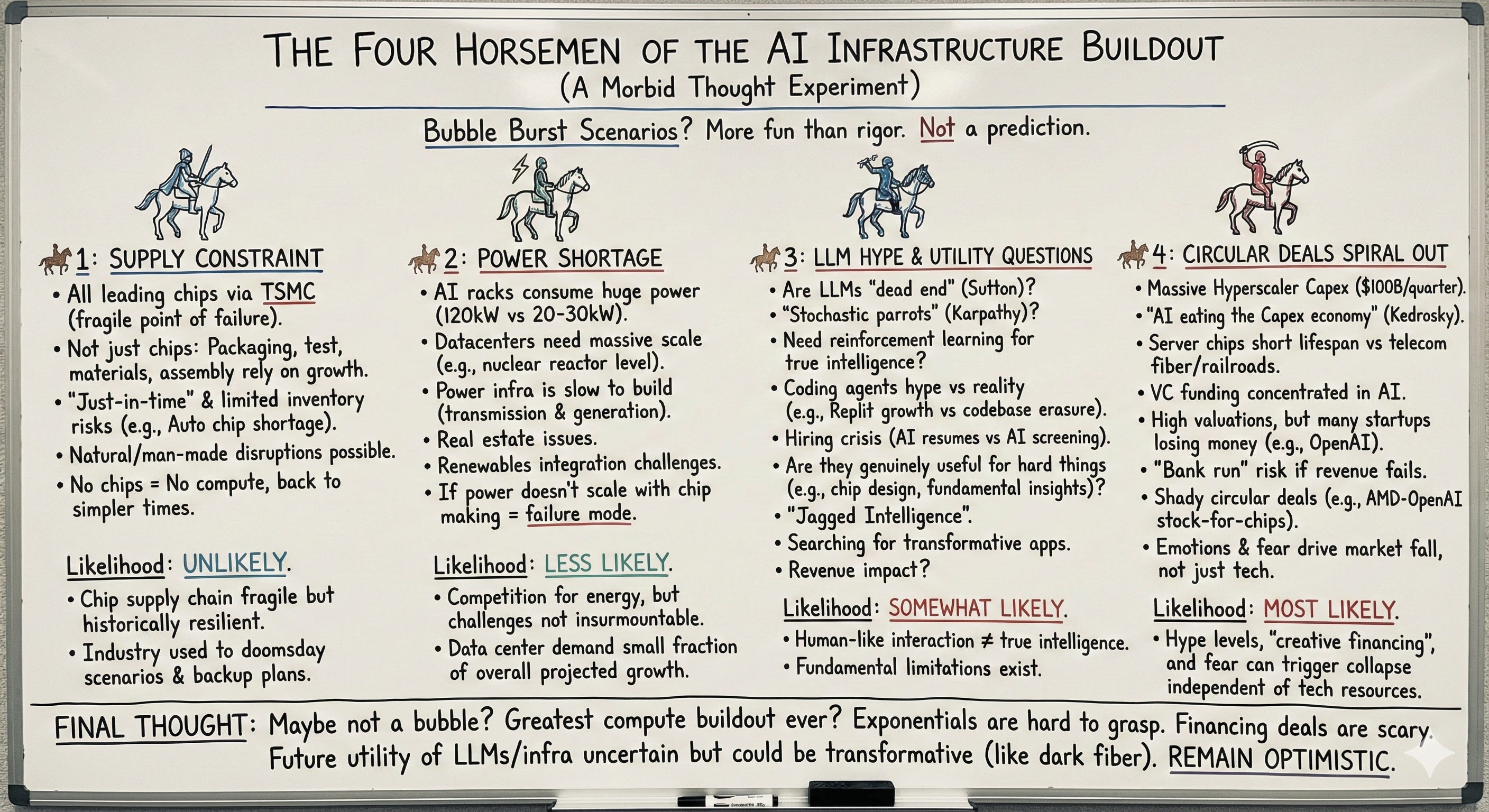
🏇🏽1: Supply Constraint
For all practical purposes, all of the world’s leading edge chips today are made by TSMC. Intel and Samsung have had their struggles, but in a world where TSMC is magically and most tragically not an option anymore, we will still be able to build chips. They might not be the best, or most economical, but we’ll get by. In the chip industry however, it’s not just making chips that counts; the rabbit hole goes much deeper.
Chips need packaging, test, assembly and material suppliers worldwide who all rely on the continued growth of chip sales. Time and again we have been privy to chip shortages of various forms, and somehow the
...This excerpt is provided for preview purposes. Full article content is available on the original publication.