Does Therapy Culture Explain the Ideological Mental Health Gap?
Conservatives report higher levels of mental health than liberals. Recently, Derek Thompson profiled a study by Schaffner et al. (2025) arguing that this might be due to liberals being more comfortable putting their problems in therapeutic terms. That paper begins by confirming earlier studies showing a mental health gap, which is reduced but still there when controlling for a wide variety of factors in a sample of 60,000 US adults. The authors then get a representative sample of a thousand, asking half of respondents about mood and half about mental health. The mental health difference is as expected, but there is no gap in reported mood at all. This implies that conservatives are more likely to say their mental health is fine even if they might not be any happier.
Lakshya Jain responded by publishing the results of a new survey for The Argument, finding that liberals tend to do worse on a “well-being score”, which largely avoided the language of mental health but asked about things like social relationships, anxiety, and whether individuals dislike themselves. Moreover, conservatives have described themselves as happier in the General Social Survey since 1972. Peltzman (2023) includes the following graph, with happiness scores rated on a scale of -100 to 100.
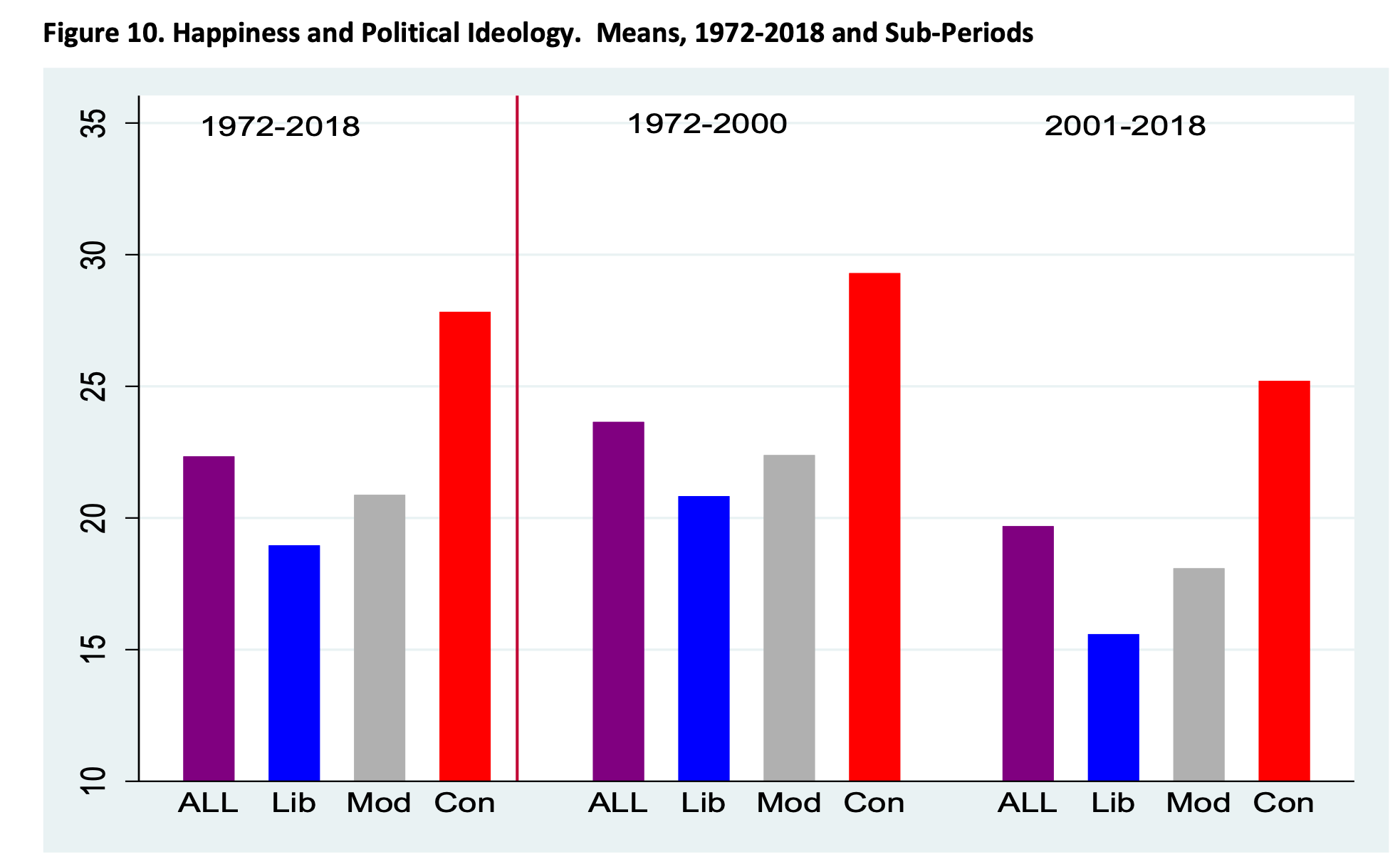
Overall, Schaffner et al. is not enough on its own to conclude that there is no mood or happiness gap based on ideology. Asking about mental health in particular may exaggerate underlying differences between conservatives and liberals, but they’re still there according to a wide body of research.
If, compared to liberals, conservatives are happier, have better mental health, or whatever else we want to call it, what might be the reason for this? There are three broad possibilities:
Liberalism causes poor psychological outcomes
Poor psychological states cause liberalism
There is some trait X that is correlated with liberalism and psychological outcomes
Note that in figuring out what X might be, we are usually not talking about normal demographic correlates like age and sex, since every competent scholar is going to control for such factors. There must be something going on that is a lot less obvious.
Theory: Liberals Accept Therapy Culture
I start with the intuition that one of the things most likely to cause mental health outcomes is beliefs about mental health. A similar view is put forward in Abigail Shrier’s Bad Therapy, which argues that it
...This excerpt is provided for preview purposes. Full article content is available on the original publication.