The Wisdom of Yoram Hazony
Well now, I'm no hero, that's understood
All the redemption I can offer, girl, is beneath this dirty hood
With a chance to make it good somehow
Hey, what else can we do now?
Except roll down the window
And let the wind blow back your hair
Well, the night's busting open
These two lanes will take us anywhere
We got one last chance to make it real
To trade in these wings on some wheels
Climb in back, heaven's waiting down on the tracks
Oh, come take my hand
We're riding out tonight to case the promised land
— Bruce Springsteen, Thunder Road
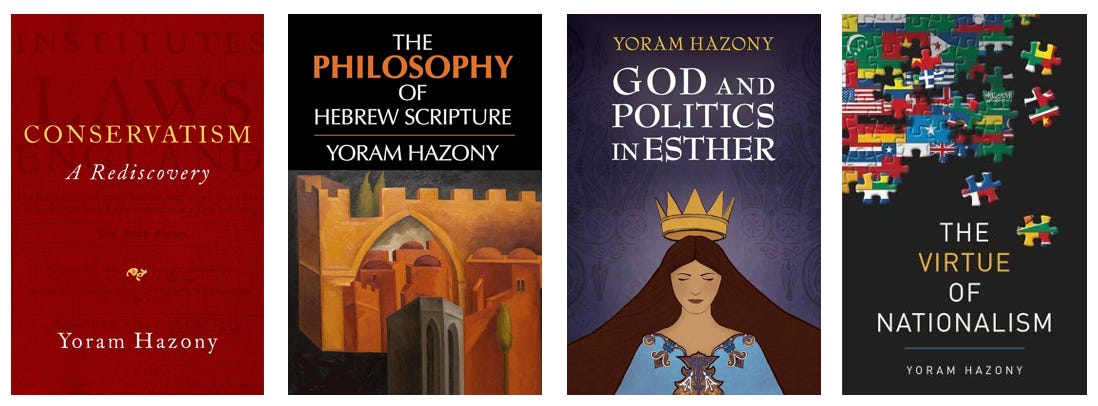
is a rebel, a romantic, and a restorer. Beneath his formidable intellect lies a quiet moral fervour, shaped as much by the Hebrew Bible as by the political wreckage of the 20th century. For Hazony, you cannot speak of politics without speaking of the family; for the family is the fundamental building block of the nation. And you cannot speak of the family without speaking of God, who is the ultimate source of loyalty, order, and moral inheritance. This covenantal chain — God, family, nation — is the foundation of his worldview.
A Politics of Obligation
An Orthodox Jew, a philosopher, and leader of the National Conservatism movement, Hazony writes with clarity and conviction. His prose is lyrical but restrained, his analysis accessible but insight dense. He sees the world not through abstract theories, but as it is lived: through the empirical examples of the past, and the stubborn realities of fallibility and compromise. In Hazony’s vision, the ordinary man struggling to raise his children and the political hero navigating statecraft are bound by the same hard obligations — loyalty, duty, and the weight of inherited tradition.
“There are righteous men who perish through their righteousness, and there are the wicked who flourish by their wickedness. Be not overly righteous…”
— Ecclesiastes 7:15-16
At the heart of his political treatise is a rejection of the liberal myth of neutrality — the fantasy that society can stand for everything, and thus stands for nothing. Against this, Hazony proposes an unapologetically normative politics rooted in scripture, in covenant, and in the unchosen obligations that form the backbone of real human community. He rejects liberalism’s promise of a smorgasbord of identities as incoherent and corrosive. He rejects conservatives who pay lip service to tradition while living atomised, secular lives.
...This excerpt is provided for preview purposes. Full article content is available on the original publication.