China’s Trade Ultimatum to Canada: Comply or Suffer
Deep Dives
Explore related topics with these Wikipedia articles, rewritten for enjoyable reading:
-
Detention of Michael Spavor and Michael Kovrig
10 min read
Michael Kovrig is interviewed in this article and references his detention. The full story of the 'two Michaels' hostage diplomacy case provides crucial context for understanding China's coercive tactics against Canada.
-
Made in China 2025
10 min read
Kovrig specifically names this policy as central to China's grand strategy. Understanding this industrial policy explains why China is pursuing technological and manufacturing dominance.
-
Rare-earth element
14 min read
The article mentions China's 'stranglehold on rare earth supply chains' as a weapon of economic coercion. Understanding what rare earths are and why China dominates their production explains this geopolitical leverage.
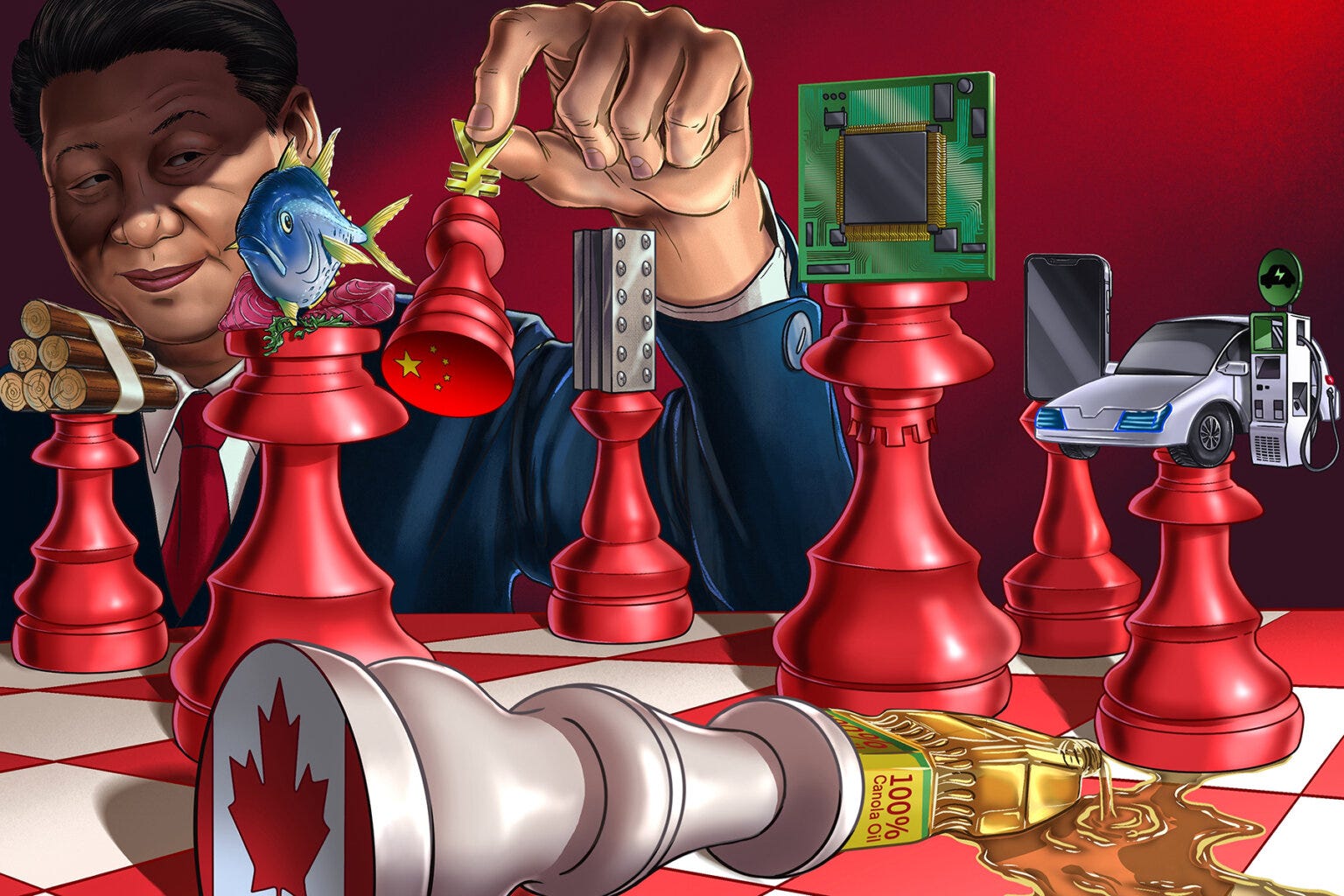
Illustration by Adam Mazur
This story was originally published on thewalrus.ca
By ,
The core assumption behind Canada’s China policy was simple: trade and politics could be kept in separate lanes. But China’s tariffs on Canadian canola, imposed earlier this year, show how that separation is collapsing. Markets are being used as instruments of intimidation, leaving middle-sized economies, like ours, to discover just how exposed they really are.
Few people grasp that shift more viscerally than Michael Kovrig. The former diplomat, who spent nearly three years detained in China, has since emerged as one of the sharpest critics of how Beijing uses economic leverage to shape political behaviour abroad. In our conversation, Kovrig steps back from any single dispute to examine China’s methods and long-term ambitions. The question he keeps circling isn’t just what China wants, but whether Canada has fully understood the game it’s already playing.
The interview, held over email, was edited for clarity and length.
Did Canada misread China’s willingness to retaliate?
After Canada, in 2024, imposed necessary import duties on China’s heavily state-supported electric vehicles, steel, and aluminum, it shouldn’t have surprised anyone that the People’s Republic of China’s government would retaliate by targeting vulnerable agri-food sectors, particularly canola.
We’ve seen this movie before. In 2018, when Canada arrested Huawei’s Meng Wanzhou, Beijing retaliated by taking Canadian citizens—like me—hostage and, economically, doing the same to agri-food companies by blocking imports. That inflicted losses on them of around $2 billion because they had to sell to other buyers at lower prices.
Canadian canola businesses, such as Richardson and Viterra, apparently dreamed that the 2018–2021 dispute was a one-off. After it ended, they ramped up and sold even more to China, only to now lose most of a $5 billion market. I hope they finally understand that, as long as they have excessive exposure to China, they’ll be targets anytime the Chinese Communist Party wants to coerce changes in Canadian policy and behaviour. As the saying goes: “Fool me once, shame on you. Fool me twice, shame on me!”
The CCP has a history of using access to China’s vast market as a disciplinary tool.
Yes, and it’s getting more aggressive. More than a dozen countries have been targeted in recent years: Japan suffered consumer boycotts due to a maritime dispute with Beijing, as did South Korea because it installed an American missile defence system. Norway was
...This excerpt is provided for preview purposes. Full article content is available on the original publication.