Going Still. Still Going.

Hi everyone,
Got the news yesterday that Vigil is debuting at #1(!) on the The New York Times best sellers list.
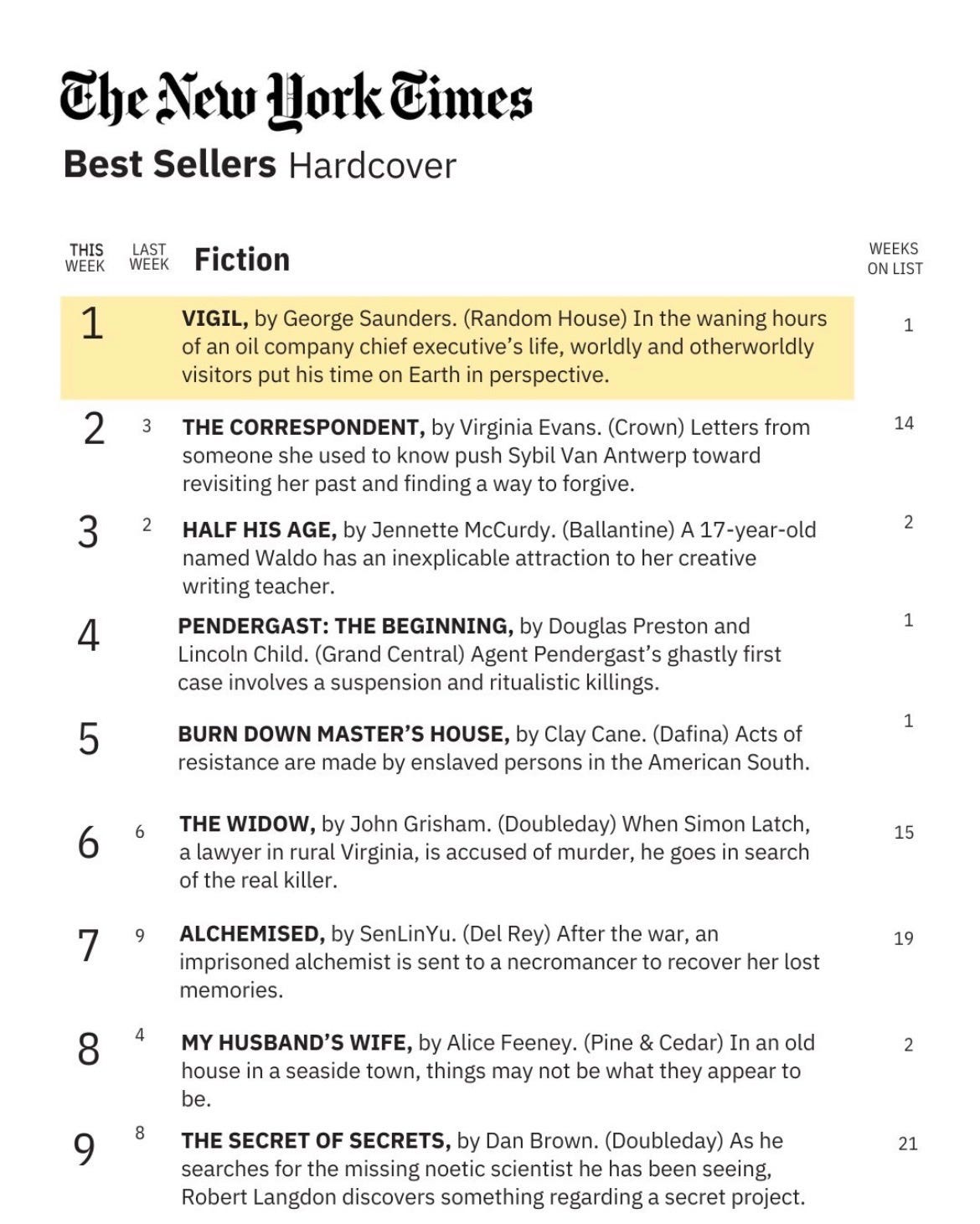
Thanks to all of you who helped this happen, by pre-ordering or otherwise buying it. What a thrill. Jeez. I mean. :)

I’m writing this little intro on a flight from Los Angeles to Vancouver. Since I last wrote, I’ve had events in San Francisco, Santa Cruz, and Los Angeles – I’ve dropped in some photos at the end of this post. You’ll also find a compendium of some of the podcasts I’ve been doing.
After Vancouver, I have a day off at home, and then it’s off to Chicago, Madison, St. Louis, Baltimore and a short visit with my parents in New Orleans, then over to the U.K., then another short visit home…and then Dallas, Austin, Houston, and San Diego. 😊
Then (early March!) done for a bit.
For today, because I’m still racing around, I thought we’d do one more beat on “Victory Lap,” in response to a question that came in over email, a version of which was also asked at the L.A. event:
Q.
Dear George,
I have a follow-up question on your post discussing the ending of Victory Lap.
(The question continues after that short commercial break…):
For what it’s worth, my interpretation of the ending was the same as your “correct” interpretation. However, it makes me think of the whole “death of the author” argument, and where the line between a misread and alternate read is. So in this case for example, it still seems like the “other side” - that Alison’s parents essentially created a happier version to help their daughter cope, and they’ve so thoroughly drilled this that she now believes it herself - is viable given what’s actually in the text. And crucially not just viable, (an alien came and wiped their memories off-page may be “viable,” but it’s outlandish and silly), but believable given the characters, and what it might mean for what the story is trying to say.
I wonder (and please bear with what might sound like woo) if part of why the original ending felt off to you, was that it erased this ambiguity, and that on some level, there being this kind of ambiguity actually led to the feeling of “this works now.”
This excerpt is provided for preview purposes. Full article content is available on the original publication.