The Week Observed: September 12, 2025
What City Observatory Did This Week
Traffic levels are going down on the I-5 bridges connecting Portland and Vancouver, even as the Oregon and Washington Transportation Departments are proposing a massive expansion that could end up costing $10 billion.
Traffic on the I-5 bridges today is lower than it was in 2005, according to ODOT statistics. The Interstate Bridge Replacement project is predicated on forecasts claiming that traffic would be 172,000 vehicles per day, now, rather than the 127,000 vehicles per day that actually used the bridge in 2024.
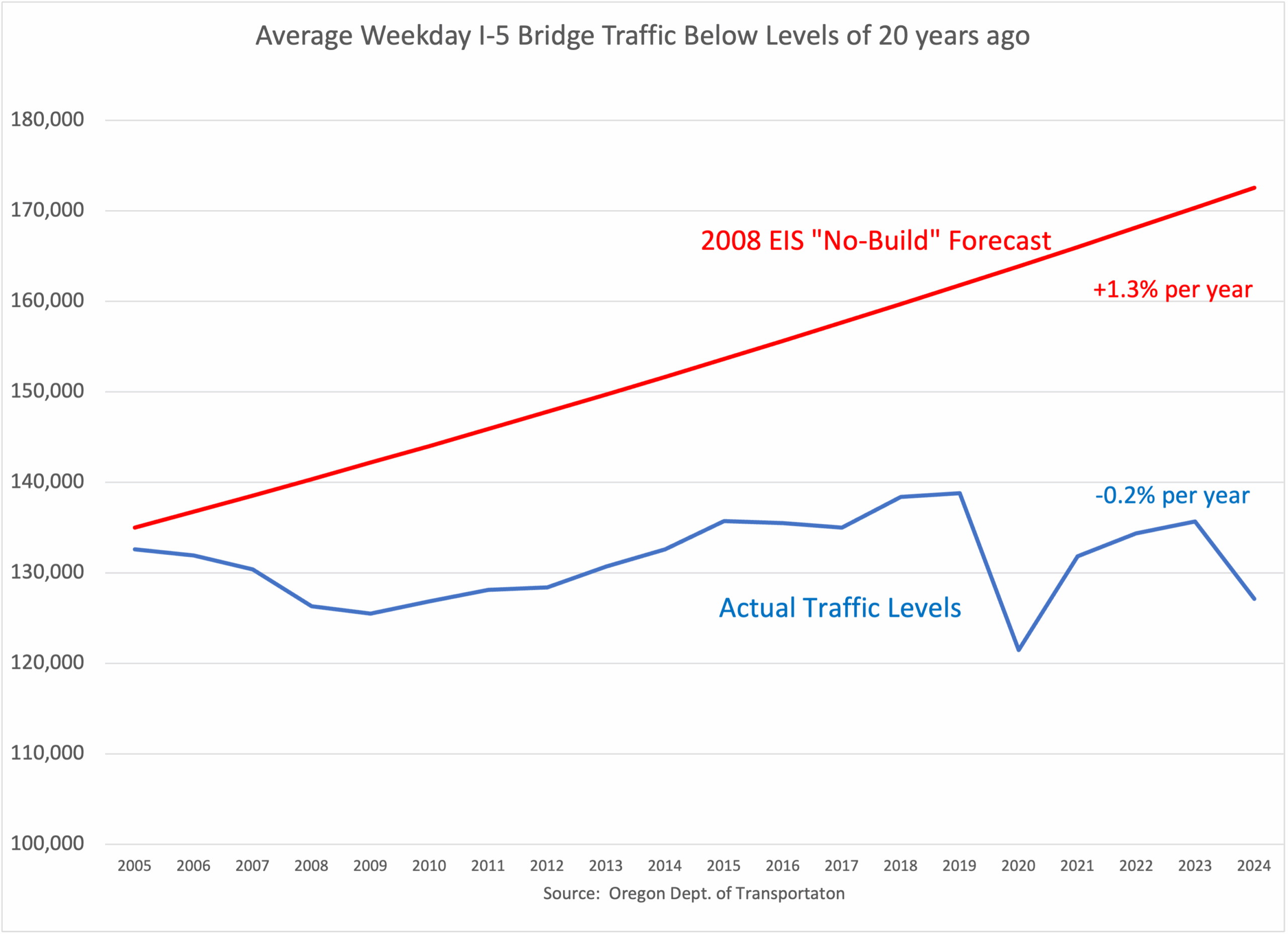
Confronted with data showing that traffic levels are declining, the project's director's asserted that congestion was bad because "every time I use that bridge, it is congested." This from a project that has spent millions on staff and consultants to gather and examine data and build complex models of current and future traffic levels on the bridge.
In sum: ODOT and WSDOT are proposing to spend as much as $10 billion to widen a roadway where traffic is declining, is less than it was twenty years ago, and shows no signs of ever reaching the levels claimed in the project's modeling and environmental analysis. Instead, we're to base this investment on the vibes as reported by a project staffer.
Must Read
No measurable diversion from Manhattan congestion pricing. One of the most constant and difficult objections to congestion pricing is the argument that tolling some roadways, but not others, will simply cause traffic to shift to other routes, producing delays and gridlock in non-tolled locations. Manhattan's congestion pricing, in effect, since January, gives us a clear opportunity to test that theory. Writing at StreetsblogNYC, the indispensable Charles Komanoff sifts through the data and finds, that contrary to popular press accounts that Manhattan pricing would produce gridlock in the Bronx have simply failed to materialize:
...There was no discernible change in vehicle speeds in Mott Haven and Port Morris [two key routes in the Bronx] in those 25 weeks vis-à-vis the same period a year earlier. The average 2025 speed for those weeks, 8.04 mph, was a minuscule 0.5 percent less than the 8.08 mph speed for the same 25 weeks of 2024. The bottom line is that traffic speeds in Mott Haven–Port Morris have neither deteriorated nor improved with congestion pricing. This indicates that traffic volumes today in Mott Haven and Port Morris do not differ from those before congestion
This excerpt is provided for preview purposes. Full article content is available on the original publication.