Nature's undoing of the curse of Colombian Alzheimer's families
Last week, I was recording with Patrick the Q2 podcast episode of human genetics round up. For those who are not familiar with the series, in the end of 2022, I spoke about some of the interesting human genetics papers published that year on The Genetics Podcast hosted by Patrick Short from Sano Genetics. Motivated by the positive feedback, Patrick asked me to do it again in 2023, and then it became a routine. This year, we've planned for four episodes, one each quarter. I've always struggled to decide which ones to discuss, as always there were more great papers than we could cover in one hour. But somehow I manage to pick a few interesting ones, of course, based on what I read recently and what stayed in my memory. The Q2 episode will be out in a few weeks from now. One of the papers I discussed was the recent Alzheimer's disease (AD)-related one published in NEJM. It was about a rare APOE Christchurch mutation as a potential genetic modifier of PSEN1 E280A mutation that causes a severe early onset form of AD.
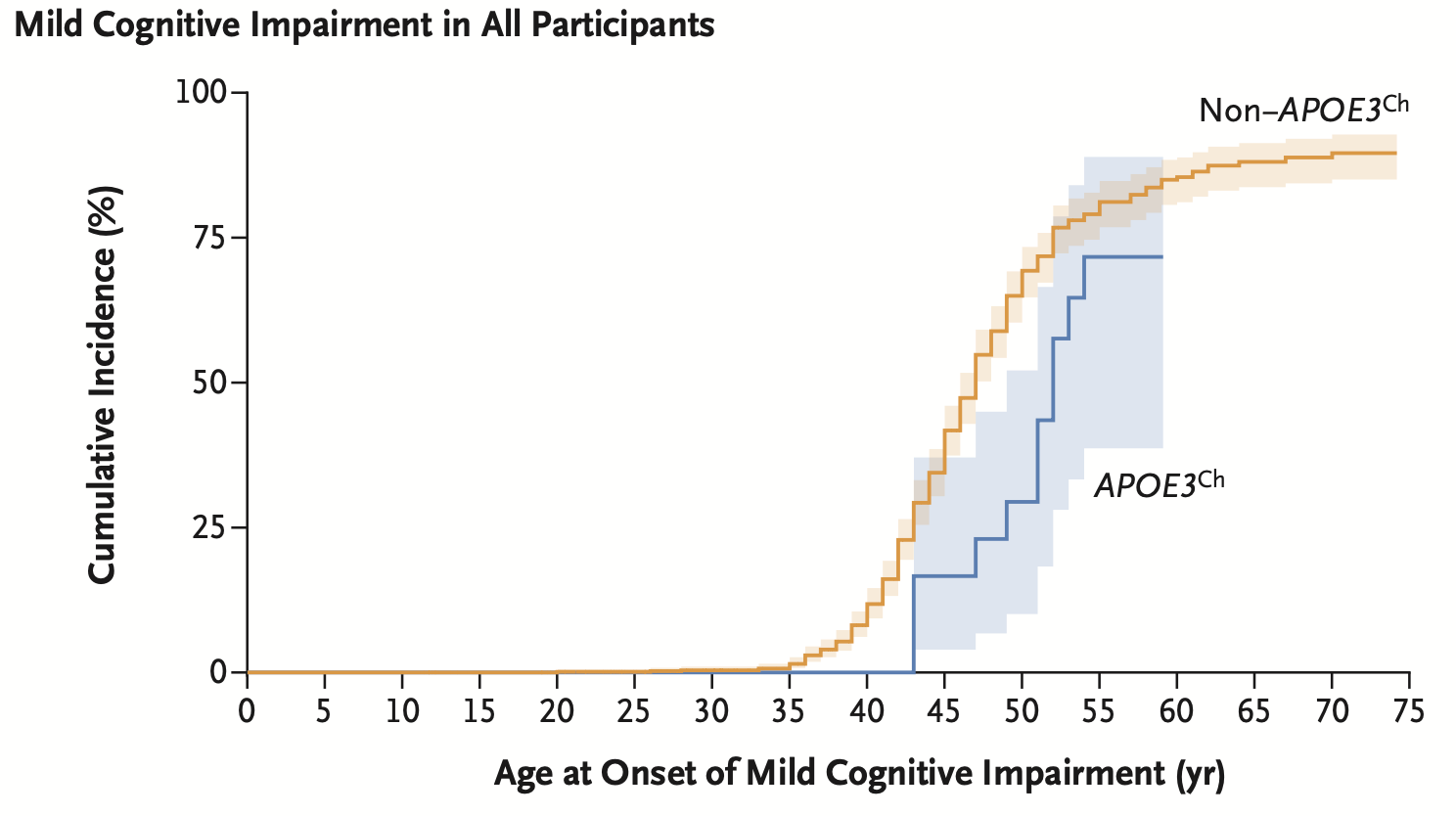
PSEN1 encodes presenelin 1, a component of a large multiprotein enzyme complex called gamma-secretase. This enzyme complex is what cleaves the amyloid precursor protein (APP) resulting in amyloid beta peptides that aggregate to form the amyloid plaques, seen in the brains of AD patients. Certain missense mutations in PSEN1 cause a severe form of autosomal dominant AD with very early onset, discovered in the mid 1990s. The largest of AD families affected by PSEN1 mutations resides in Antioquia in Colombia. It's a large pedigree of nearly 6000 members of which around 1000 individuals carry a pathogenic missense mutation, E280A1, in PSEN1. The Antioquia Alzhiemer's family has attracted a great deal of interest from AD researchers. Nowhere else in the world one can find so many AD patients, all caused by a single mutation. So, naturally, scientists have been closely watching this kindred to identify any outliers. In 2019, researchers from Harvard Medical School and Universidad de Antioquia (Arboleda-Velasquez, Lopera, O’Hare, et al. Nat Med) reported one such outlier: a Colombian woman with E280A mutation who was destined
...This excerpt is provided for preview purposes. Full article content is available on the original publication.