Diary: Val McDermid, Deep Winter
Deep Dives
Explore related topics with these Wikipedia articles, rewritten for enjoyable reading:
-
Battle of Culloden
18 min read
Referenced as the 'desolate Culloden battlefield' near the Clava Cairns, this 1746 battle was the final confrontation of the Jacobite rising and marked the end of the Highland clan system. Understanding this pivotal moment illuminates why Scottish identity and traditions became so culturally significant.
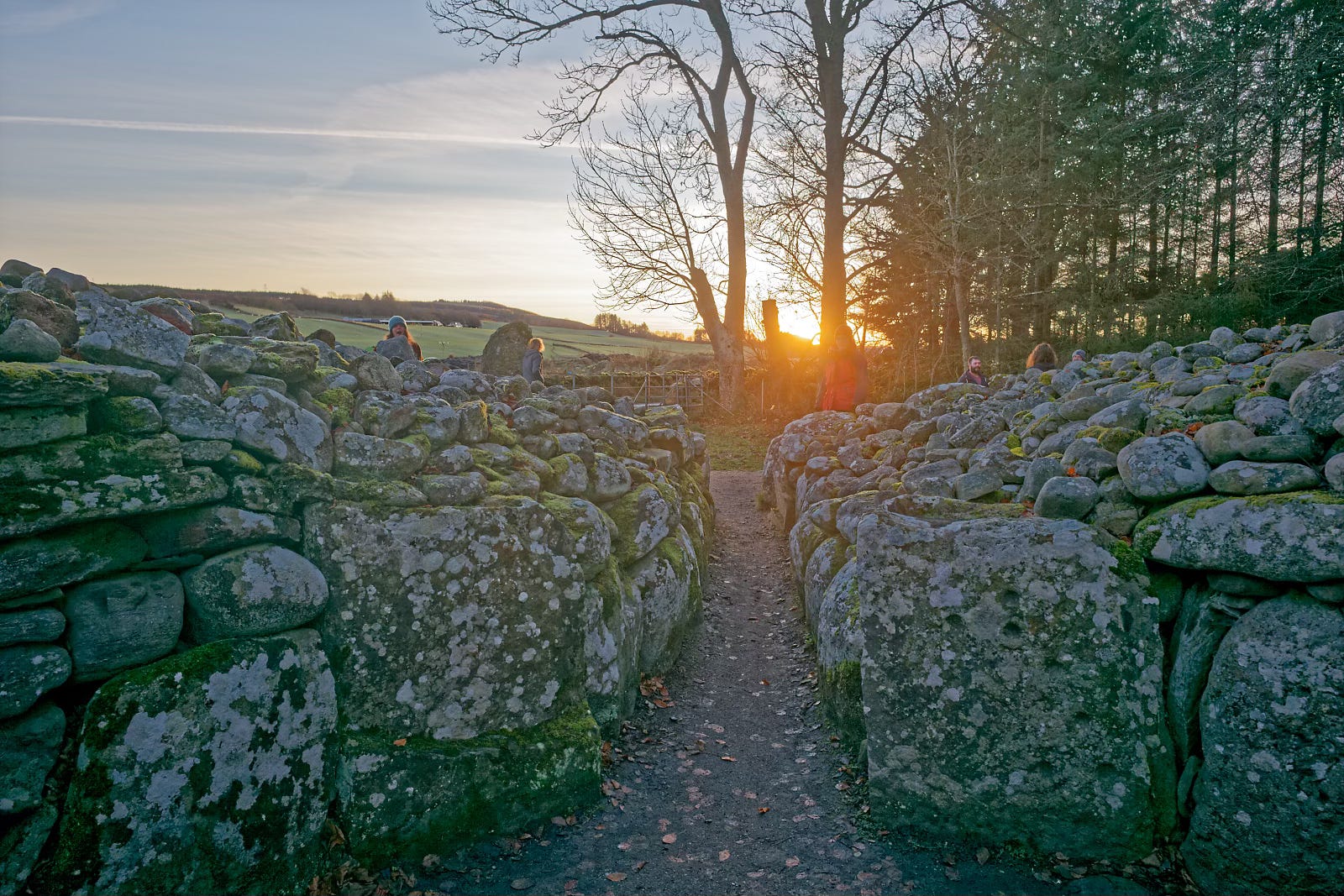
Midwinter solstice at the Clava Cairns, Scotland. Photograph © Julian Paren

The winter solstice arrives just before Christmas, on the 21/22 December. It marks the turning of the year and that same promise—the light will come back.
It’s an understanding humans have needed for thousands of years. If we want proof of that then it’s there in physical form in the layout of the many prehistoric stone circles in the Scottish Highlands and islands. A classic example sits on a terrace above the River Nairn near Inverness. About a mile south of the desolate Culloden battlefield, where Bonnie Prince Charlie’s army was famously routed in 1746, hidden in a grove of trees is the Clava Cairns. Viewers of the TV series Outlander will recognize their more recent rebranding as Craigh Na Dun. But they had already been standing there for the best part of four thousand years before that decisive April defeat of the Highland army.
Walking through the trees, you come upon the chambered tombs almost by surprise. The scale is almost shocking: the main cairn consists of a wide outer ring of stones more than twenty meters in diameter, encircling a central space five meters across. It’s impossible not to be struck by the atmosphere—the air seems still, untouched by the winds that sweep across Culloden moor from the nearby Moray Firth. The structures feel alien, almost as if they’d dropped from space.
Back in the Bronze Age, these stone tombs were painstakingly built by people who had no mechanical assistance and only rudimentary tools, a remarkable feat in itself. The circular cairns sit on a raised earth platform amid strategically placed standing stones, some almost three meters tall. The cairns themselves are aligned along a southwest/northeast axis; when the sun sets on the midwinter solstice, its rays shine down the passageway into the heart of the tomb itself and illuminate the back of the chamber. It’s an awesome feat.
And the builders didn’t just assemble the cairns from a random collection of stones. They were deliberately arranged not only in order of size but also by color. Towards the southwest, they chose red and pink sandstone. In the light of the setting sun at midwinter, they appear to glow red, the color intensifying till the sun sinks and they grow dark. Conversely, the stones on the opposite side, the northeast, have seams of quartz running through them.
...This excerpt is provided for preview purposes. Full article content is available on the original publication.