Click & Create: Turning Customer Ticket Insights into Knowledge Workflows
There is a growing emphasis on AI-assisted question answering systems to answer customer questions and handle customers' problem effectively. However, leveraging AI for such a use case requires a robust and structured knowledge base, as the answers must be grounded in the reality specific for the company.
In this blog post, I will explore the challenges and solutions in creating knowledge base for resolving issues in customer support centers.
Once you read this article, you will have a better understanding of challenges ahead of you.
I will explain the necessity of preparing the knowledge base according to the recipe below.
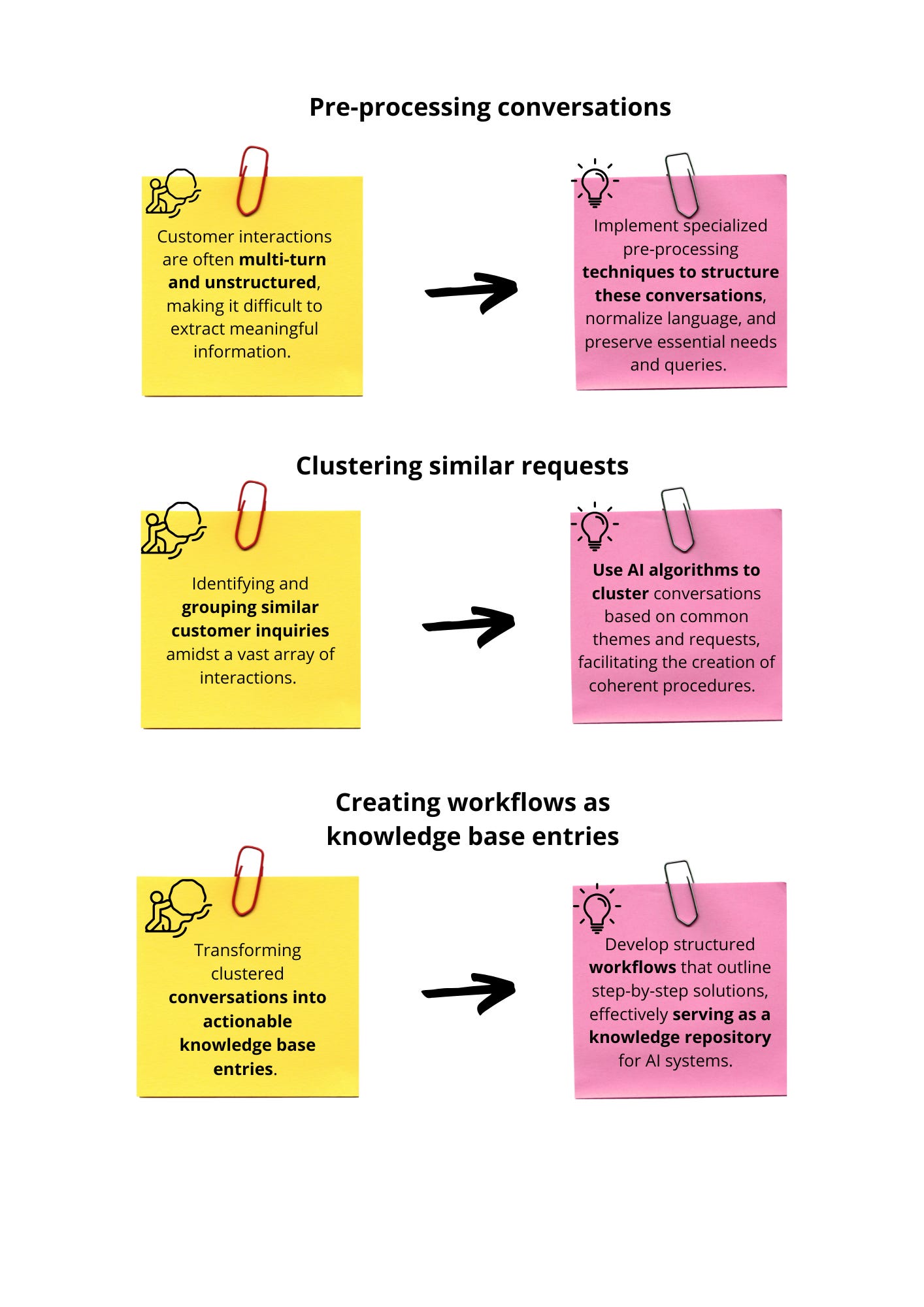
Focusing specifically on customer support, AI-assisted question answering can be categorized into two distinct flavors:
Personalized Support, where individual customer inquiries are being addressed such as order IDs, personal account details, and specific transactional information. This is particularly important in sectors like e-commerce, where customers often seek personalized assistance about their orders.
Product Technical Support, which concerns answering broader questions related to product usage, troubleshooting, and technical issues. It is popular in industries dealing with complex or technical products where customers may require detailed guidance.
In this article I am focusing on Product Technical Support and do not go into agentic workflows for solving personalized issues. Not yet 😉
What is your data readiness?
From data perspective AI-assisted question answering systems can have two types of knowledge component:
Document-Based Knowledge: These systems utilize a vast array of documents already available within a company. This can include manuals, FAQs, internal wikis, and more. The assumption is that all the information necessary to solve customer questions is written down in such textual form and all given information is assumed to be factually correct statements.
Interaction-Based Knowledge: These systems aim to take advantage of knowledge embedded in customer interactions such as tickets and emails. While it might seem intuitive to use these interactions as a knowledge source, their unstructured and often chaotic nature poses significant challenges.
Document-based knowledge comes with challenges of its own, but I will not touch upon it this time. I want to focus on the challenging nature of interaction-based knowledge.
The Challenge of Unstructured Data
For those who are less technical, it might appear that using customer tickets and emails is a viable knowledge source. However, the reality is quite different. These interactions are typically:
Unstructured and messy: Conversations with customers are dynamic and can vary widely in format
This excerpt is provided for preview purposes. Full article content is available on the original publication.