Does Global Workspace Theory Solve the Question of AI Consciousness?
Below are three sections from Chapter Eight of my manuscript in draft, AI and Consciousness, fresh new version available today here. Comments welcome!
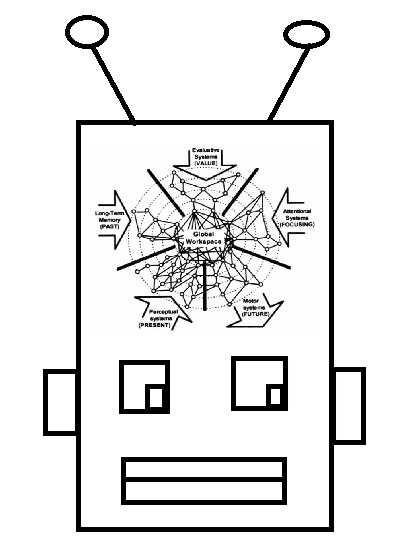
[image adapted fromDehaene et al. 2011]
1. Global Workspace Theories and Access.
The core idea of Global Workspace Theory is simple. Sophisticated cognitive systems like the human mind employ specialized processes that operate to a substantial extent in isolation. We can call these modules, without committing to any strict interpretation of that term.[1] For example, when you hear speech in a familiar language, some cognitive process converts the incoming auditory stimulus into recognizable speech. When you type on a keyboard, motor functions convert your intention to type a word like “consciousness” into nerve signals that guide your fingers. When you try to recall ancient Chinese philosophers, some cognitive process pulls that information from memory without (amazingly) clogging your consciousness with irrelevant information about German philosophers, British prime ministers, rock bands, or dog breeds.
Of course, not all processes are isolated. Some information is widely shared, influencing or available to influence many other processes. Once I recall the name “Zhuangzi”, the thought “Zhuangzi was an ancient Chinese philosopher” cascades downstream. I might say it aloud, type it out, use it as a premise in an inference, form a visual image of Zhuangzi, contemplate his main ideas, attempt to sear it into memory for an exam, or use it as a clue to decipher a handwritten note. To say that some information is in “the global workspace” just is to say that it is available to influence a wide range of cognitive processes. According to Global Workspace Theory, a representation, thought, or cognitive process is conscious if and only if it is in the global workspace – if it is “widely broadcast to other processors in the brain”, allowing integration both in the moment and over time.[2]
Recall the ten possibly essential features of consciousness from Chapter Three: luminosity, subjectivity, unity, access, intentionality, flexible integration, determinacy, wonderfulness, specious presence, and privacy. [Blog readers: You won’t have read Chapter Three, but try to ride with it anyway.] Global Workspace Theory treats access as the central essential feature.
Global Workspace theory can potentially explain other possibly essential features. Luminosity follows if processes or representations in the workspace are available for introspective processes of self-report. Unity might follow if there’s only one workspace, so that everything
...This excerpt is provided for preview purposes. Full article content is available on the original publication.