The Fertility Problem Is Getting Worse with Time
As countries get wealthier, fertility drops. This relationship is nearly universal, and its implications are very dark. We all want people to live better lives, and it’s generally bad for societies to be at sub-replacement fertility. And although most people don’t think like this, I believe that lower birth rates are bad simply because we should want more people to exist. A country seeing its fertility fall from 4 to 3 to me is undesirable simply for the reason that more people is good, even if a TFR of 3 is still fine from an economic or social perspective.
The world is getting wealthier, so if we want to solve the fertility issue, that is arguably the main headwind we are facing. But the situation is even more troubling than that, as it seems that pro-natalists are battling against time itself. Even holding GDP constant, birth rates are collapsing over time.
To see how this has worked, we can look at the numbers from Our World in Data, which provides a spreadsheet of GDP and fertility rates for countries going back to the 1950s. As a starting point, check out the straightforward relationship between the two variables in today’s world. In this article, all GDP numbers are adjusted for inflation and the cost of living.
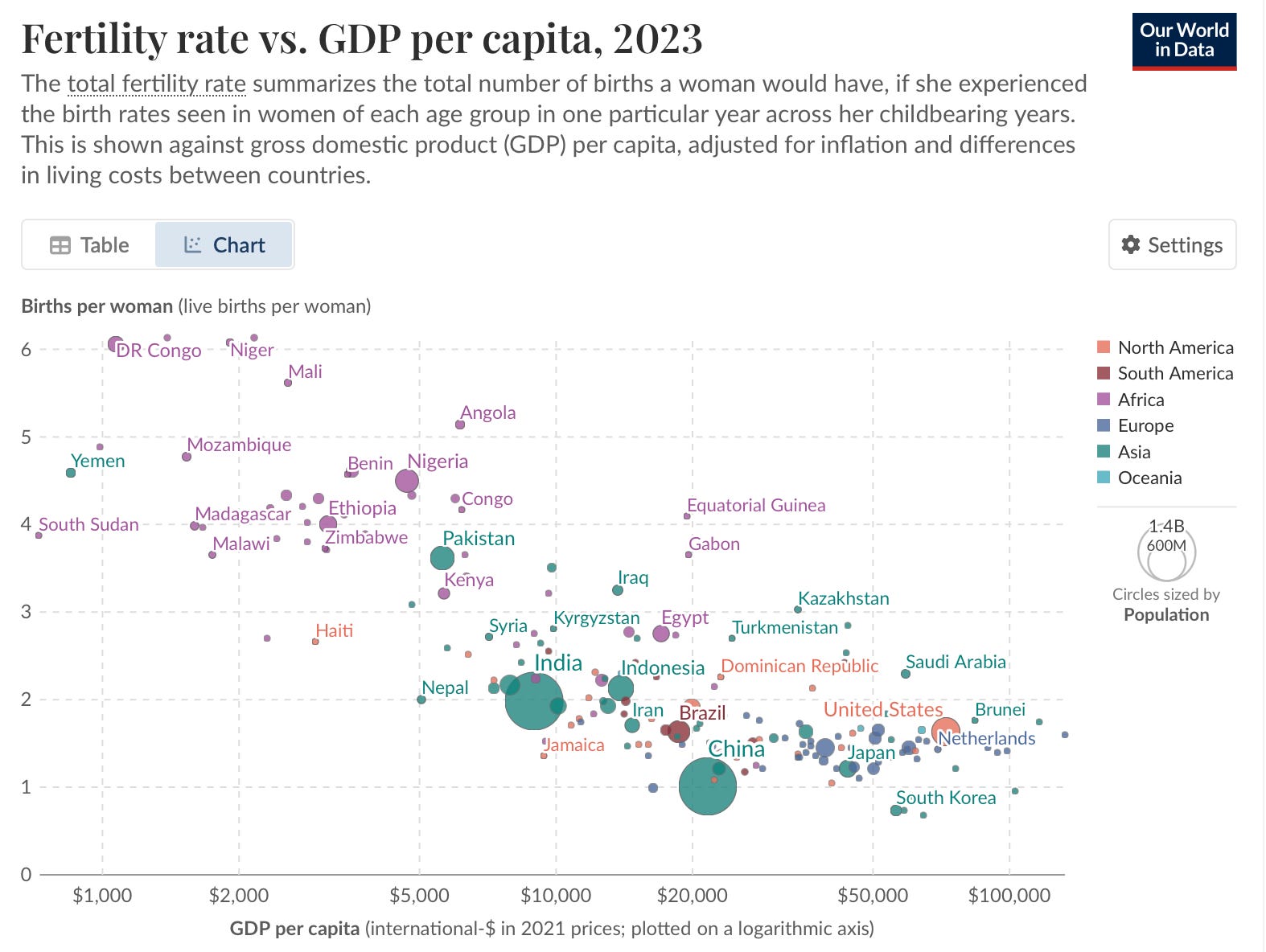
You can see that wealth isn’t the entire story when looking at how many poor modern countries there are with low fertility. This seems to have been a lot less common in previous decades. On the chart above, Ukraine is only at $16K a year, with a TFR of 0.98. Nepal had a GDP per capita of $5K, and was already below replacement. Even a passing familiarity with the data indicates that this didn’t happen in the 1980s and 1990s, or at least happened less often.
We can see a particularly extreme case of this in East Asia. China passed the GDP per capita threshold of $20,000 in 2021. That year, its fertility rate was 1.12. When Japan, Korea, Singapore, and Taiwan passed the same threshold, they were in much better shape, as can be seen in the chart below. The later an East Asian country achieved $20K, the lower its fertility at that moment.
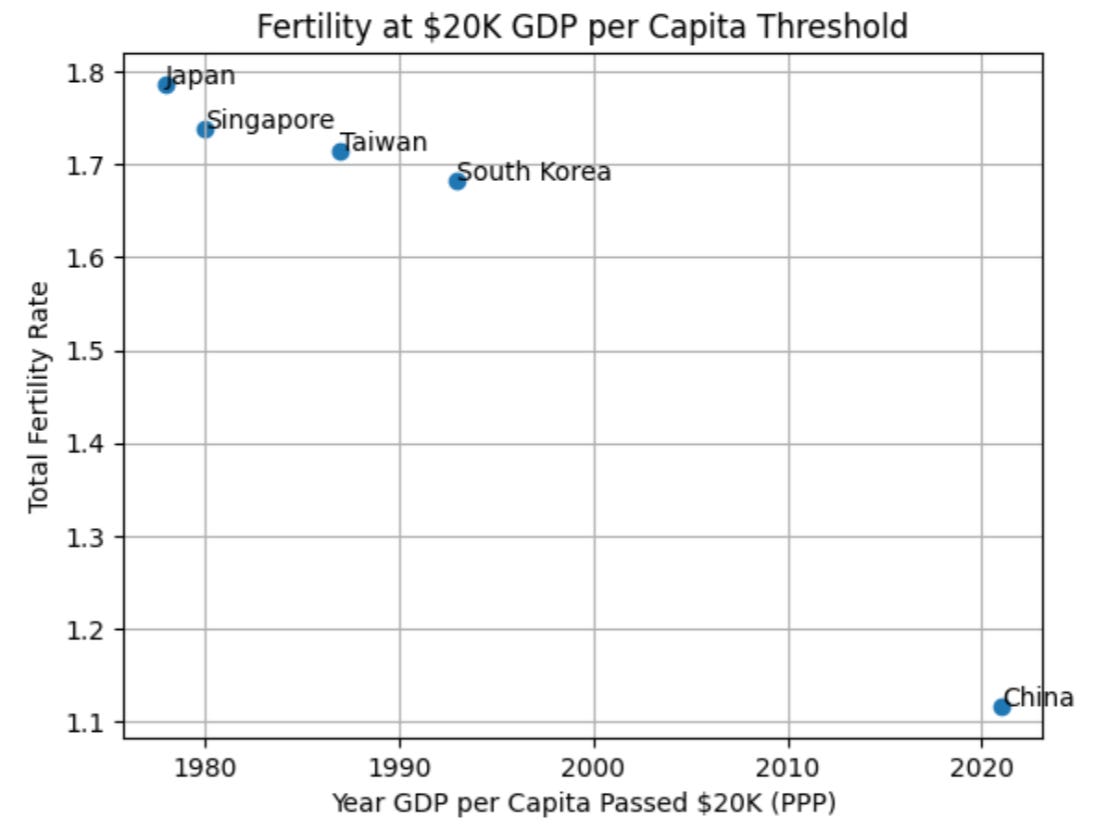
East Asian states other than China reached $20K a year between the late 1970s and early 1990s, and had TFRs in the range of 1.7-1.8 when they did so.
...This excerpt is provided for preview purposes. Full article content is available on the original publication.