The London Longevity Newsletter — Issue 09
Welcome to Issue 09 of the London Longevity Newsletter 🗞️
Back again with a fresh batch of breakthroughs and insights from the longevity biotech world! Let’s dive in 🚀🧪
RESEARCH SPOTLIGHT 🧬
Are we aging because of cancer resistance?
The evolution of cancer and ageing: a history of constraint - A new review traces the evolutionary tug-of-war between aging and cancer, showing how these two seemingly opposite processes are deeply intertwined. While cancer stems from runaway cell growth, aging reflects cell loss and decline. Because cancer threatens survival even in youth, natural selection prioritizes tumor resistance over late-life maintenance. The catch is that cancer-suppressing mechanisms like telomere shortening and cellular senescence limit cell proliferation, protect against tumours early, but drive tissue degeneration later. In this view, longevity itself may be constrained by the evolutionary need to keep cancer in check, making aging, at least partly, the price we pay for tumour resistance. Read More
Brain editing might now be closer to reality
Human genome editing has been working for disease causing mutations in the liver, blood, and eye, but the brain has so far been considered a difficult target. A flurry of breakthroughs in mice is bringing the dream of genome editing in the brain closer than ever. Researchers have used advanced CRISPR-inspired technologies like prime editing and base editing to correct mutations associated with devastating neurological disorders like alternating hemiplegia of childhood, Huntington’s disease, epilepsy and intellectual disabilities. In one study, prime editing fixed the AHC mutation across nearly half of the mouse cortex, easing seizures, improving cognitive and motor function, and extending lifespans. Other edited mice showed restored social behaviors and neural connectivity. While challenges such as targeting the brain’s defenses remain, these results in mice hint that human trials may be closer than expected. Read More
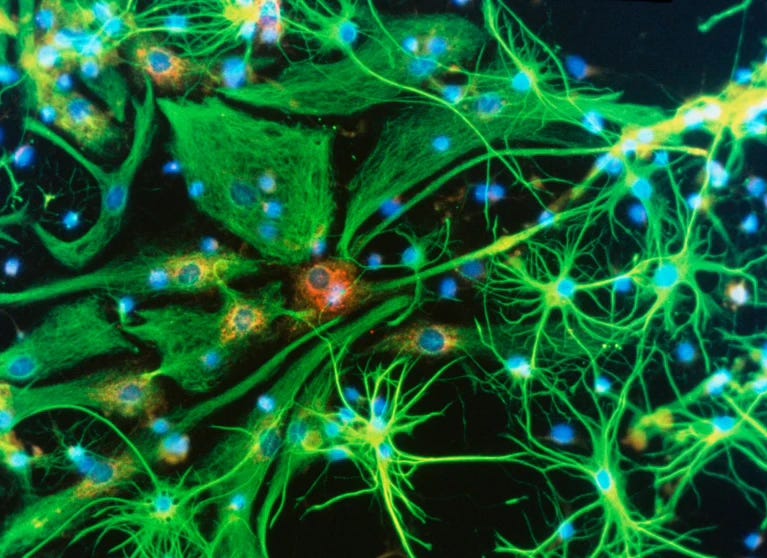
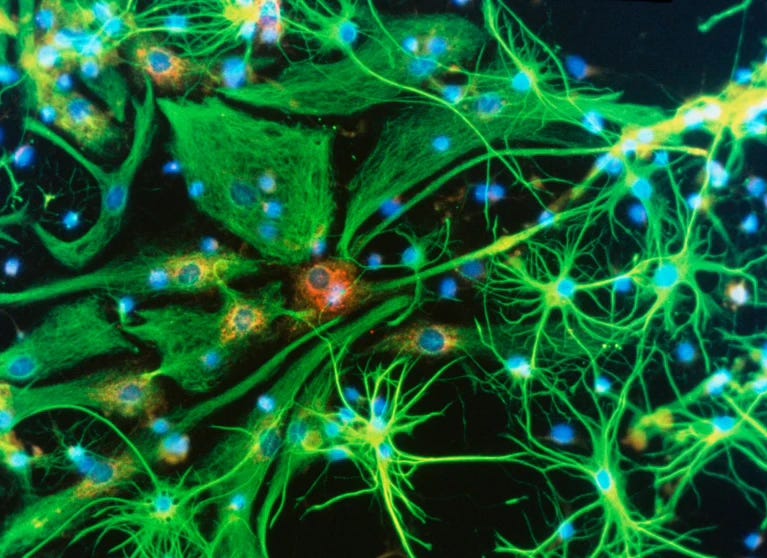
Brain cells (artificially coloured), can be infected by a virus carrying the apperatus to correct disease-causing mutations. Image: Nancy Kedersha/UCLA.
Could iron be a factor in driving brain aging?
A new study identifies ferritin light chain 1 (FTL1), an iron-associated protein, as a surprising pro-aging factor in the brain. Researchers found that FTL1 accumulates in hippocampal neurons of old mice, with levels tightly linked to cognitive decline. When young mice were engineered to mimic this FTL1 buildup, their brains showed altered iron oxidation, synaptic changes, and premature cognitive aging. Crucially, silencing FTL1 in the hippocampi of old mice reversed synaptic dysfunction
This excerpt is provided for preview purposes. Full article content is available on the original publication.