The AI Investment Boom
Thanks for reading! If you haven’t subscribed, please click the button below:
By subscribing you’ll join over 45,000 people who read Apricitas!
Last month, Microsoft made a high-profile announcement that it is paying to reopen reactor one at the Three Mile Island nuclear plant to meet the company’s growing data center power demand, joining Amazon as the second major US tech company to turn to legacy nuclear facilities for their increasing energy needs. Microsoft is the primary investor and computing provider for OpenAI, who kicked off a revolution in AI development with its release of ChatGPT less than two years ago—and the Three Mile Island reopening underscored the frenzied growth in physical investment currently going on to meet the demands of these new AI systems.

Today, AI products are used ubiquitously to generate code, text, and images, analyze data, automate tasks, enhance online platforms, and much, much, much more—with usage expected only to increase going forward. Yet these cutting-edge models require enormous computing resources for their training and inference, that computing requires massive arrays of advanced hardware housed at industrial-scale facilities, and those facilities require access to vast quantities of power, water, broadband, and other infrastructure for their operations.
Thus, the downstream result of the AI boom has been a rapid increase in US fixed investment to meet the growth in computing demand, with hundreds of billions of dollars going to high-end computers, data center facilities, power plants, and more. Right now, US data center construction is at a record-high rate of $28.6B a year, up 57% from last year and 114% from only two years ago. For context, that’s roughly as much as America spends on restaurant, bar, and retail store construction combined.
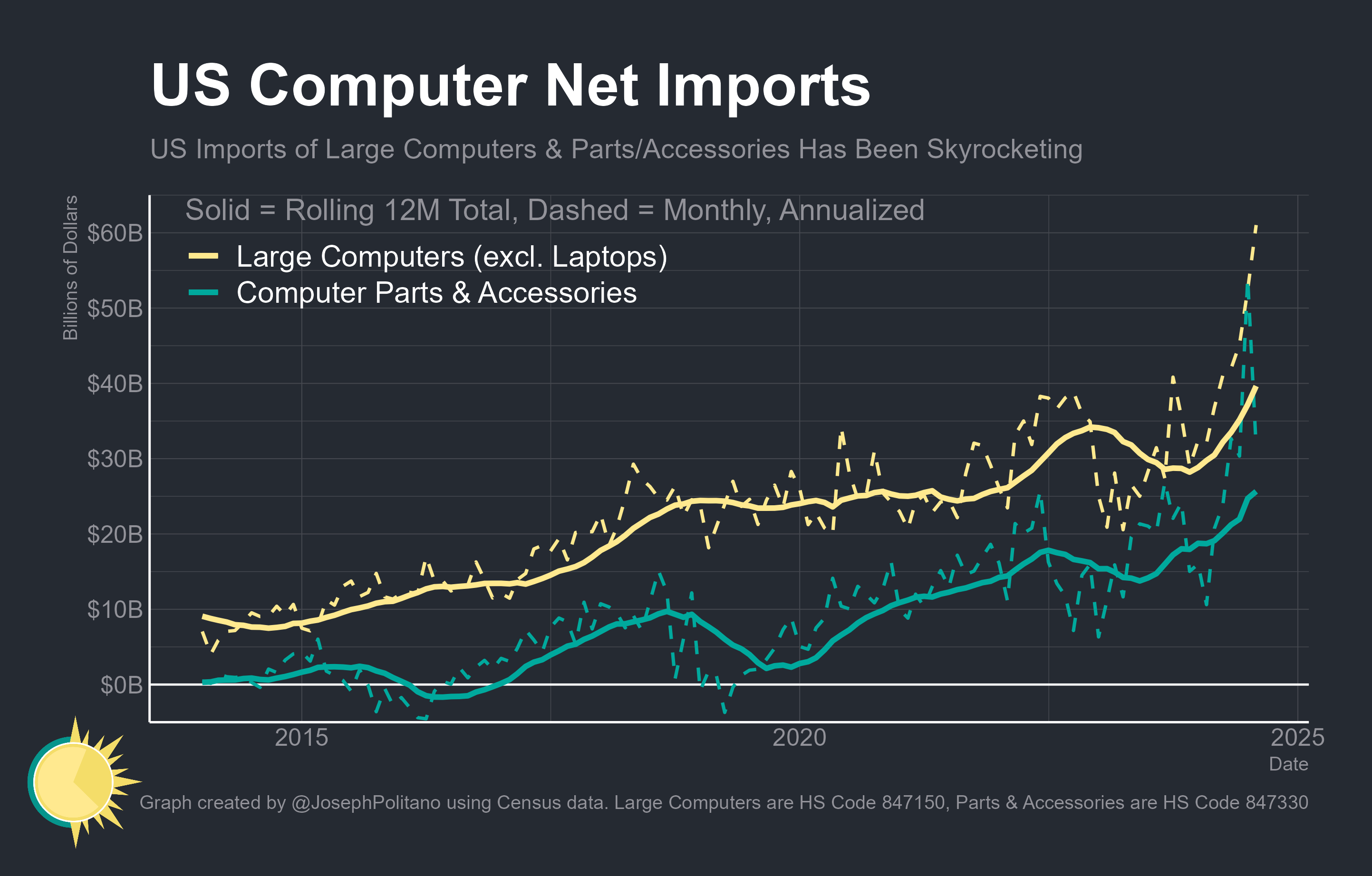
However, that construction figure is only for the physical buildings themselves—it excludes the massive racks of high-powered computers that form the brains of data centers plus the vast quantities of cables, fans, and other parts necessary to make that brain work. In August, net US imports of large computers (like those used for AI training) rose to a new record high, and net imports of computer parts, accessories, and other components had set a record high just the month before—in total, the US has brought in more than $65B across the two categories over the last year on top of rising domestic production.

The majority of these new data centers, computers, and equipment are being bought
...This excerpt is provided for preview purposes. Full article content is available on the original publication.