How to Collect Words like a Writer
Today I want to write to you about words. This is the first part of a series on How to Read like a Writer.
I recently learned from the Marginalian about the “fantastic binomial,” a phrase invented by Italian children’s book author Gianni Rodari to describe his creative process. (A “binomial” is a thing with two parts, usually a mathematical expression.) Rodari explained that many of his stories were based on a combination of two words:
Any randomly chosen word can function as a magic word to unearth those fields of memory that had been resting under the dust of time… The fantastic arises when unusual combinations are created, when in the complex movements of images and their capricious overlappings, an unpredictable affinity is illuminated between words that belong to different lexical fields.
Walk with me now to the bookshelf, where we reach up to the top shelf for a hardback book with an illustration on its cover of a person dreaming on the talking end of a neon pink telephone: this beloved object is Telephone Tales, Rodari’s 1962 book of 70 stories, each short enough for a frugal Italian businessman on the road to relate to his daughter at bedtime over a payphone. The first story that I open to is titled, “A Building for Breaking.” And here’s another one called “Educational Candy.”
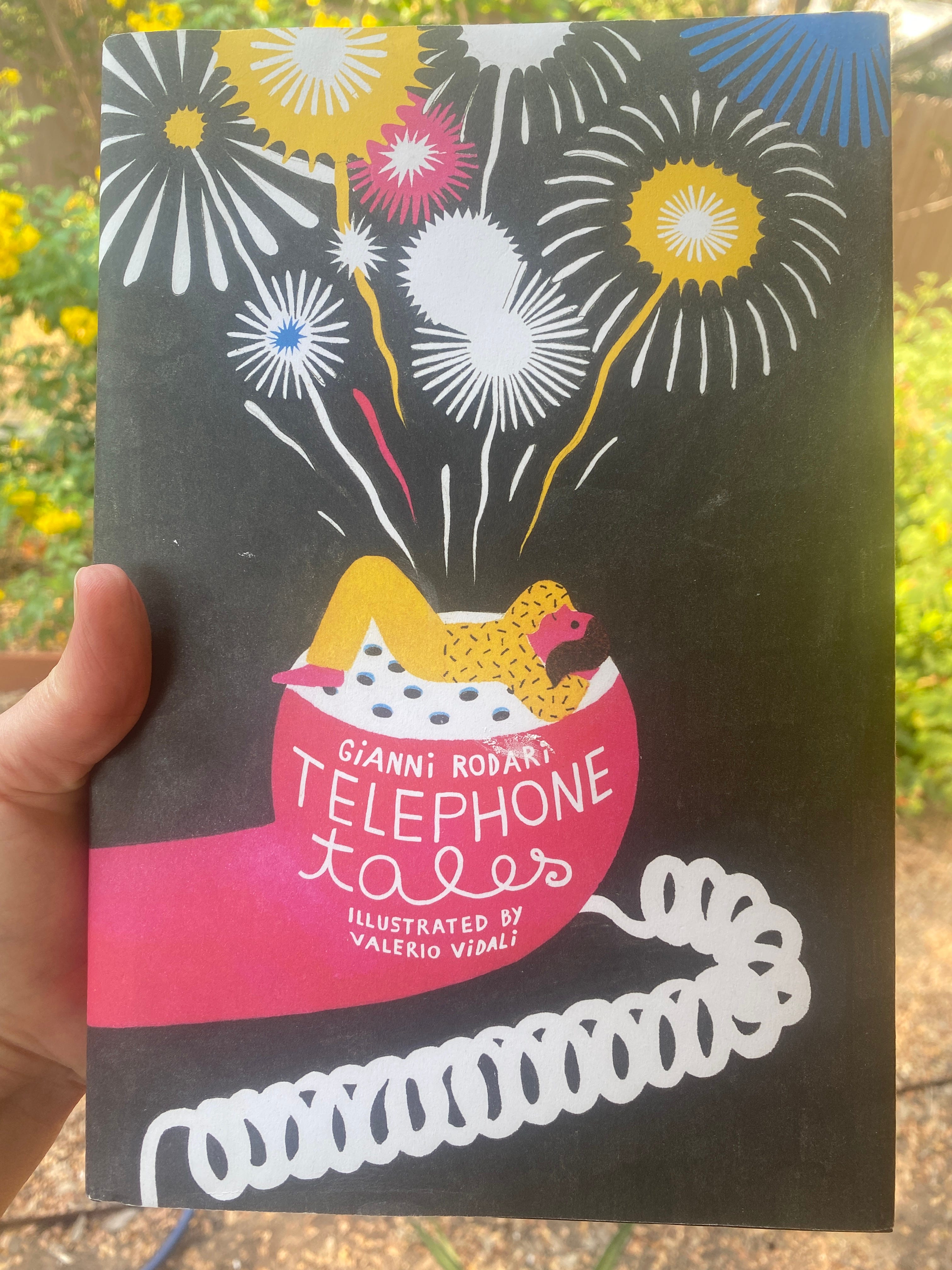
Other stories: “Gobbledy Fever,” “The War of the Bells.” I think you see my point.
As readers and writers, words are our raw material. You can’t build any piece of writing without them, and yet we don’t spend a lot of time focusing on the individual words that make up our creations.
If we get more granular in a workshop or a book review, it’s often to discuss a writer’s sentences: is the sentence structure grammatically correct, is it effective, is the writer varying short and long sentences for pace? There’s certainly nothing wrong with that. We might think that we don’t need to make a practice of studying words. (Presumably, this is particularly true for those of us who are native speakers in the language in which we usually read or write.) It can be tempting to focus on the more architectural aspects of literature, like plot structure, genre, and character development. But words are the building blocks. I think they deserve
...This excerpt is provided for preview purposes. Full article content is available on the original publication.