Land acknowledgement, Greenland edition
Deep Dives
Explore related topics with these Wikipedia articles, rewritten for enjoyable reading:
-
Dorset culture
11 min read
The article references the Dorset people as neighbors of the Norse in Greenland, calling them 'Skræling' in the sagas. Understanding this Paleo-Eskimo culture that preceded the Inuit and coexisted with Norse settlers provides essential context for the population replacement narrative central to this piece.
-
Medieval Warm Period
17 min read
The article mentions the 'Medieval Climate Optimum' as crucial to Norse colonization timing, beginning around 950 AD. This climate phenomenon enabled Norse expansion into Greenland and its eventual reversal contributed to the collapse of Norse settlements—a key factor in the population dynamics discussed.
-
Thule people
13 min read
While not explicitly named in the excerpt, the article's central argument concerns how the ancestors of modern Greenlanders (the Inuit, descended from Thule migrants) replaced both Norse and Dorset populations. The Thule expansion from Alaska represents the 'upgraded toolkit' that outcompeted earlier inhabitants.
In large precincts of left-leaning America, it has lately become commonplace for any official proceeding to be delayed until someone has intoned a somber statement of guilt acknowledging the locale’s legacy of colonization, its history as another people’s ancestral homelands (sometimes with such specificity as “since time immemorial”) and with homilies to such things as the “inherent sovereignty of indigenous people” who previously resided there. Such a self-serious ceremony could scarcely flourish (nor be so succinct and straightforward) anywhere but a continent with as few layers of human churn and conquest as North America.
But setting aside the specific bloody legacy of America’s European conquest and lingering questions of guilt and responsibility, it’s worth considering what a quarter century of genome-powered population genomics can now tell us about our upstart species’ general tendencies to usurp and wholly replace prior inhabitants. Is North America somehow unique? What do we know today about human patterns of replacement that we could not determine centuries ago when an informed person might have actually believed indigenous Native Americans had been in their “ancestral homelands” since time immemorial, rather than for some 15,000 years?
And what does it really mean to be indigenous, to be native, now that we can genuinely interrogate the layers of our species’ population history? What if a people whose genetic close kin we are accustomed to regarding as marginal or indigenous (with all the respect, compassion and pity that tend to so swiftly attach themselves to such designations) are the usurpers? What if they arrive last and are the last men standing? What if it is they who out-compete and supplant a locale’s entire contingent of long-time inhabitants? What if those vanished early inhabitants are Europeans? And what if when the dust settles, we see that the commonality of these johnny-come-latelies who out-compete long-time inhabitants and master a new locale, is not race, continent of origin or bellicosity, but simply an upgraded toolkit that runs circles around that of the locals’?
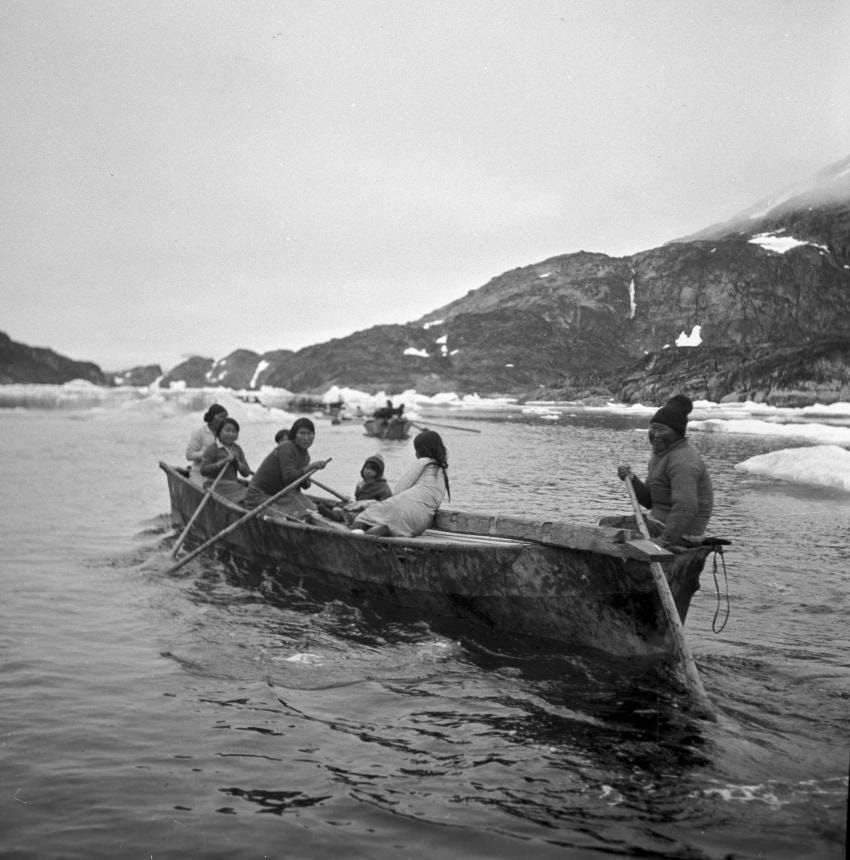
This is the case for Greenland, our subject today. We apply a genomic lens to the millennial saga of humanity’s quest to master one of the planet’s most unforgiving pieces of terrain. And if the non-European champions of our tale, the ancestors of Greenland’s 50,000 inhabitants today, supplanted both Norse and Dorset forerunners, is it time they draft a land acknowledgement? Or shall we defy chronology and
...This excerpt is provided for preview purposes. Full article content is available on the original publication.