QUANTUM TUNNELLING IN AND AROUND UKRAINE

Welcome to the desert of the real!
If you desire the comfort of neat conclusions, you are lost in this space. Here, we indulge in the unsettling, the excessive, the paradoxes that define our existence.
So, if you have the means and value writing that both enriches and disturbs, please consider becoming a paid subscriber.
The Nobel Prize laureates in physics for 2025, John Clarke, Michel H. Devoret, and John M. Martinis, used a series of experiments to demonstrate that the weird properties of the quantum world can be made palpable even in our ordinary reality. Quantum mechanics describes properties that are significant on a scale that involves single particles. In quantum physics, these phenomena are called microscopic, even when they are much smaller than can be seen using an optical microscope. This contrasts with macroscopic phenomena, which consist of a large number of particles. For example, an everyday ball is built up from an astronomical amount of molecules and displays no quantum mechanical effects. We know that the ball will bounce back every time it is thrown at a wall. A single particle, however, will sometimes pass straight through an equivalent barrier in its microscopic world and appear on the other side—a phenomenon called tunnelling. Much like a wave smashing against a groin at sea results in a smaller wave propagating to the other side, particles that exist as waves also have some probability of existing on the other side of a barrier. It is this ability that allows electrons to leap between material layers that would otherwise be impassable, at least according to large-scale physical laws.
Here the picture gets complicated: when a wave packet impinges on the barrier, most of it is reflected and some is transmitted through the barrier. The wave packet is now on both sides of the barrier and lower in maximum amplitude, but equal in integrated square-magnitude, meaning that the probability the particle is somewhere remains unity. What this means is that it is not just the wave that splits into two, but that the wave remains a unity: it behaves like a single large particle that is on both sides of the barrier. Here the trio of Nobel Prize winners intervened with their experiment:
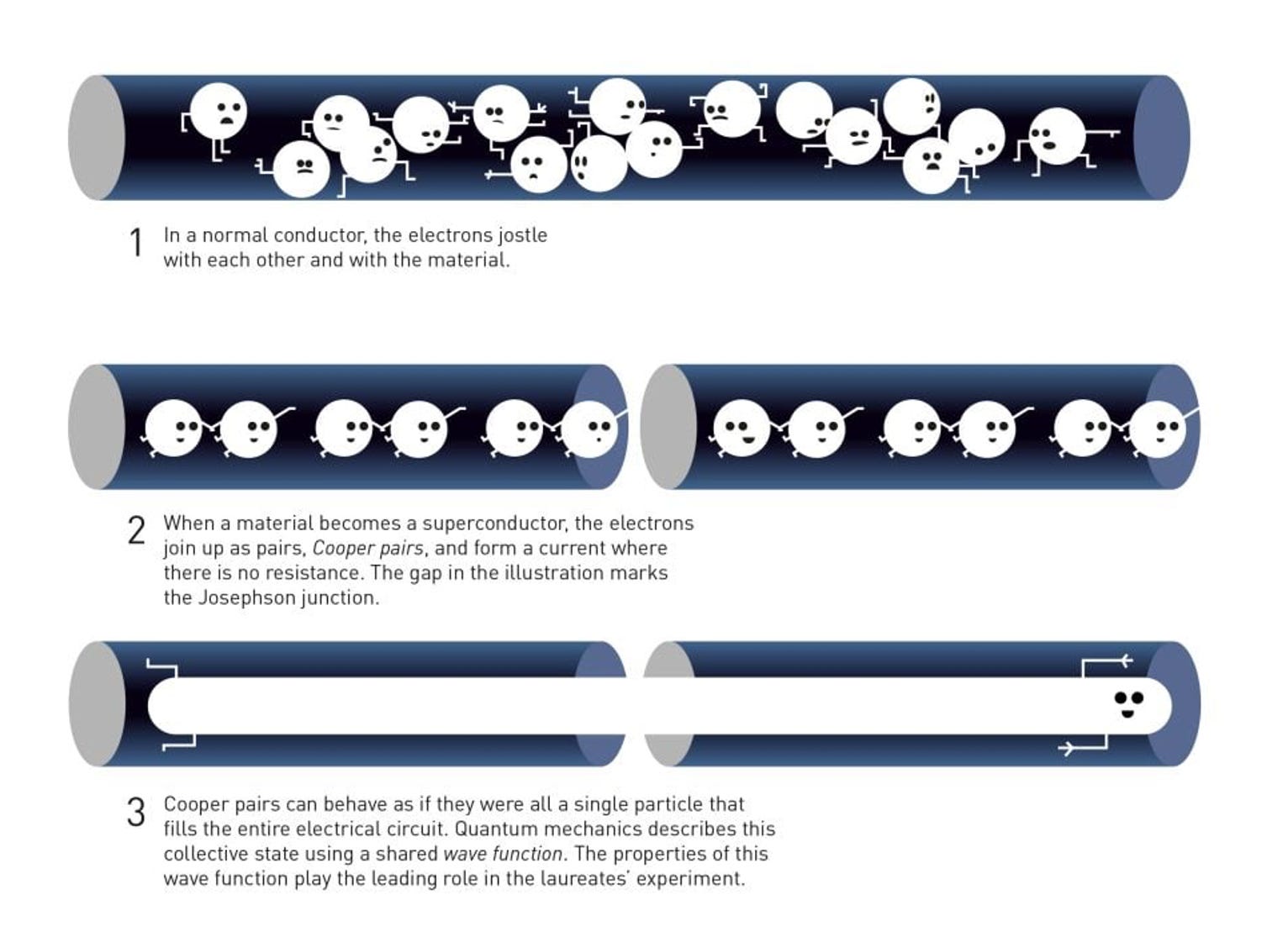
If one ever wanted a perfect example of the Hegelian dialectical triad, here we have it. We begin with a chaotic multitude of elementary particles; then comes negation
...This excerpt is provided for preview purposes. Full article content is available on the original publication.