📚 Is AI making students worse readers?
In a recent article by The Atlantic titled "Elite College Students Who Can't Read Books," Rose Horowitch describes how students today exhibit lower levels of reading compared to a decade ago. Even students at highly selective, elite colleges now struggle to read entire books. In fact, teachers often resort to assigning short excerpts and passages instead. Part of the reason students find it difficult to read is due to shortened attention spans and the distractions of social media. Another contributing factor is the pressure to prepare students for standardized tests, which often focus on short excerpts rather than longer, comprehensive reading.
With the rise of AI, students may have even more reason to avoid reading, as AI tools can quickly summarize content and transform it into alternative formats. It’s one thing to read the Spark Notes and another to read the actual book. For example, Google’s Notebook LM Audio Overview feature can convert readings into digestible podcasts, making it easier for students to simply listen to the dialogue rather than read the text directly. In this edition, we will explore how we can ensure that students continue to develop strong reading and critical thinking skills in the age of AI.
Here is an overview of today’s newsletter:
AI x Education Webinar with Sarah Newman
New AI-Powered Tools Enhancing Early Literacy Instruction
Concerns Over AI's Impact on Critical Reading and Thinking Skills
AI Use Cases in Campuses Across the World
Introduction of a human-AI system designed to provide real-time expert guidance to tutors
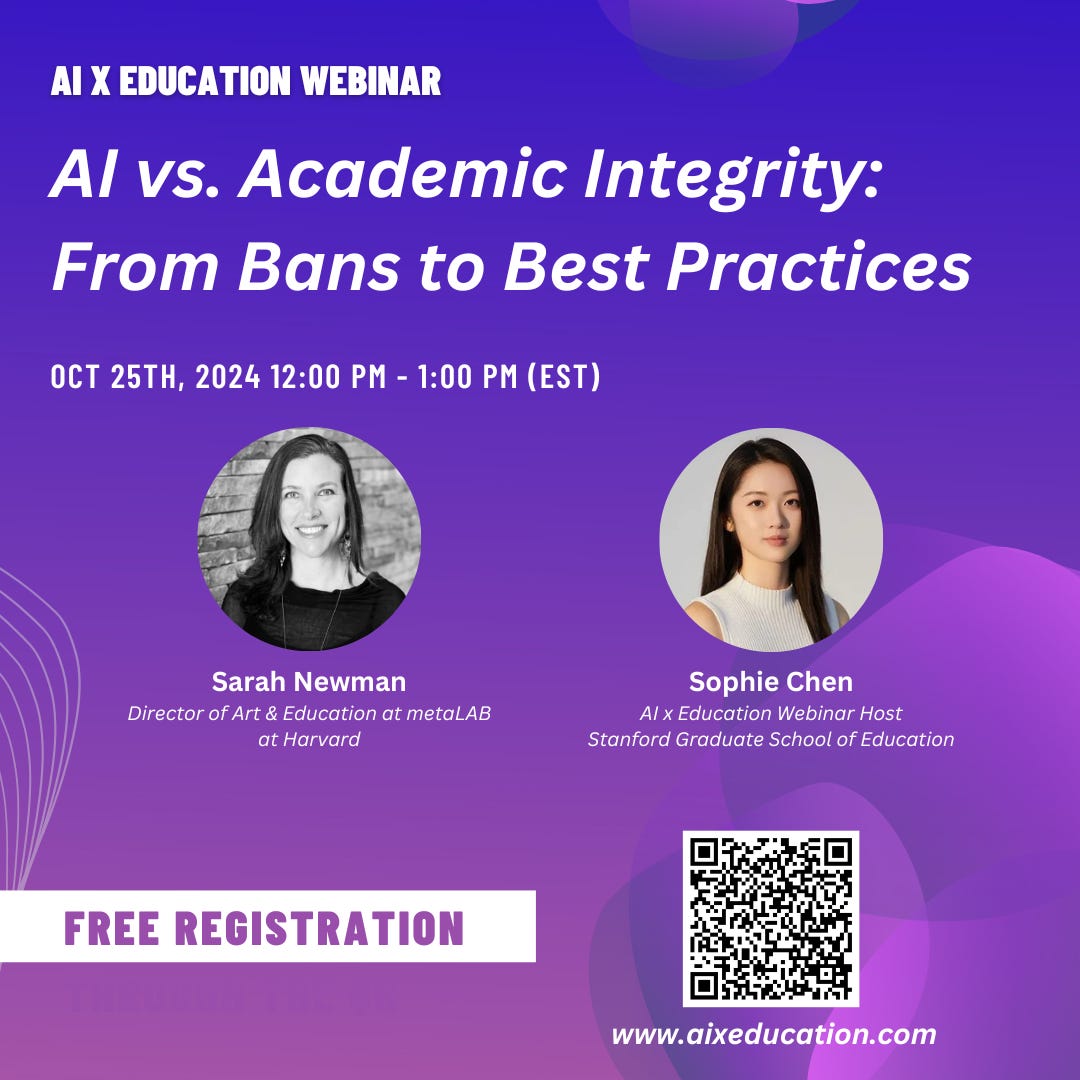
Join us on 10/25 for our next webinar in the AI x Education Webinar Series, where we will feature Sarah Newman, Director of Art & Education at metaLAB at Harvard. As generative AI becomes increasingly accessible, it undeniably influences how students approach assignments and learning. Should schools and universities ban AI from the classroom, embrace it as a powerful learning tool, or find a balance between the two? With students already leveraging AI creatively, this webinar will explore how institutions can balance innovation and academic integrity.
Sarah Newman will share best practices for creating AI course policies, drawing from her experiences workshopping ideas with students at Harvard and engaging with educators across the US and internationally. Attendees will gain concrete strategies and policy templates and a deeper understanding of how to craft AI guidelines that foster ethical use while enhancing learning, curiosity, and criticality.
Whether you're an educator,
...This excerpt is provided for preview purposes. Full article content is available on the original publication.