A good defense demands offense
Deep Dives
Explore related topics with these Wikipedia articles, rewritten for enjoyable reading:
-
Science communication
18 min read
The article centers on the failures of scientific communication during COVID-19 and the need for better public health messaging. This Wikipedia article covers the history, methods, and challenges of conveying scientific information to non-experts.
-
Community health worker
18 min read
The author advocates for meeting people 'where they are' through participatory, community-based solutions. Community health workers represent a specific model of grassroots public health that embodies this 'offensive' approach to health communication.
-
Participatory action research
15 min read
The article emphasizes 'co-developed, co-imagined solutions' and listening to communities. Participatory action research is the specific methodology behind this approach, where communities are partners rather than subjects in developing interventions.
Sometimes I reserve Fridays for thought pieces. This doesn’t include the typical evidence-based information, but rather my reflections as I navigate this magnetic storm and try to find a North Star.
This week, I was surrounded by more than 11,000 people who have dedicated their lives to keeping communities healthy at the country’s largest public health conference. It’s been a brutal year for public health. Budget cuts, lost jobs, lost research, visionary leaders gone from the federal government, and a deliberate attempt to traumatize and demoralize the entire workforce. Add the nonstop political crossfire, and it’s easy to see why so many in this field are running on fumes.
Being together again felt like a deep breath and was, quite frankly, therapeutic. You could feel this question hanging in the air: How do we save public health? That defense is essential. We can’t let decades of progress unravel.
But I couldn’t help but notice something desperately missing that is equally important: an offense.
What offense looks like
Offense is not fighting for what was broken, but fighting to create something better. In other words, loudly refusing to accept the old normal.
If we’re being honest, truly honest with ourselves, many systems were built for a different time. They haven’t kept pace with what Americans need today. For example, there is no reason a measly Texas epidemiologist should have to start a YLE newsletter in the middle of the biggest emergency we’ve ever faced. But scientific communication was one of the pandemic’s most significant shortcomings: the lack of timely, precise, nuanced, and actionable information for the public. Communication that acknowledged uncertainty, trade-offs, and the intelligence of the people. Offense is finding a gap, being responsive to the needs on the ground, and figuring out a solution.
Finding new ways to meet people where they are—on their phones, in their neighborhoods, in real conversations—not expecting them to read an 80-page PDF buried on a government website. But through participatory, co-developed, co-imagined solutions.
It requires courage to lean in, to move with hope, and to be okay with being wrong, yet willing to experiment.
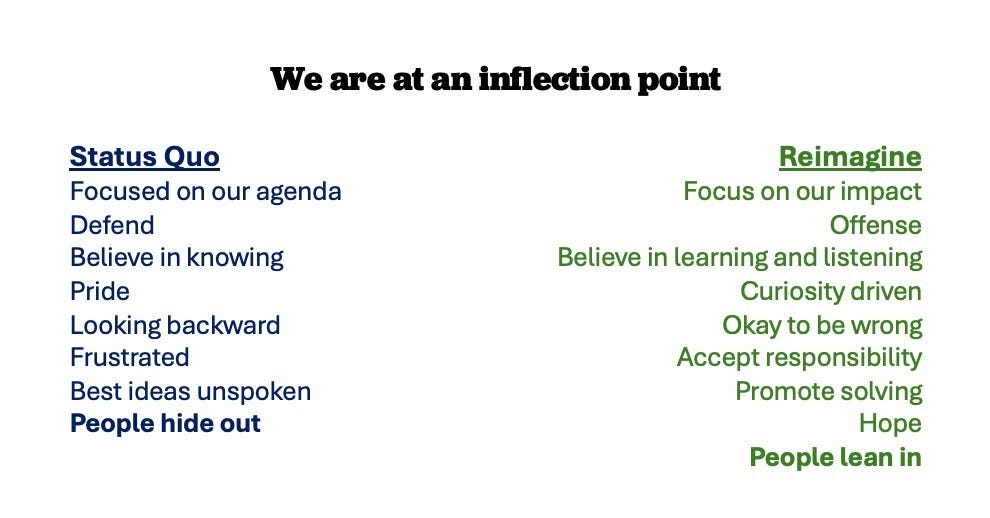
Budgets are tight. Jobs are scarce. Fear is high. But offense doesn’t always require more money. We can still be creative with our partnerships, our focus, and what we choose to protect.
A few ways to start
Here are some ideas that have
...This excerpt is provided for preview purposes. Full article content is available on the original publication.