Vibecession: Much More Than You Wanted To Know
Deep Dives
Explore related topics with these Wikipedia articles, rewritten for enjoyable reading:
-
Median
12 min read
Linked in the article (31 min read)
-
Consumer confidence index
12 min read
The article centers on the disconnect between consumer sentiment measures and economic indicators. Understanding how consumer confidence indices are constructed, their history, and their limitations would provide valuable context for evaluating the 'vibecession' phenomenon.
-
Real wages
10 min read
The article extensively discusses real wages versus nominal wages, inflation adjustment, and the brief decline in real wages during 2023-2024. A deeper understanding of how real wages are calculated and their historical significance would help readers evaluate the economic arguments presented.
The term “vibecession” most strictly refers to a period 2023 - 2024 when economic indicators were up, but consumer sentiment (“vibes”) was down. But on a broader level, the whole past decade has been a vibecession.
Young people complain they’ve been permanently locked out of opportunity. They will never become homeowners, never be able to support a family, only keep treading water at precarious gig jobs forever. They got a 5.9 GPA and couldn’t get into college; they applied to 2,051 companies in the past week without so much as a politely-phrased rejection. Sometime in the 1990s, the Boomers ripped up the social contract where hard work leads to a pleasant middle-class life, replacing it with a hellworld where you will own nothing and numb the pain with algorithmic slop. The only live political question is whether to blame immigrants, blame billionaires, or just trade crypto in the hopes that some memecoin buys you a ticket out of the permanent underclass.
Meanwhile, economists say things have never been better.
Are the youth succumbing to a “negativity bias” where they see the past through “rose-colored glasses”? Are the economists looking at some ivory tower High Modernist metric that fails to capture real life? Or is there something more complicated going on?
We’ll start by formally assessing the vibes. Then we’ll move on to the economists’ arguments that things are fine. Finally, we’ll try to resolve the conflict: how bad are things, really?
Are We Sure The Vibes Are Bad?
I’ll assume you’ve already heard the complaints about the economy coming from the media, social media, et cetera. But are we sure there isn’t a meta-vibecession? The vibes about the vibes are bad, but really, the vibes are good? Maybe the media just -
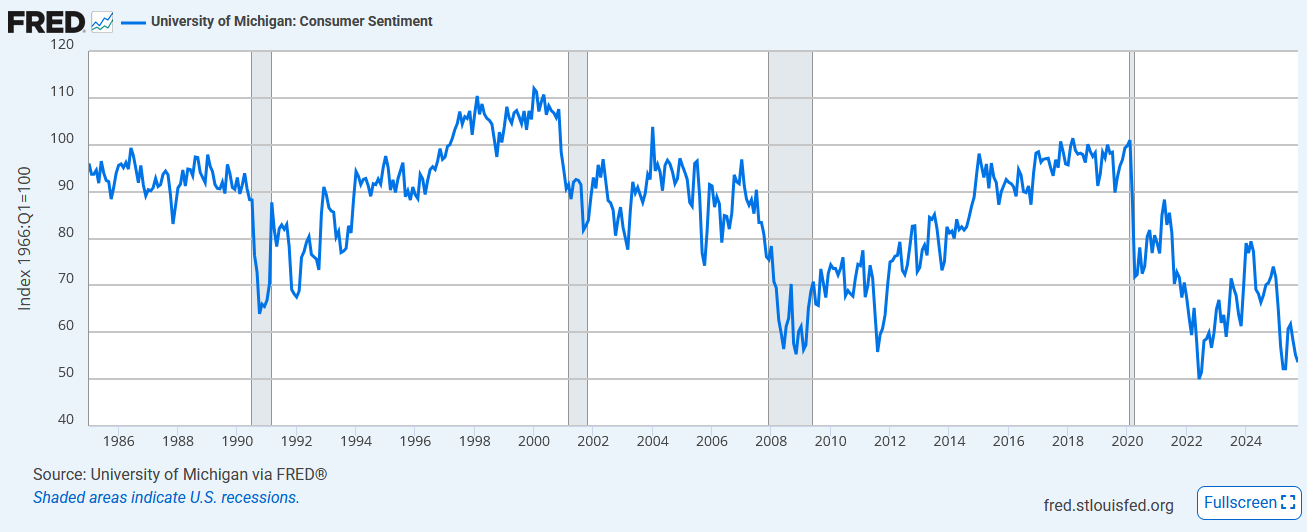
- oh god, no, it’s even worse than I thought. The vibes are awful.
This is the official measure of vibes, the Index of Consumer Sentiments. Can we trust it?
One reason not to trust it is that most of its questions take a form like “do you think things are better than last year?” or “do you think things will be better next year?” These are local and don’t really allow you to compare today vs. 1980. But consumers are terrible at answering these questions in the spirit in which they’re intended; for example, when the economy is bad, “do you think things will be
...This excerpt is provided for preview purposes. Full article content is available on the original publication.