How to Block ICE In Your City
ICE and the Border Patrol’s terror campaign has taken the lives of Renée Good and Alex Pretti, and led to the abduction of five-year-old Liam Conejo Ramos, among countless others. Minneapolis has answered with an astonishing surge of courage. Neighborhood Signal chats and daily community-watch patrols have turned sidewalks into lines of mutual aid and defense, while the January 23 day of mass protest and disruption proved a willingness on the part of residents to stop business as usual in defiance of ICE’s violent repression.
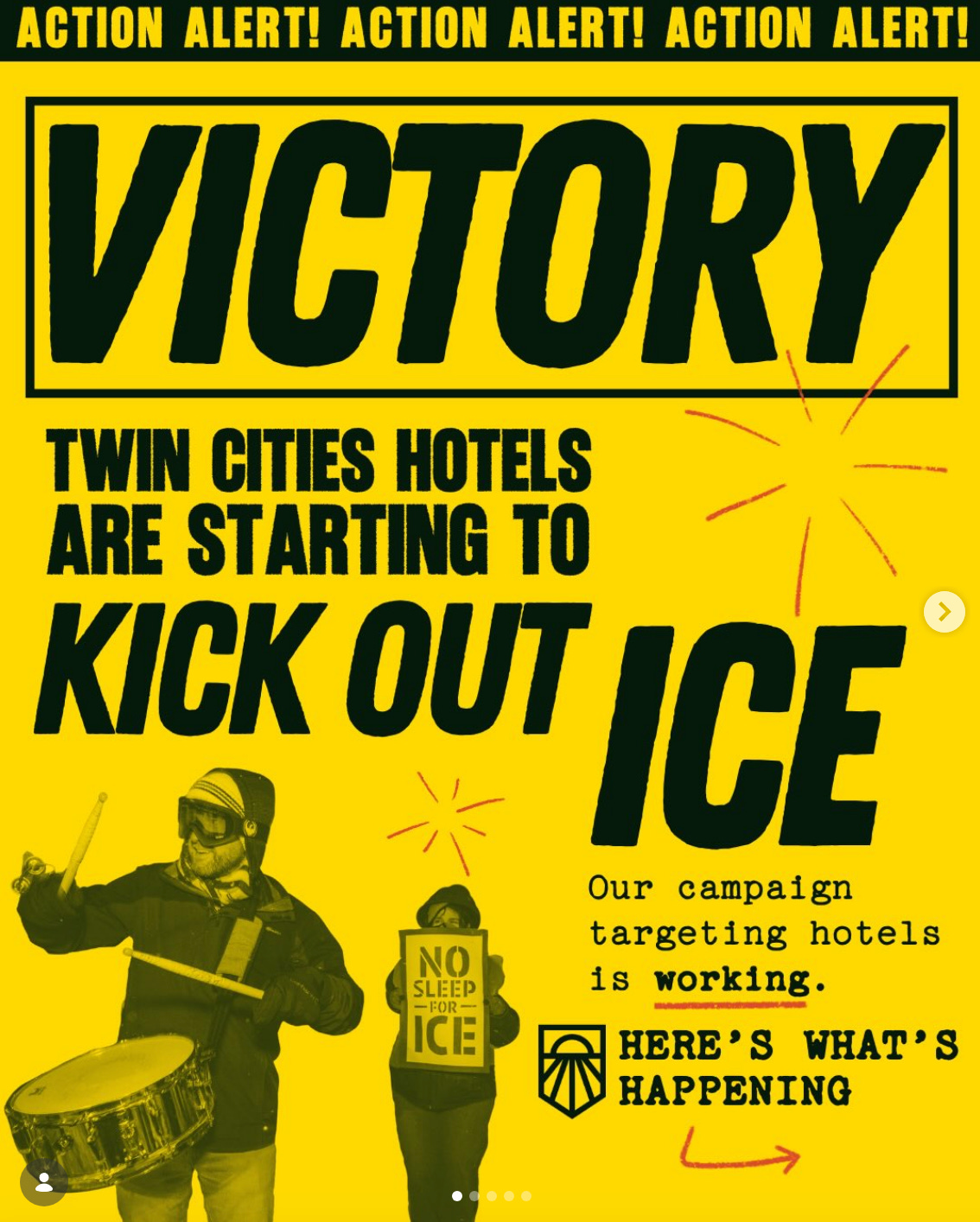
The Twin Cities Sunrise Movement has pushed the resistance onto offense, targeting the Hilton hotels that quietly house ICE agents. This campaign to get companies to break from ICE has led to an impressive string of local victories, including getting a local Hilton to refuse service to ICE, sparking outrage from the Department of Homeland Security and the subsequent capitulation of Hilton nationally to the administration.
I spoke with Aru Shiney-Ajay, Sunrise Movement’s executive director and a lifelong Minneapolis resident, about the city’s organizing pushback and how ICE’s opponents can go on the offense nationwide by pressuring companies like Hilton, Enterprise, and Home Depot to stop collaborating with the agency.
ERIC BLANC: What has it felt like to be a Minneapolis resident and organizer these past two months?
ARU SHINEY-AJAY: It feels like living in a war zone. I was really reluctant to say that at first, but every few hours I get a Signal message about ICE — usually within walking distance of me. Two weeks ago, I had a friend who had a gun pointed at their head by ICE agents, and other friends have been dragged out of their cars and detained. It feels like you’re walking around and, at any moment, you could be grabbed and kidnapped. It’s come to a point where something as simple as recording an interaction with ICE can be met by being shot, which is a really different level of fear to carry around.
At the same time, it’s also the most organized community I’ve ever experienced anywhere. We’ve hit a density in Minneapolis where over 4 percent of every single neighborhood is in a Signal chat at the neighborhood level—and it might be higher, because those are just the Signal chats we’re centrally tracking. In St. Paul, there’s a neighborhood called Frogtown. It’s heavily Hmong. Every day, we create a rapid response Signal chat
...This excerpt is provided for preview purposes. Full article content is available on the original publication.