Do Commodities Get Cheaper Over Time?
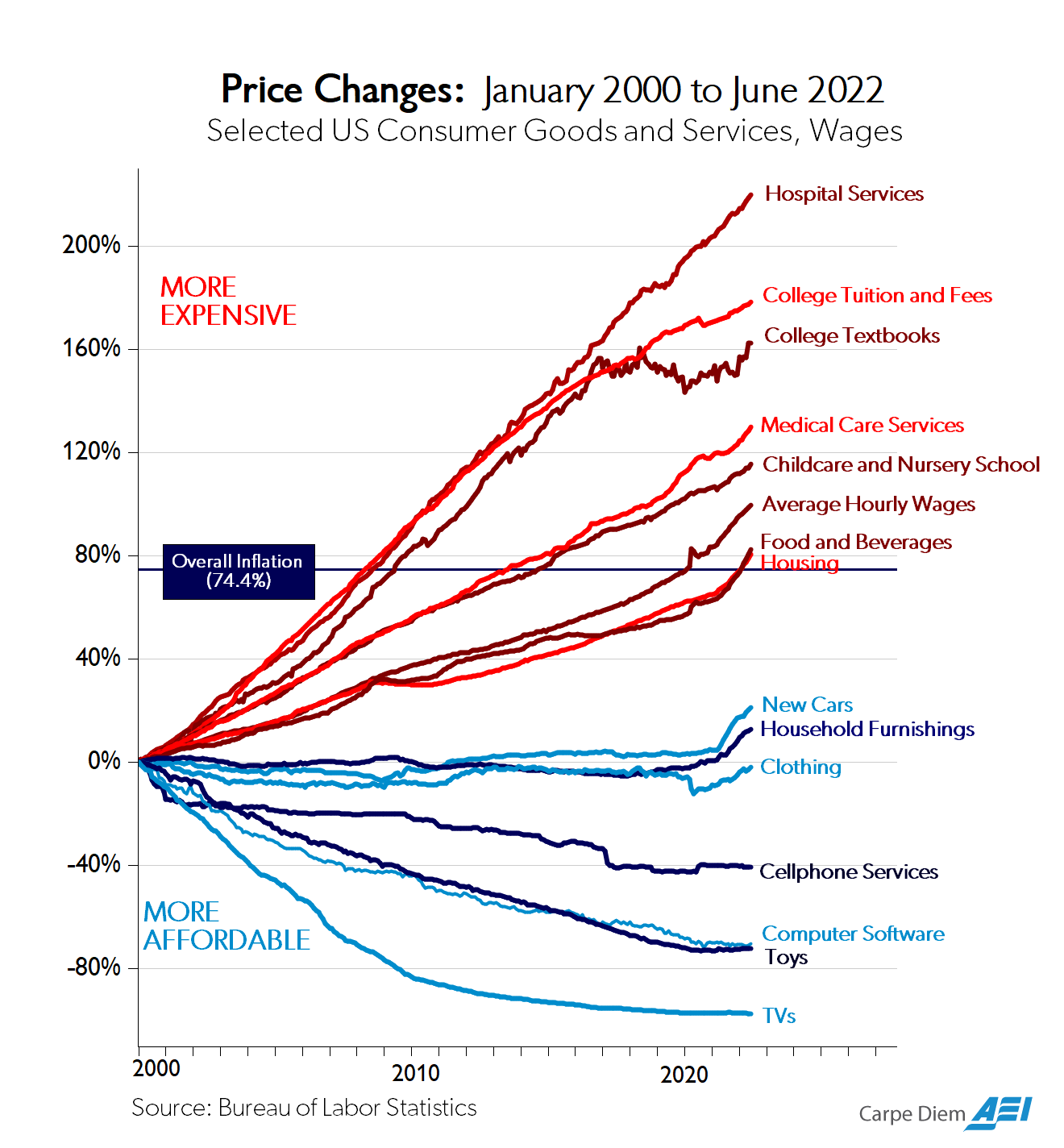
This American Enterprise Institute chart, which breaks down price changes for different types of goods and services in the consumer price index, has by now become very widely known. A high-level takeaway from this chart is that labor-intensive services (education, healthcare) get more expensive in inflation-adjusted terms over time, while manufactured goods (TVs, toys, clothing) get less expensive over time.
But there are many types of goods that aren’t shown on this chart. One example is commodities: raw (or near-raw) materials mined or harvested from the earth. Commodities have many similarities with manufactured goods: they’re physical things that are produced (or extracted) using some sort of production technology (mining equipment, oil drilling equipment), and many of them will go through factory-like processing steps (oil refineries, blast furnaces). But commodities also seem distinct from manufactured goods. For one, because they’re often extracted from the earth, commodities can be subject to depletion dynamics: you run out of them at one location, and have to go find more somewhere else. In my book I talk about how iron ore used to be mined from places like Minnesota, but as the best deposits were mined out steel companies increasingly had to source their ore from overseas. And the idea of “Peak Oil” is based on the idea that society will use up the easily accessible oil, and be forced to obtain it from increasingly marginal, expensive-to-access locations.
(Some commodities, particularly agricultural commodities that can be repeatedly grown on a plot of land, don’t have the same sort of depletion dynamics, though bad farming practices can degrade a plot of land over time. Other commodities get naturally replenished over time, but can still get used up if the rate of extraction exceeds the rate of replenishment; non-farmed timber harvesting and non-farmed commercial fishing come to mind as examples.)
Going into this topic, I didn’t have a great sense of what price trends look like for commodities in general. Julian Simon famously won a 1980 bet with Paul Ehrlich that several raw materials — copper, chromium, nickel, tin, and tungsten — would be cheaper (in inflation-adjusted terms) after 10 years, not more expensive. But folks have pointed out that if the bet had been over a different 10-year window, Ehrlich would have won the bet.
To better understand how price tends to change for different commodities and raw materials, I looked
...This excerpt is provided for preview purposes. Full article content is available on the original publication.