Top AI Agentic Workflow Patterns
Deep Dives
Explore related topics with these Wikipedia articles, rewritten for enjoyable reading:
-
Metacognition
16 min read
The Reflection Pattern described in the article - where an agent critiques and improves its own work - is a direct implementation of metacognition (thinking about thinking). This psychological concept explains why self-monitoring and self-evaluation lead to improved performance, providing scientific grounding for the reflection workflow pattern.
Tinkering with prompts can only get you so far. (Sponsored)

Most companies get stuck tinkering with prompts and wonder why their agents fail to deliver dependable results. This guide from You.com breaks down the evolution of agent management, revealing the five stages for building a successful AI agent and why most organizations haven’t gotten there yet.
In this guide, you’ll learn:
Why prompts alone aren’t enough and how context and metadata unlock reliable agent automation
Four essential ways to calculate ROI, plus when and how to use each metric
Real-world challenges at each stage of agent management and how to avoid them
When we first interact with large language models, the experience is straightforward. We type a prompt, the model generates a response, and the interaction ends.
This single-turn approach works well for simple questions or basic content generation, but it quickly reveals its limitations when we tackle more complex tasks. Imagine asking an AI to analyze market trends, create a comprehensive report, and provide actionable recommendations. A single response, no matter how well-crafted, often falls short because it lacks the opportunity to gather additional information, reflect on its reasoning, or refine its output based on feedback.
This is where agentic workflows come into play.
Rather than treating AI interactions as one-and-done transactions, agentic workflows introduce iterative processes, tool integration, and structured problem-solving approaches. These workflows transform language models from sophisticated text generators into capable agents that can break down complex problems, adapt their strategies, and produce higher-quality results. The difference is similar to comparing a quick sketch to a carefully refined painting. Both have their place, but when quality and reliability matter, the iterative approach wins.
In this article, we will look at the most popular agentic workflow patterns and how they work.
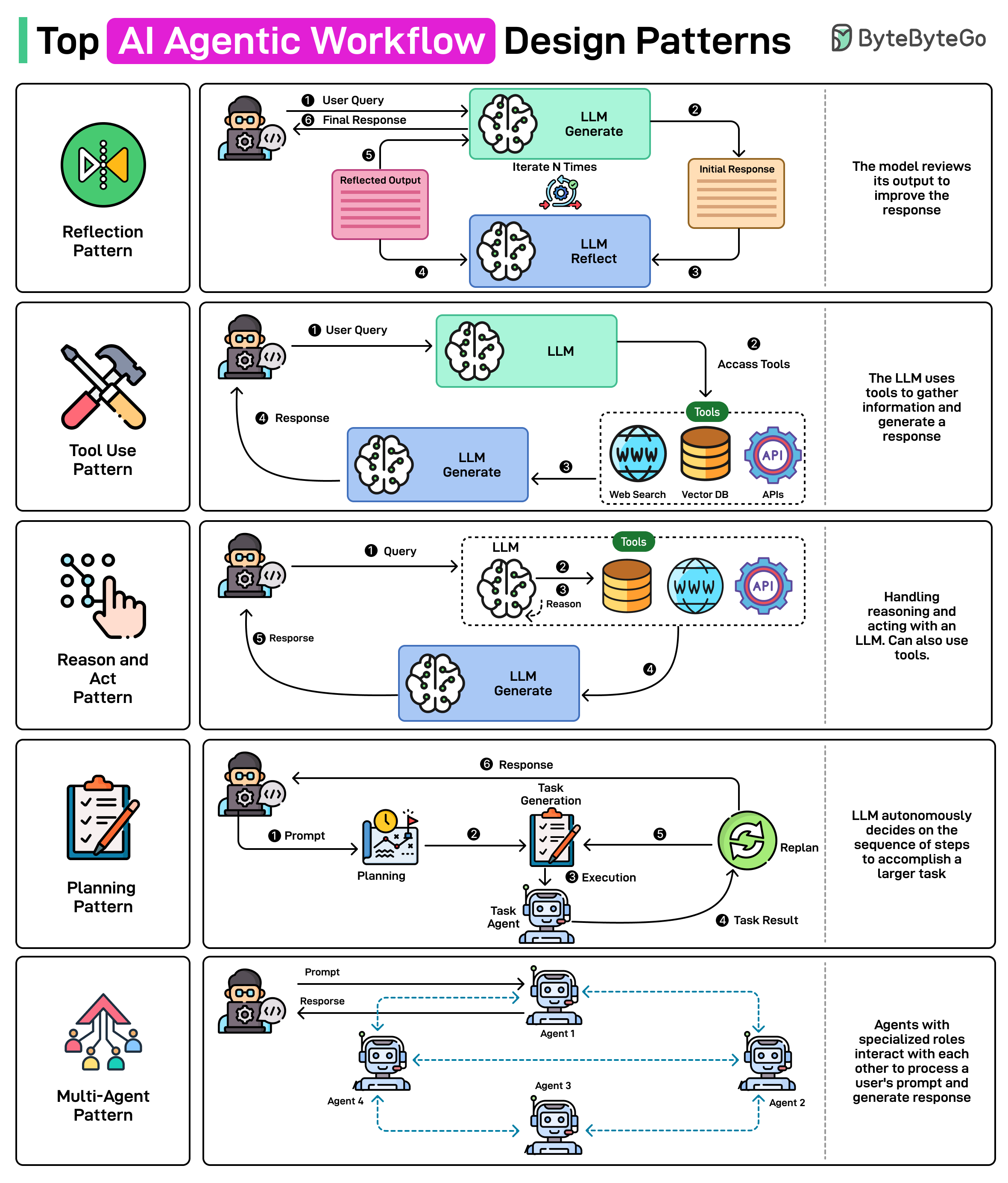
Understanding Agentic Workflows
An agentic workflow doesn’t just respond to a single instruction. Instead, it operates with a degree of autonomy, making decisions about how to approach a task, what steps to take, and how to adapt based on what it discovers along the way. This represents a fundamental shift in how we think about using AI systems.
Consider the difference between asking a basic chatbot and an agentic system to help write a research report. The basic chatbot receives our request and generates a report based on its training data, delivering whatever it produces in one response. An agentic system, however, might first search the
...This excerpt is provided for preview purposes. Full article content is available on the original publication.