The Company as a Machine for Doing Stuff
Deep Dives
Explore related topics with these Wikipedia articles, rewritten for enjoyable reading:
-
CANDU reactor
14 min read
The article specifically mentions Canadian CANDU reactors as part of Forrest Heath's vision for uranium mining and power generation in Colombia. Understanding how these unique pressurized heavy-water reactors work and why they don't require enriched uranium provides fascinating technical context for the infrastructure ambitions discussed.
-
Vertical integration
15 min read
The article's core thesis—that the best companies are 'machines for doing stuff' rather than vehicles for wealth extraction—directly relates to the concept of vertical integration, where companies expand to control more of their value chain. This provides business strategy context for understanding why founders like Forrest Heath want to keep building within their company rather than extracting profits.
-
Motivation
17 min read
The article's central 'Lottery Test'—whether founders would continue their work if they won a billion dollars—is fundamentally about intrinsic versus extrinsic motivation. Understanding the psychology research behind why some people are driven by the work itself rather than external rewards illuminates the founder archetype the author is describing.
Welcome to the 499 newly Not Boring people who have joined us since our last essay! Join 254,224 smart, curious folks by subscribing here:
Hi friends 👋 ,
Happy Tuesday! Short one for you today, about something I’ve been thinking about.
On a recent episode of Jack Altman’s Uncapped podcast, now-former Sequoia Steward Roelof Boetha said that there are too many startups: “There’s a lot more talent than really interesting companies to be built. And I think we’re spreading a lot of that talent thin right now.”
Another way of putting this is that a lot of people are starting startups because they can, not because they can’t not; building startups to win the lottery instead of building the thing they would build if they’d already won it.
This essay is on something I’ve noticed about the really interesting ones.
Let’s get to it.
Today’s Not Boring is brought to you by… Framer

Framer gives designers superpowers.
Framer is the design-first, no-code website builder that lets anyone ship a production-ready site in minutes. Whether you’re starting with a template or a blank canvas, Framer gives you total creative control with no coding required. Add animations, localize with one click, and collaborate in real-time with your whole team. You can even A/B test and track clicks with built-in analytics.
Ready to build a site that looks hand-coded without hiring a developer? Launch your site for free at Framer dot com, and use code NOTBORING for a free month on Framer Pro.
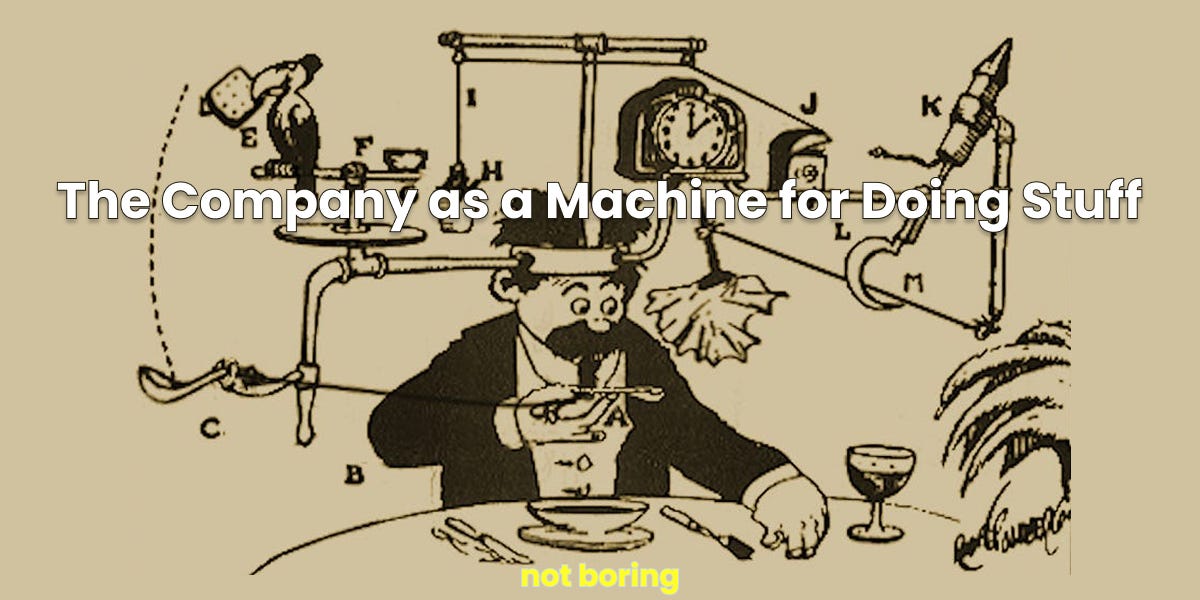
The Company as a Machine for Doing Stuff
A couple of months ago, I was down in Medellín, Colombia visiting Forrest Heath and his company, Somos Internet, in which Not Boring Capital invested last year and about which you’ll learn much more soon.
We were sitting on a couch on the third floor of Somos’ new office. As often happens when I spend time with Forrest, the conversation turned to how he would build certain things better, cheaper, and faster.
He could mine uranium from Colombia’s mountains and shovel it pretty much right into imported Canadian CANDU reactors to create tremendous amounts of power cheaply, with no enrichment required, for example. If Colombia was going to take advantage of flying cars, he’d need to build landing pads for them. Medellín is mountainous; he had a plan for building more metro cables throughout the city to unlock more
...This excerpt is provided for preview purposes. Full article content is available on the original publication.