Taleb’s Law
Deep Dives
Explore related topics with these Wikipedia articles, rewritten for enjoyable reading:
-
Combined-cycle power plant
1 min read
The article discusses gas turbines from GE Vernova, Siemens, and Mitsubishi without explaining how modern gas-to-power technology works. Combined cycle plants use both gas and steam turbines to achieve 60%+ efficiency, which is central to understanding why these turbines are so valuable for AI data center power demands.
-
Nassim Nicholas Taleb
17 min read
The article opens with a Taleb quote and names the phenomenon 'Taleb's Law,' but assumes readers know who he is. His background as a risk analyst, options trader, and author of 'The Black Swan' provides essential context for why his observation about commodity cycles carries weight in financial analysis.
“I’ve seen gluts not followed by shortages, but I’ve never seen a shortage not followed by a glut.” – Nassim Taleb
There are large swaths of North America where the cleanest hydrocarbon on the board is selling for the equivalent of $0.25 per gallon of gasoline. In 2025 money, no less.
One million BTUs of natural gas is the energy equivalent of about eight gallons of gasoline. Using round numbers, the 12-month strip price of natural gas—an average of forward futures contracts over the next year and a common benchmark used for industry pricing—is roughly $4 per million BTUs at Henry Hub at the time of this writing. In the Permian Basin and Western Canada, that number is closer to $2 per million BTUs.
This vast bounty of nearly free energy is reshaping the global economy, fueling the US side of the AI arms race, and significantly altering the geopolitical landscape. It is also causing a stampede of orders for the gas turbines most commonly deployed to make maximum use of the fuel, triggering a substantial backlog in a market that many thought had seen its best days:
“Three companies will need to supply most of the historic demand for new gas plants: GE Vernova, Siemens Energy, and Mitsubishi Power — who together serve over 75 percent of projects under construction. Booming demand for turbines has led each of these companies to report extended delivery timelines. Mitsubishi states that turbines ordered today will not be delivered until 2028–2030. Siemens reports a record backlog of €131 billion (US$148 billion). And GE Vernova has announced new turbines will not be available until late 2028 at the earliest. When delivery backlogs exceed the expectations of developers and utilities, they can create unexpected delays and project cost overruns.”
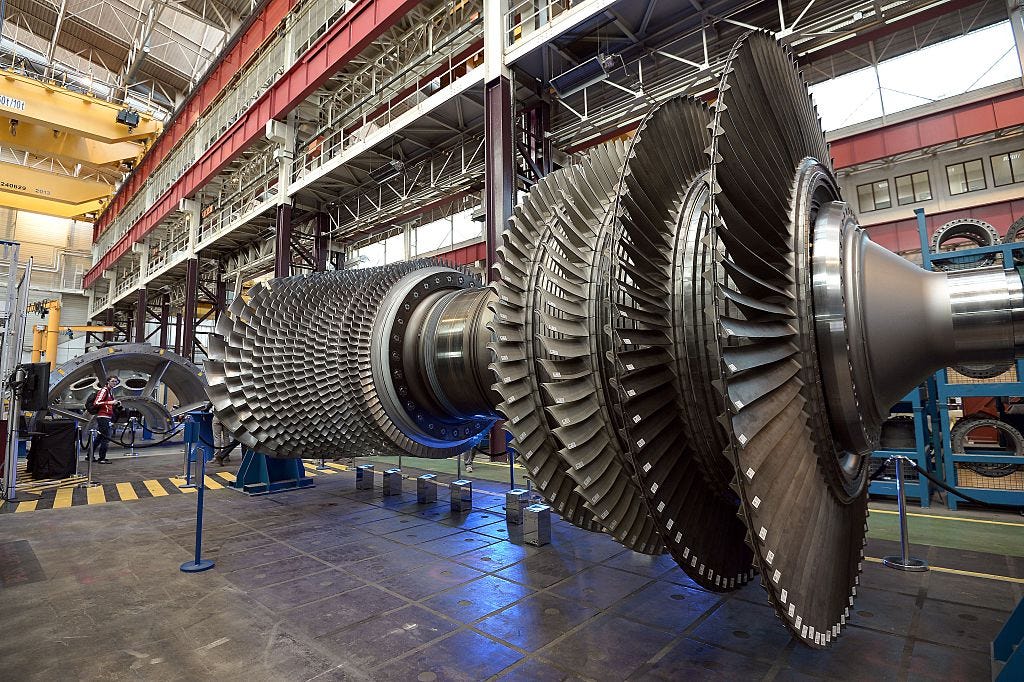
Oligopolists whose products are suddenly in hot demand tend to enjoy windfall profits, and this situation is no different. Consider GE Vernova (GEV), which was spun out of its parent, General Electric, in early 2024. Saddled as it was with the black hole of liabilities dragging down its wind energy business, the parent company was surely more than happy to see it go and likely tossed in the mature gas turbine business to paper over what was otherwise a classic financial triage operation. Alas, no bad deed goes unrewarded these days, and GEV’s stock is up
...This excerpt is provided for preview purposes. Full article content is available on the original publication.