Countering Russia’s Long-Range Drone Threat
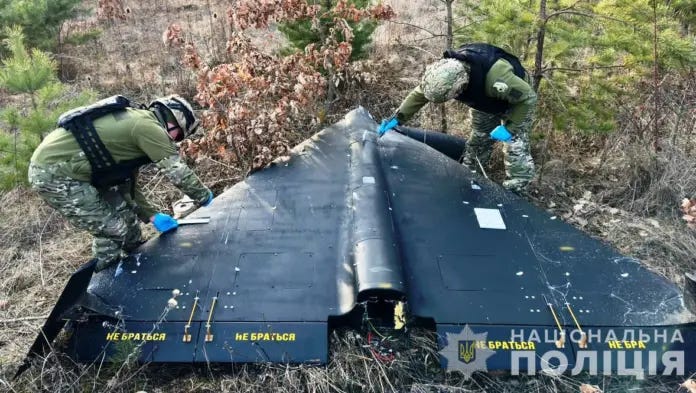
Picture: National Police of Ukraine
Despite large investments in missile defense, current European efforts remain ill-suited to countering cheap, long-range drones that Russia has employed extensively against Ukraine, as highlighted by the incursion of Russian Gerbera long-range drones into Polish airspace a few days ago.
This post provides some pointers on how European states can best respond to the long-range drone threat from Russia.
Western insufficiencies
While the incursion of Russian long-range drones into Poland may have served as a wake-up call for European decisionmakers — prompting quick inquiries in Ukraine about acquiring long-range drone interception technology from Ukraine — the episode should not have come as a surprise.
As Russian long-range drones, initially imported Shahed-131 and Shahed-136 models and later domestically produced variants like the Geran-2, have pummeled Ukrainian cities and infrastructure from the sky, it was always clear that Western and Central European states would face even greater challenges against Russian long-range drones than Ukraine does.
Although European states have made significant investments in missile defense — Germany alone has spent or announced air and missile defense procurements exceeding 10 billion euros — these efforts have not sufficiently addressed the long-range drone threat Russia poses to both Ukraine and Europe. Moreover, the debate on long-range drone defense has largely failed to account for the technological realities of modern air defense solutions.
Shahed-type drones vs European defenses
Three types of technologies are usually considered most suitable for intercepting long-range drones cost-effectively: mobile anti-aircraft guns, interceptor drones, and low-cost interceptor missiles. All come with challenges.
First, a challenge common to all systems — and often omitted in public debate — is the need for detection and tracking capabilities that provide early warning and guide the intercepting projectiles to their targets, whether they are bullets, drones, or missiles.
For example, while long-range drones are relatively cheap, typically costing $1,000 to $5,000 depending on type, they must be paired with radar systems that deliver timely warning and precise tracking. This is especially critical for the types of interceptor drones we are seeing in Ukraine, which only provide for limited endurance and low speed, leaving only a narrow interception window. As a result, even a slight error in interception timing is likely to cause failure.
Another problem with the interceptor drone concept is that it still relies on skilled pilots. While autonomous interceptor drones are under development, they are not yet mature, and
...This excerpt is provided for preview purposes. Full article content is available on the original publication.