No one knows what a body can do
Here are some clichés you’ll hear at ultramarathons.
“It’s 90% mental and the other half is physical.”
“It’s not about the destination, it’s about the journey.”
“Find your why.”
“Start slow, then slow down”
“One mile at a time”
“Trust the training.”
“Dig deep.”
“Keep moving forward.”
“I’m never doing this again” (usually followed by signing up for another one)
“Type 2 fun” (miserable during, but fun in retrospect)
Most of them are rather trite. But many of them ring true because they are. The problem with clichés is not that they’re false (they’re often true in some sense) but that they lack specificity and precision, they’re riddled with exceptions, and usually provide little actionable information. Some of those, however, are worth chewing on. And so you are warned, I will be rehearsing some clichés in what follows.
The setting
Last weekend, I started my sixth and completed my fourth 100-mile race, the Hellbender 100 near Old Fort, NC, which this year featured an alternate, and some say “easier,” course due to the devastation caused by Hurricane Helene last fall. The area was severely hit, and many of the trails are still closed. This alternate course did not look, at least on paper, as exciting as the original course. We did not ascend Mount Mitchell, for instance, the highest point east of the Mississippi. And we repeated some sections more than a beautiful loop course typically allows. Still, this was a challenging course (the repetition frankly didn’t help) with its own charms.
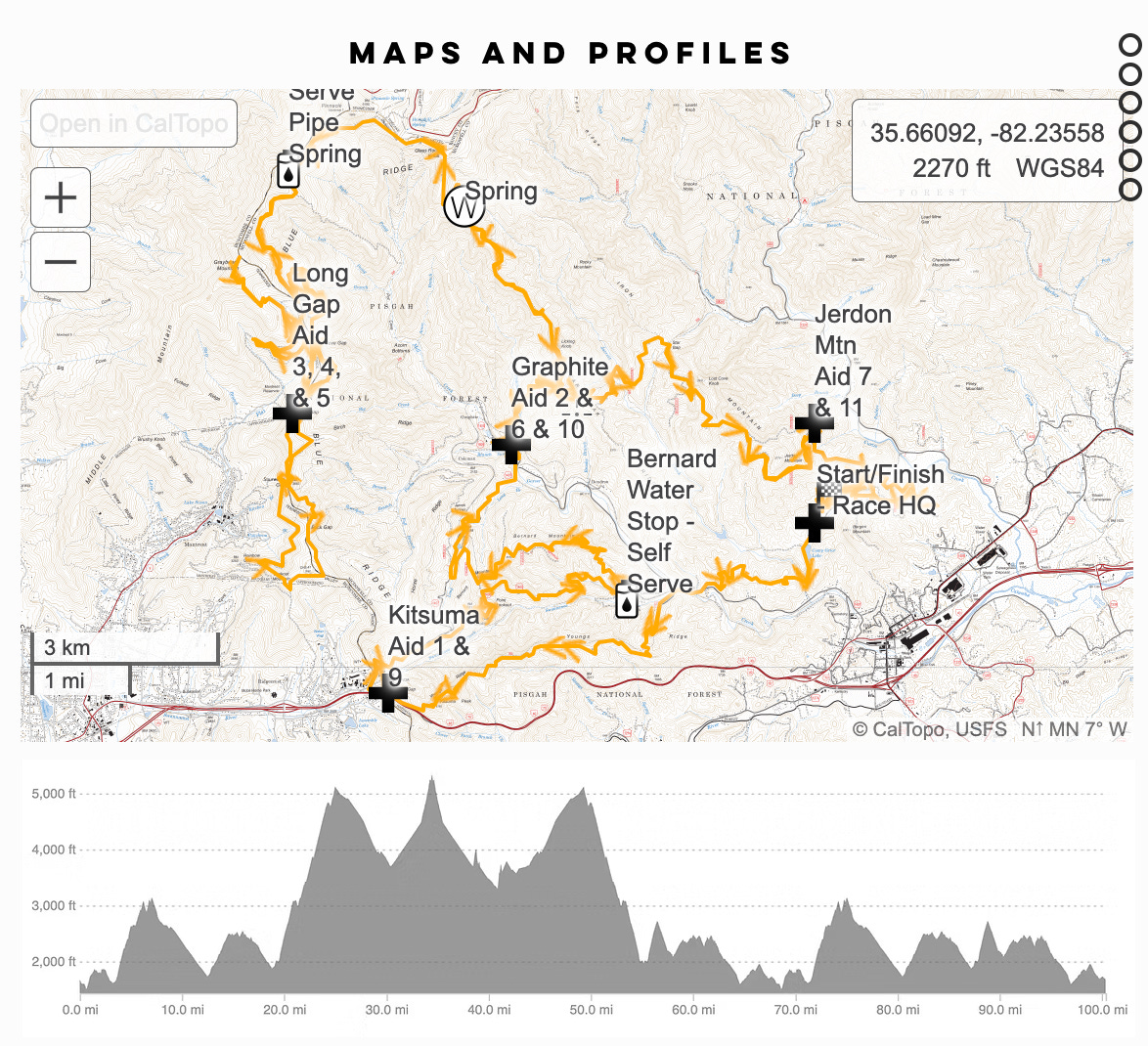
This essay is not a race report, breaking down the race section by section as well as covering training and race prep. It’s an art to write those well; most of them I find boring to read, so writing one, I can’t imagine. What I want to do instead is mull over some things I’ve learned running 100-milers.
What is a one-hundred-miler? It is a one-hundred-mile footrace! You have to complete the distance in as little time as possible, powered only by your own feet. Some will be a tad longer (Cruel Jewel, for instance, which I completed twice and quit once, hovers around 103-105 miles). Your GPS watch may record more or less than exactly 100 miles. But typically, that’s what the race distance is supposed to be. One hundred miles, or 160.9 kilometers. However, the most significant variation is terrain. You’ll find trail races,
...This excerpt is provided for preview purposes. Full article content is available on the original publication.