CCP Purges as Camp
Deep Dives
Explore related topics with these Wikipedia articles, rewritten for enjoyable reading:
-
Wang Lijun incident
11 min read
Linked in the article (10 min read)
-
Gu Kailai
14 min read
Linked in the article (7 min read)
-
Neil Heywood
12 min read
Linked in the article (8 min read)
Anon contributor “Soon Kueh” occasionally writes about China and delights in bureaucracy.
Disclaimer: All the quotes and information are obtained directly from Pin Ho and Wenguang Huang’s A Death in the Lucky Holiday Hotel: Murder, Money, and an Epic Power Struggle in China unless stated otherwise.
Under Xi’s regime, CCP purges have been exceptional in terms of quantity and quality. Xi has now purged more officials than Mao ever did, and he is not stopping. While purging is now a normalised feature of Xi’s rule, fresh rounds of purges always invite new political divinations, rumours of succession politics, and new speculations on the cabinet’s factional alignments.
While understanding realpolitik is fun, what about the fanfare, the drama, the campiness associated with purges? Unfortunately, because of the party’s opaque politics, we are rarely privy to the internal processes of a successful purge and can only debate about the outcomes once the dust settles. Alas, we can only imagine what it’s like being a fly on the wall in the recent PLA purge, but we can draw from memory to extrapolate. So far, the only crack that allowed us a rare glimpse into the party’s shrouded political intrigue occurred 13 years ago, during the purge of Bo Xilai. For longtime party watchers, it was a strangely serendipitous time to witness how the chips fell out of place — from Wang Lijun’s 王立军 botched defection at the American embassy, to Gu Kailai’s 谷开来 shoddy murder of British businessman Neil Heywood, and the resulting purge of Bo’s faction. Borrowing mainly from Pin Ho 何頻 and Wenguang Huang’s 黃聞光 A Death in the Lucky Holiday Hotel: Murder, Money, and an Epic Power Struggle in China, this article takes a trip down memory lane to revisit Bo’s fantastical downfall and indulges in a campiness rarely associated with the CCP.
Act 1: The Hero’s Return to Greatness
.jpg)
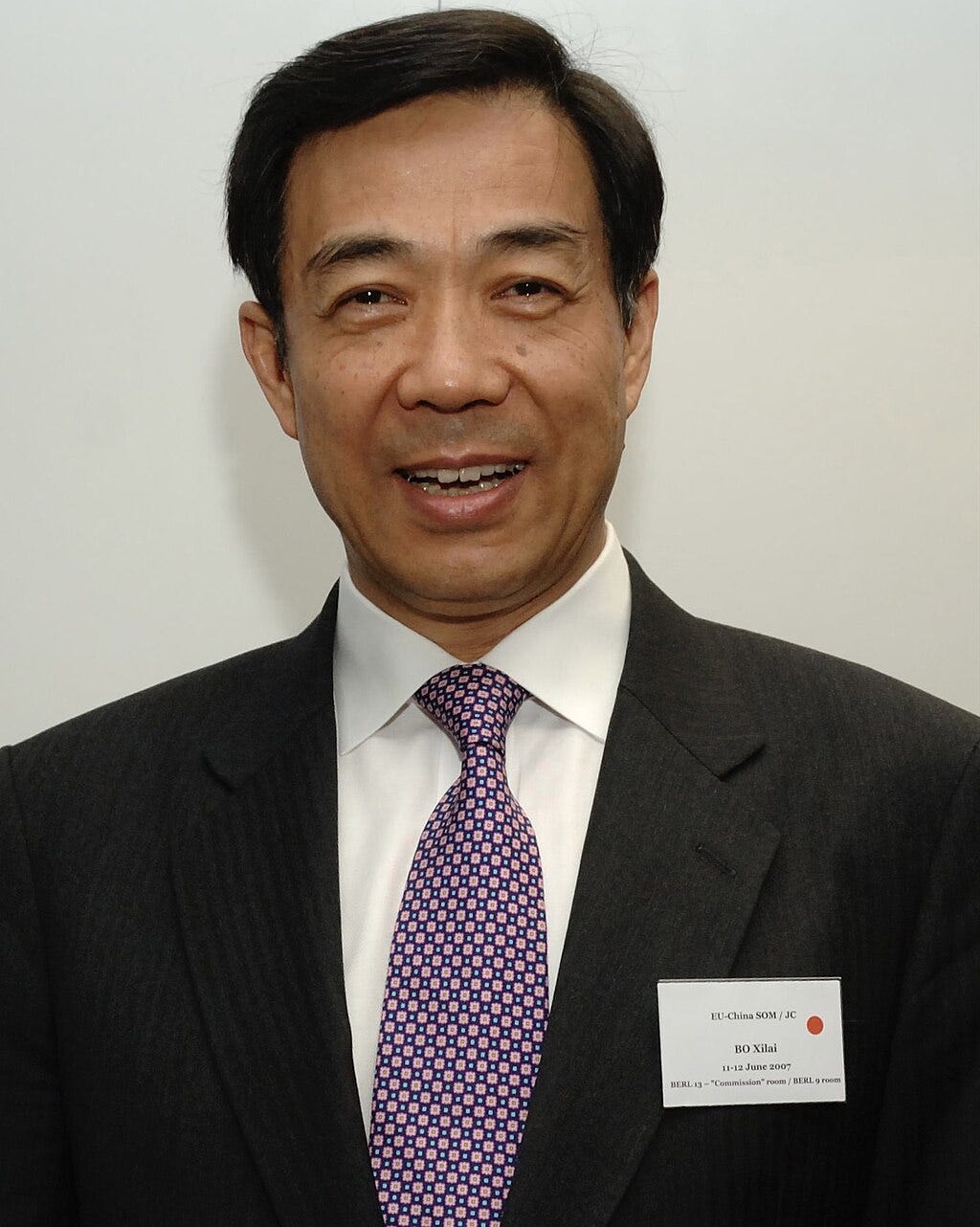
Our tale begins as a wǔxiá 武侠 novel, with Bo Xilai as our main protagonist, attempting a return to greatness. The revenge trope of the fallen prince is a common theme in the wǔxiá genre and Chinese historical dramas. Forced into exile, the disgraced noble prince swears to bide his time in the shadows as he slowly accumulates resources(韬光养晦 and plans for his return to glory.
As the son of former high-ranking revolutionary Bo Yibo 薄一波, Bo
...This excerpt is provided for preview purposes. Full article content is available on the original publication.