Abduction in Caracas
Deep Dives
Explore related topics with these Wikipedia articles, rewritten for enjoyable reading:
-
United States invasion of Panama
13 min read
The article explicitly references the 'Noriega formula' and compares Maduro's abduction to Noriega's capture. Understanding the 1989 Panama invasion provides essential historical context for this parallel.
-
Simón Bolívar
19 min read
The article invokes Bolívar's warning about American imperialism in Latin America. His anti-colonial philosophy and liberation of multiple South American nations directly informs Venezuelan political identity.
-
Delta Force
11 min read
The article claims Delta Force conducted Maduro's abduction and references drug trafficking allegations. Understanding this elite special operations unit's history and missions provides context for the operation described.
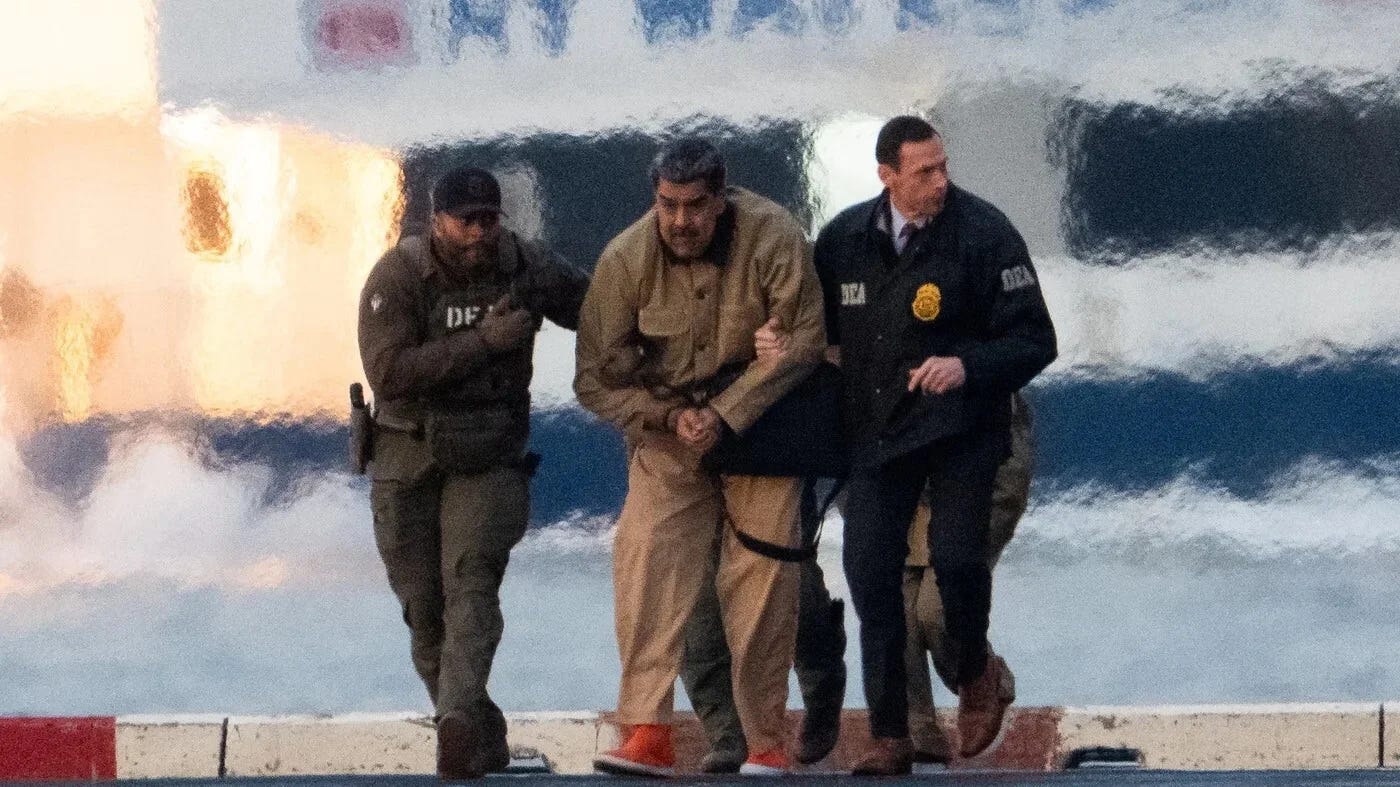
Two decades before US forces kidnapped Venezuelan president Nicolás Maduro this weekend, Hugo Chávez had already predicted the approach:
Years ago, someone told me: “They’re going to end up accusing you of being a drug trafficker—you personally—you, Chávez. Not just that the government supports it, or permits it—no, no, no. They’re going to try to apply the Noriega formula to you.” They’re looking for a way to associate Chávez directly with drug trafficking. And then, anything goes against a ‘drug trafficker president’, right?
On the morning of 3 January, Trump tweeted a Happy New Year message. The US had carried out “a large scale strike on Venezuela and its leader.” President Maduro and his wife Cilia had been “captured and flown out of the Country.” Trump said more details would follow in a few hours’ time. The details, however, were confused.
Later that day, an old friend from Caracas rang to say that secret negotiations had been taking place for some time between the regime and the Americans. The Americans wanted Maduro’s head, which he refused to supply—according to the New York Times, he was offered transport to a well-cushioned retirement in Turkey, which he scorned, to his great credit. And though repeatedly offering to negotiate with Washington on questions of oil and US drug imports, he was also rallying Venezuelans against Trump’s military build-up in the Caribbean.
The Trump administration evidently preferred negotiating with Delcy Rodríguez, the vice-president, and others in Venezuela, where the two key ministers are Diosdado Cabello at the Interior Ministry and Vladimir Padrino at Defence. Both have support in the Army, some 100,000 strong, and Cabello also commands the popular militia forces, which are said to be larger still. As Trump reinforced his threatening armada over the past few months, the Maduro government responded by arming sections of the population.
The question of who now governs Venezuela has therefore become crucial. The first answer came from Trump: “We are going to run the country until such time as we can do a safe, proper and judicious transition.” But the Trump Administration is caught in a cleft stick. Trump’s MAGA base is not in favour of sending American troops to be killed in foreign countries—this was a
...This excerpt is provided for preview purposes. Full article content is available on the original publication.