Justin Yifu Lin warns U.S. AI bubble will burst in 5 years, causing another international crisis
Deep Dives
Explore related topics with these Wikipedia articles, rewritten for enjoyable reading:
-
Dot-com bubble
15 min read
Lin explicitly compares the current AI boom to the dot-com bubble of 2000, predicting a similar crash. Understanding the mechanics, timeline, and aftermath of the dot-com bubble provides essential context for evaluating his prediction about AI.
-
Quantitative easing
17 min read
Lin argues that U.S. quantitative easing after 2008 inflated stock markets and created the conditions for the current bubble. Understanding this unconventional monetary policy mechanism is crucial for following his argument about dollar dominance and market distortions.
Justin Yifu LIN is Dean of the Institute of New Structural Economics, Dean of the Institute of South-South Cooperation and Development and Professor and Honorary Dean of the National School of Development (NSD) at Peking University. He was the Senior Vice President and Chief Economist of the World Bank, 2008-2012. Prior to this, Mr. Lin served for 15 years (1994-2008) as Founding Director and Professor of the China Centre for Economic Research (CCER), the NSD’s predecessor, at Peking University.
At the 10th Fudan Chief Economist Forum in Shanghai on November 23, Lin warned that the current artificial intelligence boom in the United States shows clear signs of an asset bubble. If it bursts, he argued, the shock could be comparable to the 2008 global financial crisis in terms of its impact on the U.S. and world economy.
Lin also called on China to adopt more proactive monetary and fiscal policies. In his view, Beijing needs to shake off theoretical constraints such as deficit “red lines” and textbook doctrines that treat money as neutral, and use targeted credit and public investment more boldly to support technological upgrading and growth, so long as productivity is rising.
Lin pushed back strongly against popular explanations for China’s slower growth in recent years. He argued that:
The idea that “the state-owned sectors advance at the expense of the private sector” is not the root cause; government-led investment has been a response to external shocks and a weakening private sector, not the original problem.
Population ageing is not to blame either, because the effective labour force, adjusted for years of schooling, has continued to rise.
In Lin’s view, the real drags on growth have been the weak external demand growth, U.S. restrictions on China’s access to key technologies, which force China to devote large resources to overcoming chokepoints, and a crisis of confidence at home and abroad, fuelled by fashionable pessimism about China.
Lin’s remarks were compiled and published by Guancha.cn, a domestic news outlet.
The following English translation has been reviewed by Lin.
—Yuxuan Jia
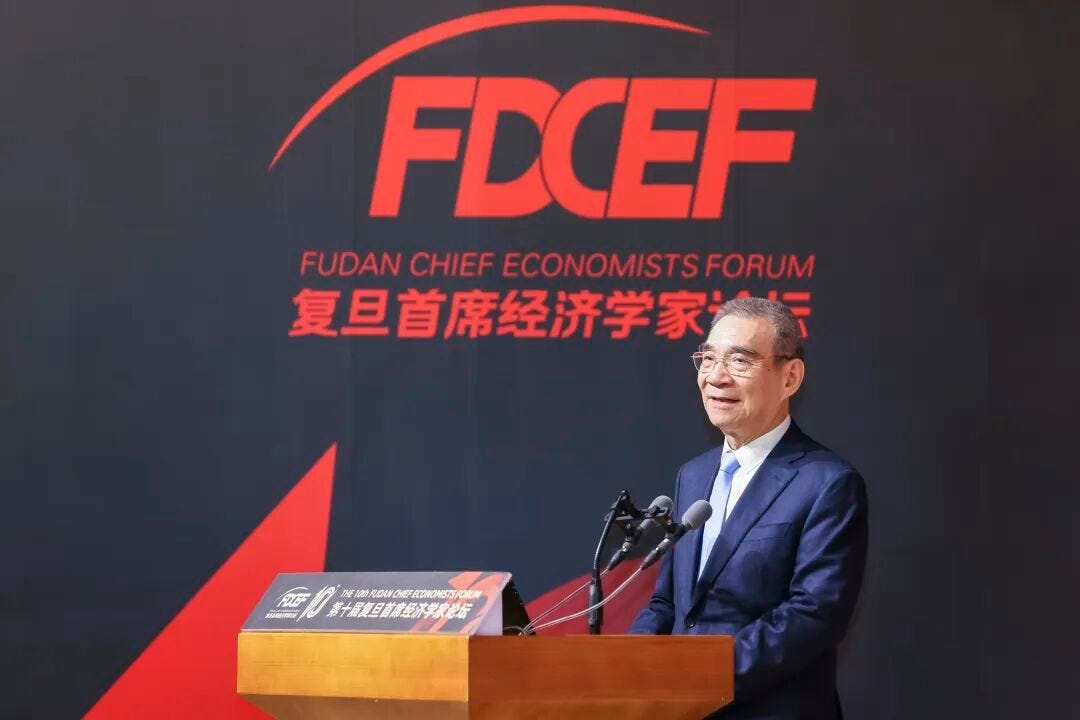
林毅夫:制定“十五五”增长目标,关键要突破几个误区
Justin Yifu Lin: Setting Growth Targets for the 15th Five-Year Plan Requires Overcoming Several Misconceptions
Good morning to all friends from academia and industry.
I attended the very first Fudan Chief Economist Forum, and it is a great pleasure to return for the tenth. Today, I would like to take this opportunity to discuss the international economic
...This excerpt is provided for preview purposes. Full article content is available on the original publication.