Day 12: Turnabout is Fair Play
Deep Dives
Explore related topics with these Wikipedia articles, rewritten for enjoyable reading:
-
Breakup of the Bell System
12 min read
The article references AT&T remedies leading to semiconductor chips and wireless phones as examples of successful structural remedies - this is the landmark case being alluded to
Rhetorical reversals are a great American tradition. Thomas Paine’s famous revolutionary pamphlet “Common Sense” took its title from a British publication of the same name while inverting its arguments. Where the British accused Revolution-hungry Americans of regressing to a state of native savages, Paine turns around and argues that it is, instead, the British who are backwards-looking, while the Americans are at the cutting edge of civilization, focused on progress. Indeed, whereas the British traveled only for commerce and plunder, Americans traveled to forge connections for the benefit of humankind. Paine does it again in “Rights of Man,” responding to Edmund Burke’s defense of aristocracy with another reversal: it was the aristocrats who were too emotionally unstable to lead and the people who were naturally prudent and in touch with the real world. He wrote: “Mr. Burke talks of nobility; let him show what it is. The greatest characters the world have known, have risen on the democratic floor. Aristocracy has not been able to keep a proportionate pace with democracy. The artificial noble shrinks into a dwarf before the noble of nature.”
None of the parties at this week’s closing arguments for Google adtech remedies mentioned this heritage (although the DOJ did quote a different Founder—Ben Franklin—for his famous idiom “an ounce of prevention is worth a pound of cure”), but both put this rhetorical reversal technique into practice throughout the day, with respect to a variety of goals: effectiveness, caution, simplicity, trust, and time.
Effectiveness and Certainty
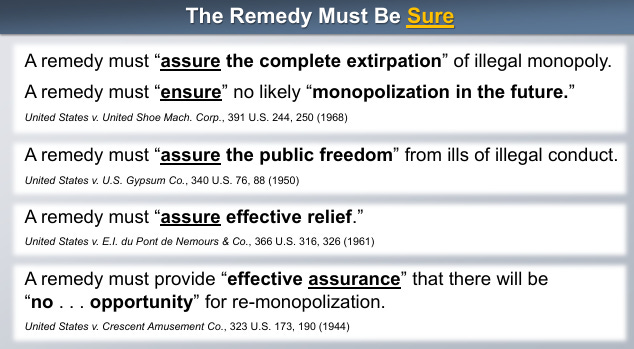
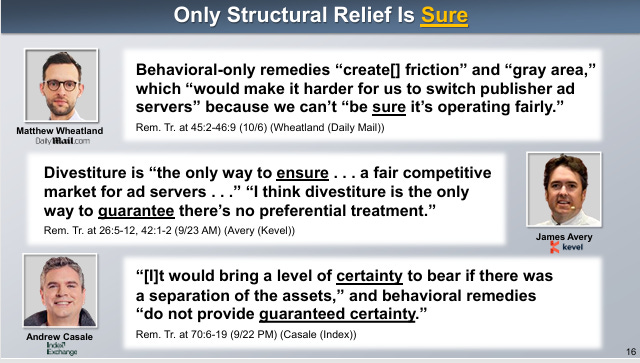
Beyond reprising it summary of the four remedy objectives noted during the opening statements of the remedy phase, the DOJ repeatedly emphasized that a minimum requirement for remedies is that they must be effective. Yes, the judge has discretion with respect to what the remedy will require of Google, but the judge should only choose between options that are effective. The DOJ pointed out that every witness (except for Google’s experts and last minute friendly-witness from WikiHow) agreed that only structural remedies would ensure effective and certain relief.
Google argued that, to the contrary, it is behavioral relief that is effective (unsurprisingly, quoting Professor Herbert Hovenkamp in support of that view). After all, Google said, every witness agreed that its proposal to integrate prebid into the auction process would yield competitive benefits and help level the playing field. And one advertiser, when asked whether divestiture would further improve competition more than
...This excerpt is provided for preview purposes. Full article content is available on the original publication.