The Week Observed: October 31, 2025
Deep Dives
Explore related topics with these Wikipedia articles, rewritten for enjoyable reading:
-
Megaproject
10 min read
The article discusses multiple billion-dollar infrastructure projects with cost overruns and delays. Understanding megaproject theory—including why they systematically underestimate costs and overestimate benefits—provides crucial context for the patterns described.
-
Induced demand
13 min read
The article explicitly references 'the science of induced travel' when criticizing the LAX freeway expansion. This economic and transportation planning concept explains why building more roads often increases rather than decreases congestion.
-
Columbia River Crossing
12 min read
The article directly compares the Interstate Bridge Replacement to its 'doppelgänger' the Columbia River Crossing, which became a 'zombie project.' Understanding this failed predecessor illuminates the political and financial dynamics at play.
What City Observatory Did this Week
Another Portland area highway mega-project has a catastrophic cost overrun. We’ve tried to like the Burnside Bridge project. Unlike other Portland-area transportation mega-projects, its pretty resolutely focused on just a like-for-like, but seismically updated replacement for the nearly hundred year old Burnside Bridge in downtown Portland—no “auxiliary” lanes, massive interchanges or elevated approaches. It should stand as an object lesson to OregonDOT that you don’t need to—and shouldn’t—expand highway capacity in urban centers. Alas, the project, which was supposed to have cost about $965 million has now doubled in price to as much as $1.8 billion
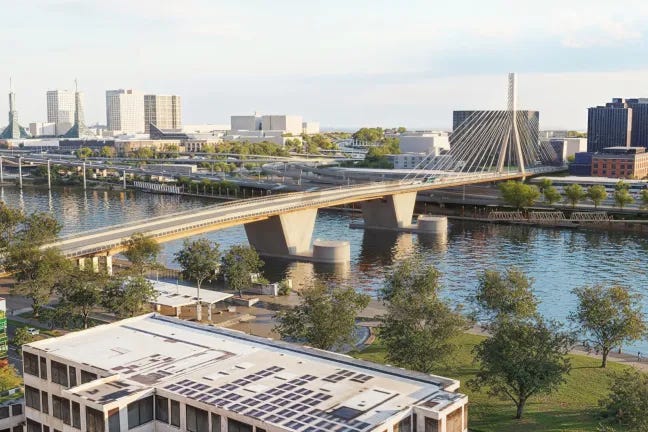
This is leading to the indefinite postponement (zombie-status) for the project. While Multnomah County officials want to blame the federal funding uncertainty, the bridge was never a good candidate for major federal funding, and the huge cost overrun is hardly the fed’s fault. Our best estimate is that on a price and quantity adjusted basis, the proposed Burnside Bridge is now three to six times more expensive than two recently constructed Willamette River bridges in Portland. It’s more evidence of the chronic problem of initial estimates “low-balling” the cost of a project to get approval, knowing that once some funding is committed and some earth is moved, political pressure will build to “get ‘er done” regardless of the cost. That appears to be what is at work here, as well.
An interview with Lars Larson. Conservative talk-show host Lars Larson asks whether the Interstate Bridge Project is “already dead.” There are plenty of signs that the project is in trouble: it has fallen more than two years behind the schedule it set in 2020 for completing its environmental review, has delayed producing a new cost estimate for almost two years, seems likely to grow in cost to the $9-10 billion range, is struggling to convince the Coast Guard to allow a relatively low fixed span structure that will impede river traffic, and stands to lose billions of dollars of federal money because of delays and Trump Administration hostility. On top of all that, its director for the past five years just announced he’s stepping down.

Larson and City Obervatory’s Joe Cortright discuss these issues, and whether the project will die. More likely, as did its doppelgänger, the proposed Columbia River Crossing, it will turn into a zombie project--still nestled in the plans of state highway
...This excerpt is provided for preview purposes. Full article content is available on the original publication.