190. SNAP WTF?
Deep Dives
Explore related topics with these Wikipedia articles, rewritten for enjoyable reading:
-
Shadow docket
14 min read
The article focuses on emergency applications and administrative stays at the Supreme Court - the 'shadow docket' refers to this exact practice of issuing orders without full briefing or oral argument, which has become increasingly controversial in recent years
-
Supplemental Nutrition Assistance Program
15 min read
SNAP is the central subject of the legal dispute discussed in the article, serving 42 million Americans. Understanding its history, funding mechanisms, and administration provides essential context for why the case matters
-
Supreme Court of the United States
20 min read
The article explains how Justice Jackson handled this case because she is the circuit justice for the First Circuit. This lesser-known aspect of Supreme Court procedure - where each justice is assigned to oversee specific circuits - is central to understanding why Jackson acted alone
Welcome back to “One First,” a (more-than) weekly newsletter that aims to make the U.S. Supreme Court more accessible to lawyers and non-lawyers alike. I’m grateful to all of you for your continued support, and I hope that you’ll consider sharing some of what we’re doing with your networks:
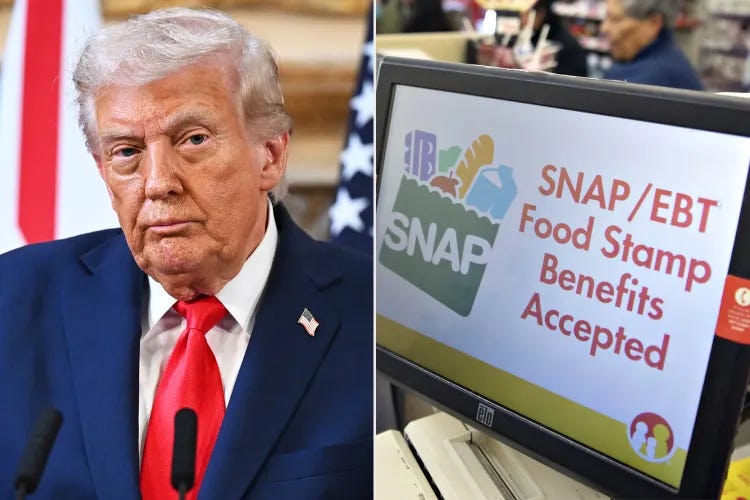
I wanted to put out a very brief post to try to provide a bit of context for Justice Jackson’s single-justice order, handed down shortly after 9 p.m. EST on Friday night, that imposed an “administrative stay” of a district court order that would’ve required the Trump administration to use various contingency funds to pay out critical benefits under the Supplemental Nutrition Assistance Program (SNAP).
It may surprise folks that Justice Jackson, who has been one of the most vocal critics of the Court’s behavior on emergency applications from the Trump administration, acquiesced in even a temporary pause of the district court’s ruling in this case. But as I read the order, which says a lot more than a typical “administrative stay” from the Court, Jackson was stuck between a rock and a hard place—given the incredibly compressed timing that was created by the circumstances of the case.
In a world in which Justice Jackson either knew or suspected that at least five of the justices would grant temporary relief to the Trump administration if she didn’t, the way she structured the stay means that she was able to try to control the timing of the Supreme Court’s (forthcoming) review—and to create pressure for it to happen faster than it otherwise might have. In other words, it’s a compromise—one with which not everyone will agree, but which strikes me as eminently defensible under these unique (and, let’s be clear, maddening and entirely f-ing avoidable) circumstances.
I. How We Got Here
Everyone agrees that, among the many increasingly painful results of the government shutdown, the U.S. Department of Agriculture (USDA) can no longer spend the funds Congress appropriated to cover SNAP—a program that helps to fund food purchases for one in eight (42 million!) Americans. Everyone also agrees that there are other sources of appropriated money that the President has the statutory authority to rely upon to at least partially fund SNAP benefits for the month of November. The two questions that have provoked the most legal debate is whether (1) he has the authority to fully fund SNAP; and (2)
...This excerpt is provided for preview purposes. Full article content is available on the original publication.