What the Trump-Putin Summit Means for Ukraine, Europe, and Peace
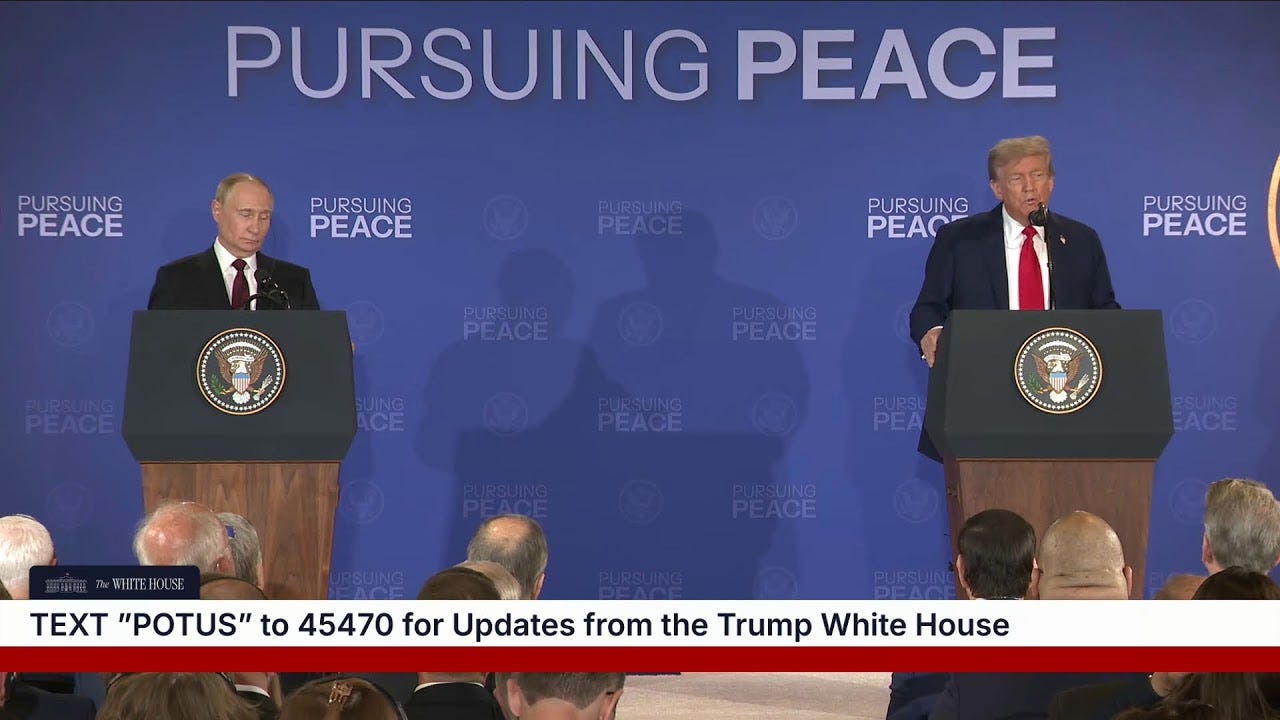
Picture: The White House
On 15 August, U.S. President Donald Trump and Russian President Vladimir Putin met in Alaska for a high-profile Trump-Putin summit to discuss the ongoing war in Ukraine, prospects for a lasting peace agreement, and the future of European security.
The Trump-Putin meeting left behind an uneasy mix of relief and apprehension. Relief, because the encounter could have produced a much deeper alignment between Washington and Moscow at the expense of Ukraine and Europe. Apprehension, because Trump’s remarks still left open the possibility of a settlement framework shaped on Russian terms, with Europe and Ukraine reduced to secondary roles.
This post examines both the implications of the Trump-Putin meeting and discusses the conditions required to pursue a realistic path toward a just and durable peace.
What the Trump-Putin Summit Means for Ukraine
Bad, but it could have been worse. That is how I would summarize the Trump-Putin summit episode.
On the positive side, Trump does not appear to have been fully swayed by Putin’s ‘great power concert’ diplomacy, which seeks to sideline Ukraine and Europe and settle the war and Europe’s future directly between the United States and Russia.
Listening to Trump afterward, he seems to envision some role for Ukraine and its European partners, though it remains unclear what exactly that might be. In the worst case, Trump could simply expect Ukraine to accept whatever understanding he and Putin reached (the word “deal” that was printed in international media afterwards appears to be a translation error) and for European states to follow along. Much will depend on the expected meeting between Zelensky and Trump in the coming days.
Perhaps the most troubling element was Trump’s explicit acceptance of Russia’s demand that the war be settled as part of a broader agreement on European security, involving European states and NATO’s role, rather than being confined to Russia and Ukraine.
This is, of course, entirely inappropriate, as Russia’s future role in Europe can only be discussed once it returns to the community of law-abiding states, makes amends, and demonstrates readiness to act as a constructive rather than destructive player on the international stage.
The saving grace may lie in Trump’s well-known tendency to echo the last person he spoke to — in this case, Putin. In a best-case scenario, he might revert to his “ceasefire first” line, which remains the correct and appropriate policy, once he has spoken
...This excerpt is provided for preview purposes. Full article content is available on the original publication.