Pruning for the Future
Deep Dives
Explore related topics with these Wikipedia articles, rewritten for enjoyable reading:
-
Sunk cost
17 min read
The article centers entirely on sunk cost as a psychological and economic phenomenon - the Wikipedia article provides rigorous academic grounding, experimental evidence, and the distinction between the fallacy and rational decision-making that would deepen understanding
-
Urban decay
15 min read
The article discusses shrinking cities, retiring infrastructure, and the Minneapolis I-94 example - urban decay covers the socioeconomic processes of population decline and infrastructure abandonment that Hagens argues we should proactively manage
This essay is adapted from last week’s Frankly video monologue titled “Sunk Cost and the Superorganism.” In the future, we’ll be adapting more Frankly videos to written versions and continuing to post them on Substack, so stay tuned for more.
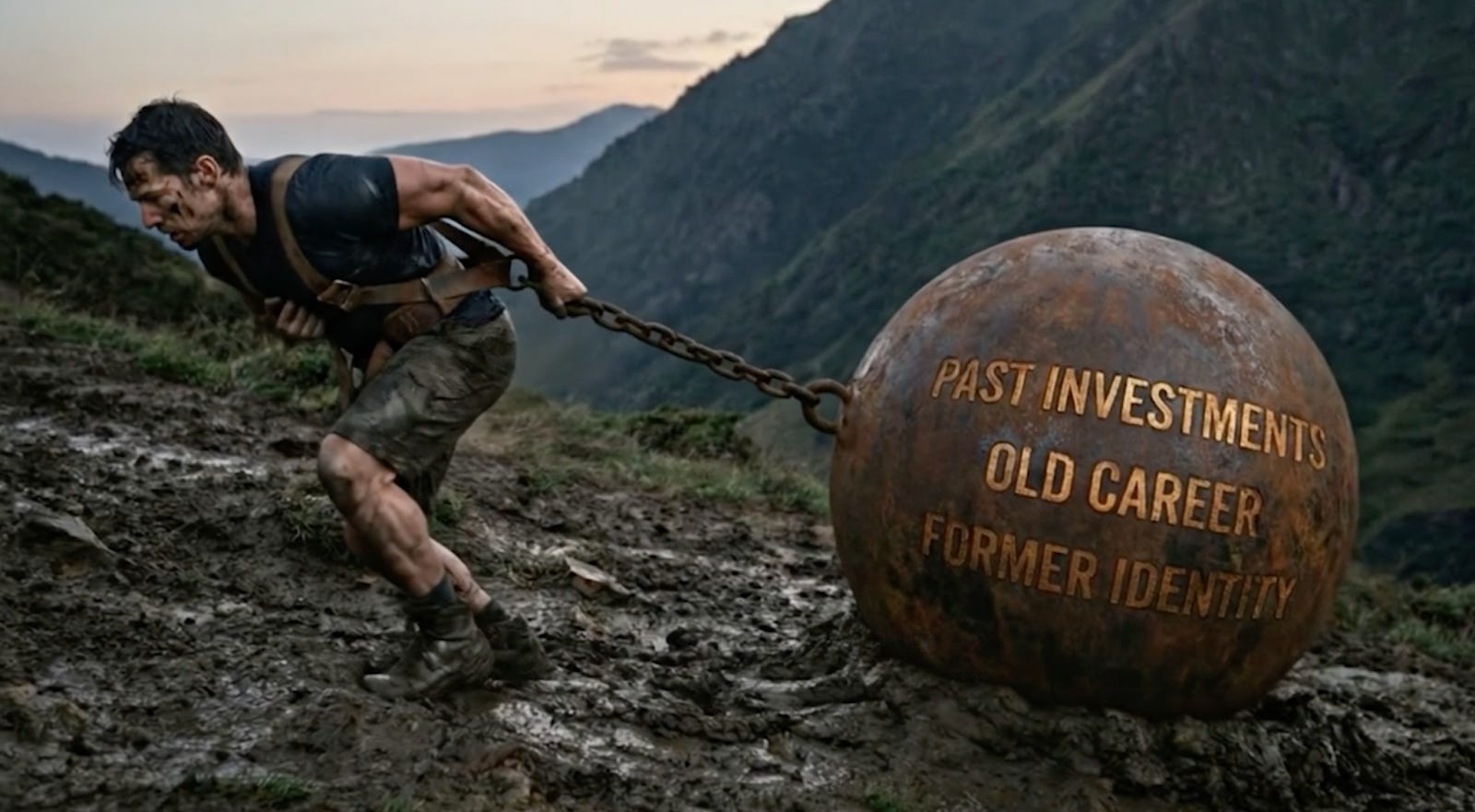
Have you ever gone to a movie, realized it was terrible halfway through, and yet stayed until the end because you’d already invested time and money into it?
If so, this experience was an example of the macroeconomic behavioral dynamic called sunk cost, which I think has large implications for us personally and for our culture in the coming decades. Today, I want to talk about sunk cost not as just an economic term from textbooks, but as a real force shaping our lives, our homes, our careers, and the way civilization reacts to the Great Simplification.
What Is Sunk Cost?
By definition, sunk cost is any past expense – time, money, effort – that cannot be recovered. If we were totally rational as people, or as a species, logic would tell us that sunk costs should be ignored. We cannot regain any of what we’ve lost by continuing to spend more on that same thing. At the same time, continuing forward with the same past actions will only hurt us and make it harder to change course in the future.
Instead, if we were truly logical, we should make decisions based only on our present situations, circumstances, and expected future payoffs. Of course, this is easier said than done because humans have memories, emotions, and social status – all things that we’ve tied our sense of identity to. We protect past investments as if they were living things, as if they were literally us.
Sunk cost shows up in small ways all the time in our society: that previously mentioned bad movie we sit through, a huge meal we keep eating even though we’re full, or an expensive jacket we wear that’s a size too big. We might chuckle a bit at these examples because they’re familiar, and they seem pretty trivial in the grand scheme of things. But, if you apply this same economic logic to careers, romantic partners, home mortgages, or national infrastructure…the stakes become quite high.
When it comes to the human predicament, where (in the not-too-distant future) we will need to completely change the way society works, this sunk cost psychological phenomenon
...This excerpt is provided for preview purposes. Full article content is available on the original publication.