Trapped in the hell of social comparison
Deep Dives
Explore related topics with these Wikipedia articles, rewritten for enjoyable reading:
-
Social comparison theory
18 min read
The article's central thesis is that social media has amplified social comparison, making people unhappier. This foundational psychological theory by Leon Festinger explains why humans compare themselves to others and how these comparisons affect self-evaluation and emotions.
-
Relative deprivation
10 min read
The article discusses how exposure to wealthy influencers makes people feel worse about their own economic situation despite objective improvements. Relative deprivation theory explains this phenomenon of feeling disadvantaged based on comparisons to reference groups rather than absolute conditions.
-
Conspicuous consumption
15 min read
The influencer lifestyle content described (private jets, European vacations, fancy houses) exemplifies conspicuous consumption. Thorstein Veblen's concept explains the economic and social dynamics of wealth display that social media has democratized access to viewing.

Interest rates have begun to come down. Inflation has mostly subsided, and the real economy is still doing decently well despite Trump’s tariffs. So why are American consumers more pessimistic than they were during the depths of the Great Recession or the inflation of the late 1970s?
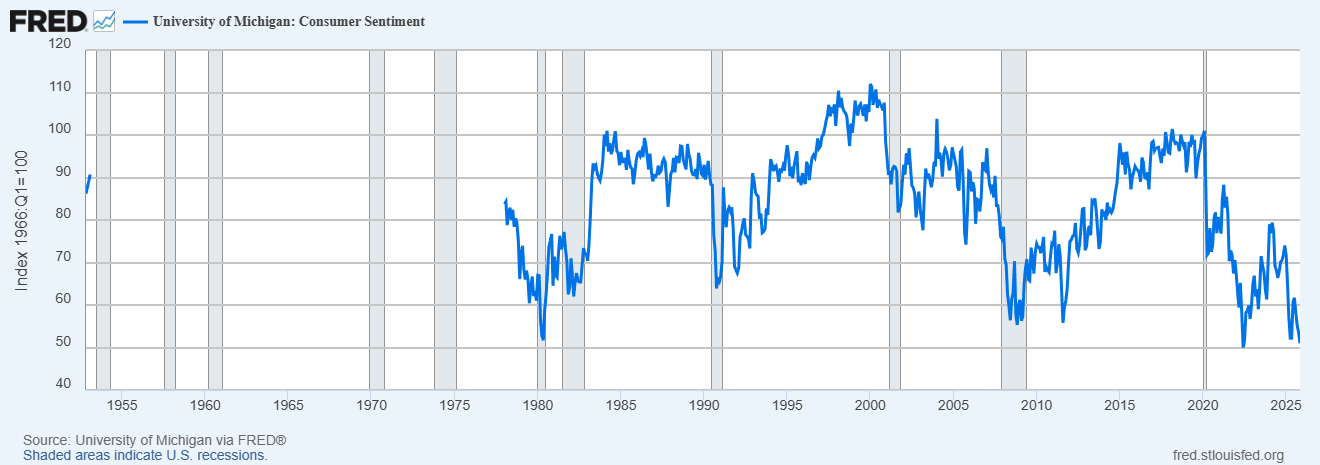
It’s possible to spin all sorts of ad hoc hypotheses about why consumer sentiment has diverged from its traditional determinants. Perhaps Americans are upset about social issues and politics, and expressing this as dissatisfaction about the economy. Perhaps they’re mad that Trump seems to be trying to hurt the economy. Perhaps they’re scared that AI will take their jobs. And so on.
Here’s another hypothesis: Maybe Americans are down in the dumps because their perception of the “good life” is being warped by TikTok and Instagram.
I’ve been reading for many years about how social media would make Americans unhappier by prompting them to engage in more frequent social comparisons. In the 2010s, as happiness plummeted among young people, the standard story was that Facebook and Instagram were shoving our friends’ happiest moments in our faces — their smiling babies, their beautiful weddings, their exciting vacations — and instilling a sense of envy and inadequacy.
In fact, plenty of careful research found that using Facebook and Instagram made people at least temporarily unhappier, and there’s some evidence that social comparisons were the reason. Here’s Appel et al. (2016), reviewing the literature up to that point:
Cross-sectional evidence demonstrates a positive correlation between the amount of Facebook use and the frequency of social comparisons on Facebook…A similar pattern emerges for the impression of being inferior…Some of these studies…have documented an association between social comparison or envy and negative affective outcomes…
Causal relationships between Facebook use, social comparison, envy, and depression have also been established experimentally. For example, in a study about women's body image…women instructed to spend ten minutes looking at their Facebook page rated their mood lower than those looking at control websites. Furthermore, participants in the Facebook condition who had a strong tendency to compare their attractiveness to others were less satisfied with their physical appearance…
In summary, available evidence is largely consistent with the notion that Facebook use encourages unfavorable social comparisons and envy, which may in turn lead to depressed mood.
Note that during the 2010s, consumer confidence was high. Even if people were comparing their babies
...This excerpt is provided for preview purposes. Full article content is available on the original publication.