Is China Cooking Waymo?
Deep Dives
Explore related topics with these Wikipedia articles, rewritten for enjoyable reading:
-
Neom
13 min read
Linked in the article (18 min read)
In terms of international expansion, Chinese firms are way ahead of the American competition. Chinese companies have worked out Autonomous Vehicle (AV) deployment deals with more than thirteen countries. The US: two. Chinese companies are also exporting something closer to a full autonomy stack — vehicles bundled with cloud services, AI traffic management systems, and road sensors.
There’s also the supply chain. Unlike frontier AI models, where US export controls on Hopper and Blackwell GPUs have genuinely constrained China’s progress, AVs operate in a different hardware regime. Here, the leverage between the US and China is more evenly matched, and in some cases, inverted.
Today’s Content:
AVs in the US and China
The International AV market
Who has leverage in the AV supply chain
At times, this piece reads like a typical “US vs China” article, but in fact we’re seeing more of a “co-opetition” dynamic highlighted in the AI industry. In fact, the perhaps more interesting aspect is how the line between “Chinese AV company” and “US AV company” blurs in practice. Chinese AVs use NVIDIA chips, Waymo uses Chinese-made Zeekr vehicles, and Uber and Lyft partner with Chinese AV firms internationally, not to mention critical minerals. The industries are too tangled for neat distinctions… but let’s try to untangle them anyway.
1. AVs in the US and China
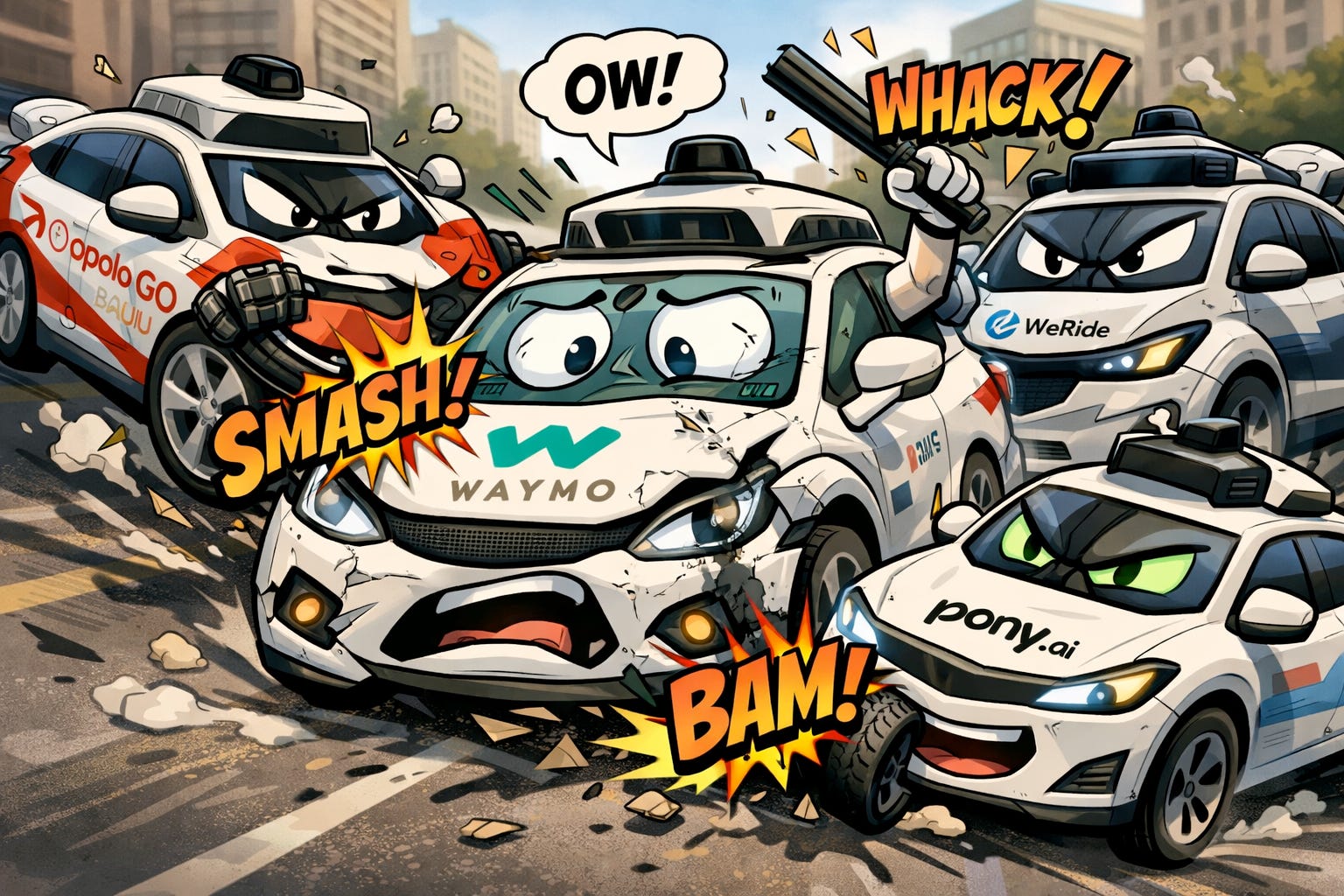
The US has Waymo. China has its “big three”: Baidu’s Apollo Go, WeRide, and Pony.ai (whose founders ChinaTalk interviewed last year).
There are other potential players in the US, like Amazon’s Zoox and Tesla (RIP GM’s Cruise). But right now, Waymo is the only American company operating a scaled, paid Level-4 robotaxi service, which enables vehicles to handle all driving tasks within specific operating zones. China also has BYD and Xiaomi with L2 driving features (who could transition to L4 soon), and many more robovan, robus, robodelivery, and robotruck companies on track for L4 deployment.
In aggregate terms, China appears to have the edge in overall deployment. An analysis by SCSP suggests Chinese autonomous-vehicle operators have collectively logged roughly 149 million autonomous miles, compared to around 106 million miles for US firms — a roughly 1.4 to 1 advantage.1
But mileage comparisons are limited. Companies report different levels of autonomy, mix supervised and driverless miles, and disclose data unevenly across jurisdictions. Ridership is a different way to look at it, where China has completed ~30 million
...This excerpt is provided for preview purposes. Full article content is available on the original publication.