What Trump really wants with AI
As Donald Trump issued his latest round of threats to seize Greenland, he illustrated his intent with, what else, some AI slop.
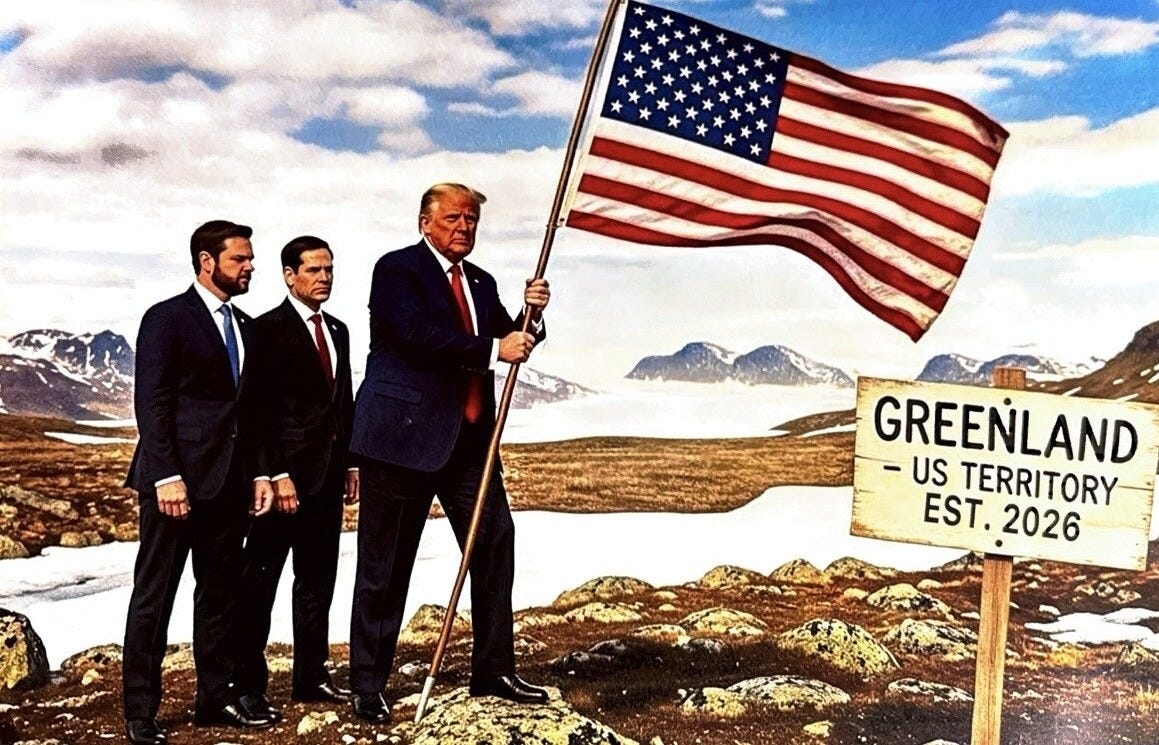
Trump posted the above image on Truth Social, along with another one depicting some kind of a strategy meeting in the Oval Office being held in front of a map with the United States, Greenland, and Canada all colored in like the American flag.
This sort of thing has become standard practice for Trump and his team. The administration shares AI-generated images on social media so frequently it’s been termed slopaganda. It tracks: Given that it’s voluminous and cheap, fundamentally unconcerned with conveying truth or accuracy, free of nuance, and generally adheres to a gaudy, homogenous aesthetic, it’s fitting that AI imagery has become an ideal vessel for state expression.
But the embrace goes beyond aesthetics. The administration’s AI images, from the ‘Ghiblified’ picture of a woman crying as she’s arrested by ICE, to grainy faux video clips of Obama getting arrested, to that reel of a razed and redeveloped Gaza, to the more recent ‘Defend the Homeland’ and Greenland conquest posts, are unified by the same impulse: to project MAGA dominance.
In the administration’s repeated use of gen AI, Trump’s not just articulating his policy aims with AI, but articulating his approach to AI policy, too. Both are rooted in the drive to dominate. It’s a point I think we’d do well to underline as we enter year two of the Trump administration and year four of the AI boom, and as Trumpworld and Silicon Valley bind their projects, personnel, and futures ever closer together.
Take what was perhaps the AI industry and the Trump administration’s key shared ambition last year: A 10-year moratorium on state AI laws, colloquially known as preemption. At the behest of Meta, Google, OpenAI, and other tech firms, as well as crypto and AI czar David Sacks, Trump allies tried to get legislation to that effect passed in Congress twice. It came up short both times, facing intra-GOP opposition as well as general blowback on the grounds that it was an optically toxic gift to big tech and fundamentally antidemocratic. It was instead, as readers of BITM know, turned into an executive order that aims to accomplish the same ends, just via coercion, withholding state funds, and threat of litigation
...This excerpt is provided for preview purposes. Full article content is available on the original publication.