READING: John Maynard Keynes on Isaac Newton
Deep Dives
Explore related topics with these Wikipedia articles, rewritten for enjoyable reading:
-
Isaac Newton's occult studies
11 min read
Keynes's central thesis is that Newton was 'the last of the magicians' - deeply engaged in alchemy and theology. This Wikipedia article directly addresses the hidden Newton that Keynes discovered in the papers, covering his alchemical manuscripts and biblical chronology work.
-
Royal Mint
1 min read
The article mentions Newton as 'Master of the Royal Mint' for the last three decades of his life. This lesser-known phase of Newton's career, where he aggressively prosecuted counterfeiters and oversaw England's great recoinage, represents his transformation from reclusive scholar to public figure.
Newton wasn’t just the architect of modern physics and celestial mechanics; he was also theologian and alchemist. “voyaging through strange seas of thought” indeed. Even the “Principia” was intuition dressed-up as geometry…
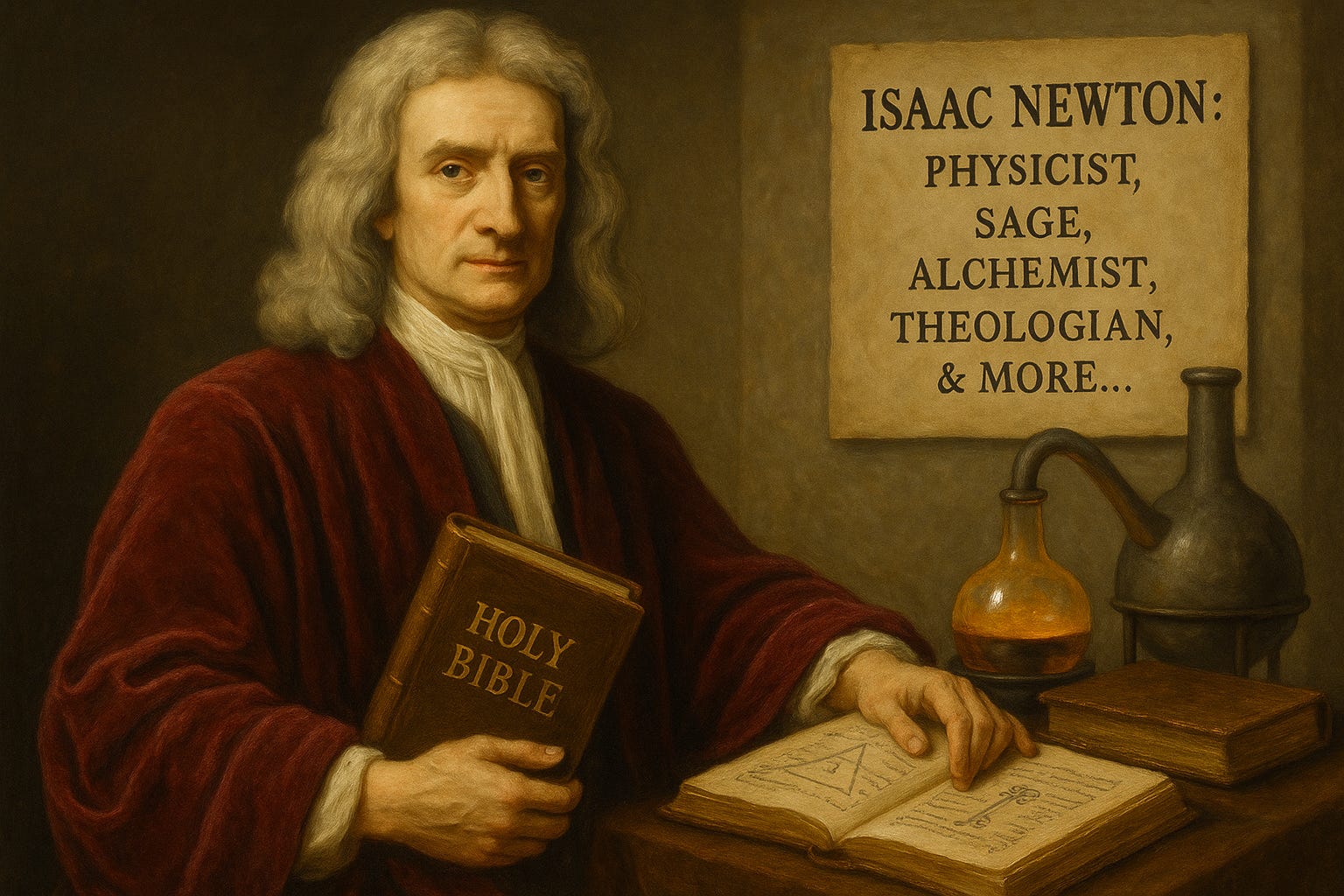
The Isaac Newton we mostly know is the Newton of physics at Cambridge University before 1696, and then the Newton the Age of Reason Enlightenment Grandee, the quarter-century President of the Royal Society, and the Master of the Royal Mint up until his death in 1727.
The relatively affable man-about-town renowned genius receiving callers later in life—the person who may (or may not) have said:
I do not know what I may appear to the world, but to myself I seem to have been only like a boy playing on the seashore, and diverting myself in now and then finding a smoother pebble or a prettier shell than ordinary, whilst the great ocean of truth lay all undiscovered before me…
The diamond-hard brilliance of insight into natural physical law early in life—the person who could write to Robert Hooke in a sort-of friendly and sort-of not dispute over priority:
What Des-Cartes did was a good step. You have added much in several ways, and in particularly in taking the colours of thin plates into philosophical consideration. If I have seen further it is by standing on the shoulders of Giants…
recognizing the importance of cumulative teamwork across the ages in discovery, while the subtext is that he, Isaac Newton, is a very tall person himself.
Newton was indeed among the First of the Scientists—those who sought ideas that described how the world revealed itself in experiment, and then back-propagated those into premises which were valid only by their success at organizing the results of experiments, and hence always subject to debate and change, as experimental knowledge grew. He was, in his rôle as physicist, not one of those who started with rock-solid premises and sought to derive from them by logical deduction detailed implications that would be equally rock-solid. He was, in his rôle as physicist, not one who developed and promoted ideas that felt right for the acknowledged or unacknowledged reason that they were convenient for a ruling caste that operated a society-of-domination by which it took 1/3 of the crops and 1/3 of the crafts, giving nothing in return. And in this role, and in his role as one of the main Philosophers of the Age
...This excerpt is provided for preview purposes. Full article content is available on the original publication.