Army / Navy in Advancing AI and Drones
Deep Dives
Explore related topics with these Wikipedia articles, rewritten for enjoyable reading:
-
Defense Production Act of 1950
15 min read
The article explicitly mentions DPA powers as a key tool for mobilizing the industrial base. Understanding the history and scope of this Cold War-era legislation—how it was used during Korean War mobilization and recently during COVID-19—provides crucial context for current defense industrial policy debates.
-
Military–industrial complex
12 min read
The article discusses the relationship between private capital, defense contractors, and government procurement. Eisenhower's famous warning and the historical evolution of this relationship provides essential background for understanding current debates about FAR regulations and private investment in defense.
-
Unmanned surface vehicle
18 min read
The article mentions the Navy going 'full speed ahead on USVs' and China developing drone motherships. Understanding the technical capabilities, current deployments, and strategic implications of unmanned surface vehicles helps contextualize this naval transformation.
Welcome to the latest edition of Defense Tech and Acquisition.
DoW pursues a wartime footing with focused tech and private capital.
SECWAR harnessing AI for DoD and new AI EO for fed government.
Army transformation includes more drones and AI to formation
Navy is full speed ahead on USVs and a Golden Fleet
Air Force awards new missile contracts to NGC for SiAW and AARGM.
Space Force continues reoptimization plan and works on ops-qcq integration.
Gen Guetlein shares that Golden Dome has a plan…and lots of risks.
China pushing ahead with drone motherships and nuclear UUVs.

Putting the Industrial Base on a Wartime Footing

Given that the U.S. industrial base is overwhelmingly comprised of private sector firms, the DoW relies on incentives, procurement reforms, investment, and targeted authorities, including tools like long-term contracts, subsidies, workforce training, and Defense Production Act (DPA) powers, rather than coercion or commandeering of industries.
By contrast, a wartime economy occurs when the state directly shapes production, labor allocation, and consumption, and where consumer priorities are subordinated to the needs of the state.
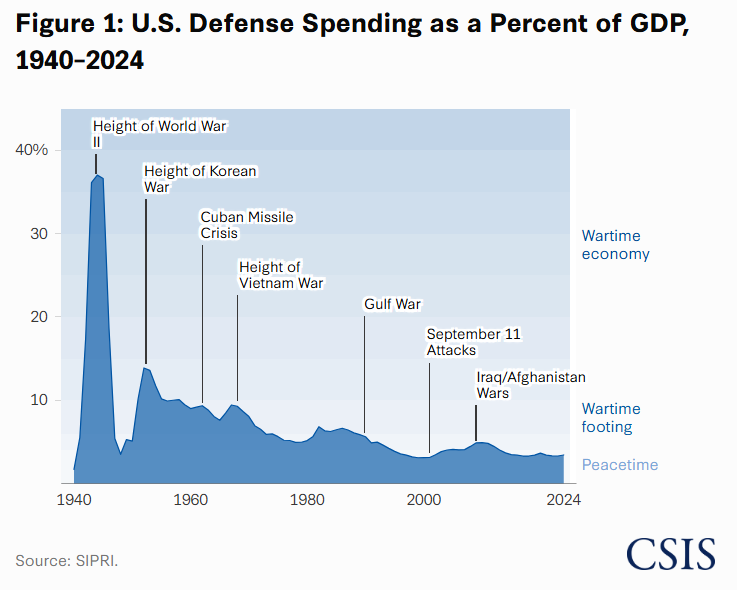
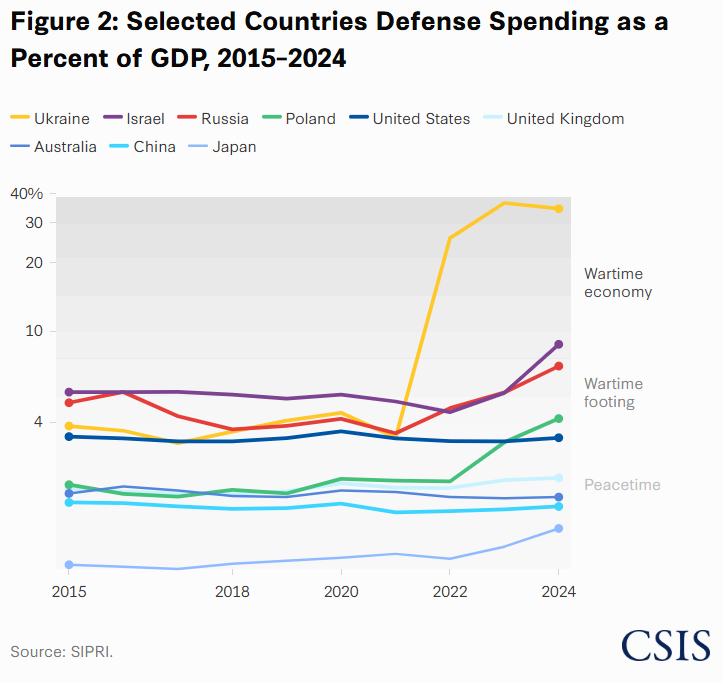
There are three steps to putting the industrial base on a war footing.
Spend more on defense. Getting to 5% of GDP would put the U.S. in line with Cold War or Gulf War defense levels that would enable greater numbers of forces, increased procurement of weapons systems, and greater investments in readiness.
Invest in the systems and platforms that will be required at the outset of a conflict, ensuring readiness from day one. As Secretary Hegseth stated, “speed to delivery is now our operating principle,” The DOD’s disestablishment of the overly deliberative and slow JCIDS, the creation of a 2-to-production standard, and numerous other initiatives are focused on speed to delivery and scale.
Sustainment—the ability to maintain, repair, and replace adequate levels of capabilities needed to prevail in prolonged conflict. This requires decisions today to ensure that the U.S. successfully sustains a resilient, surge-ready defense industrial base to succeed during a high-intensity conflict in the Indo-Pacific.
It is time for government and industry to get after it and put our industrial base on a wartime footing to operate with the speed, scale, and sustainment necessary to prevail in any future fight.
Jerry also discussed their paper on the DefAero pod.
Pentagon Weighs Consolidation of DIU Tech Portfolio

Emil Michael, the DoW’s CTO,
...This excerpt is provided for preview purposes. Full article content is available on the original publication.