PEACE FOR OUR TIME? YES, UNFORTUNATELY!
Welcome to the desert of the real!
If you desire the comfort of neat conclusions, you are lost in this space. Here, we indulge in the unsettling, the excessive, the paradoxes that define our existence.
So, if you have the means and value writing that both enriches and disturbs, please consider becoming a paid subscriber.
Comparisons between Trump’s peace efforts and Chamberlain’s proclamation in 1938 that his Munich agreement with Hitler achieved a “peace for our time” were repeated again and again after the meeting of Trump and Putin in Alaska, with the idea that the peace Trump wanted to impose on Ukraine would effectively amount to Ukraine’s capitulation to Russia. In a similar way, Trump’s claim that he has already ended eight wars is ridiculed. However, I think that Trump’s peace efforts should not be dismissed as a ridiculous fake: his mixture of diplomatic activity and the use of brutal military and economic force to stop a war is effectively a model of “peace for our time,” a model of how (economic and military) wars could be and will be ended in our era. After Taylor Swift’s triumphant Eras Tour, we now see an equally triumphant Trump peace tour all around the world.
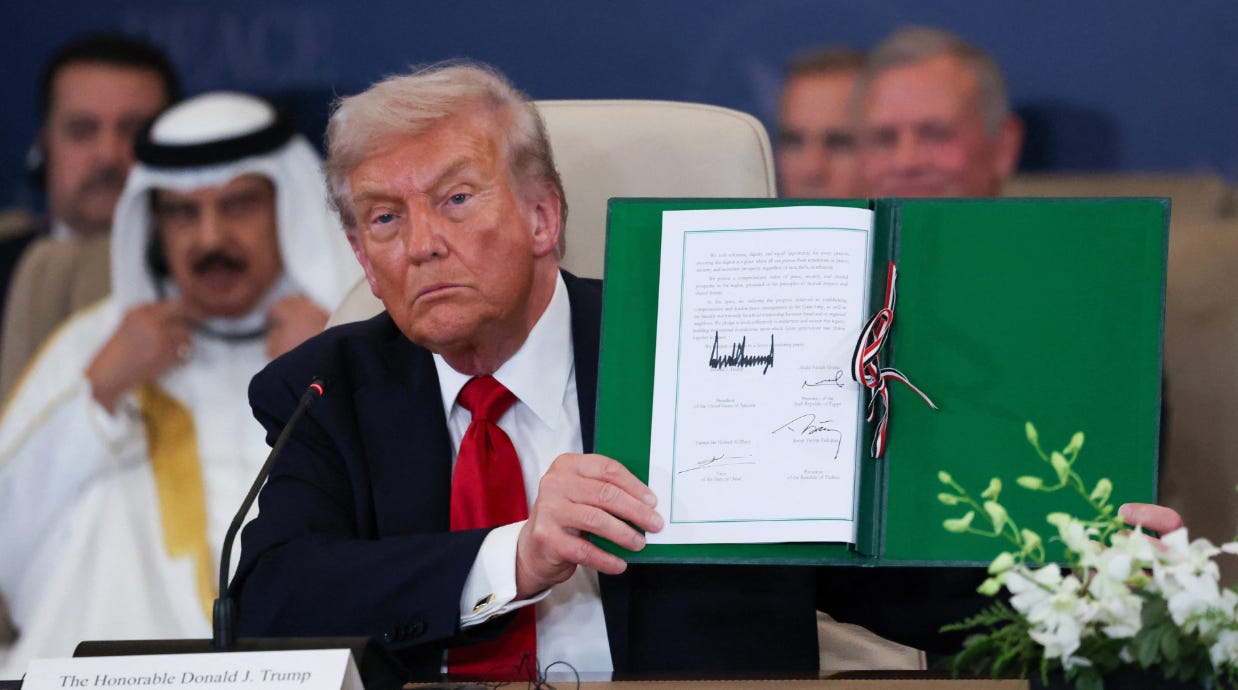
There were two big news stories about Donald Trump in October 2025. The first concerns the trade war between the US and China; the second is Trump’s success in imposing a ceasefire in the Middle East war, an act that will strengthen his image as a global peacemaker. These two acts seem to point in opposite directions: Trump as a global peacemaker versus Trump engaged in brutal economic warfare. My claim is that there is no essential difference between the two: in both cases, Trump is acting in exactly the same way.
Let’s begin with the first act: Trump announced he will impose an additional 100% tariff on goods from China, on top of the 30% tariffs already in effect, starting November 1 or sooner. The threat is a massive escalation after months of a trade truce between the two nations. Trump’s announcement is tied to Beijing ramping up export controls on its critical rare earths, which are needed to produce many electronics. Markets closed sharply lower on Friday after Trump’s initial comments, with the Dow falling by 878 points, or 1.9%. The S&P 500 was down 2.7%, and the tech-heavy Nasdaq tumbled 3.5%.1 Was
...This excerpt is provided for preview purposes. Full article content is available on the original publication.