Does anyone know why we're still doing tariffs?
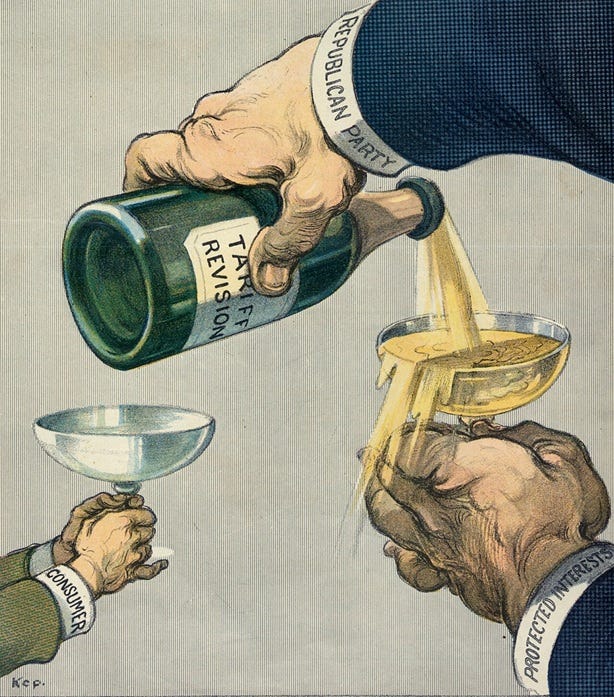

In case you haven’t heard, the Supreme Court just ruled many of Donald Trump’s tariffs illegal:
[T]he Supreme Court ruled that the unilaterally imposed [tariffs] were illegal…No longer does Trump have a tariff “on/off” switch…Future tariffs will need to be imposed by lengthy, more technical trade authorities — or through Congress…
In a 6-3 ruling, the Supreme Court said that affirming Trump's use of the International Emergency Economic Powers Act (IEEPA) would "represent a transformative expansion of the President's authority over tariff policy."…Chief Justice John Roberts said that IEEPA does not authorize the president to impose tariffs because the Constitution grants Congress — and only Congress — the power to levy taxes and duties.
This doesn’t mean that Trump’s tariffs are going to suddenly vanish. More are on the way. There are older laws passed by Congress in the 1960s and 1970s that authorize the President to raise tariffs under certain circumstances. Here’s a summary by the Yale Budget Lab:
[T]he president has other sources of legal authority to enact tariffs without further congressional action. These authorities generally fall into two groups: those that require investigations by federal agencies but have few if any restrictions on the eventual tariffs imposed (Sections 201, 232, and 301) and Section 122, which provides a temporary authority to impose tariffs without an investigation, but is limited to a 15 percent rate for only 150 days. There is another authority, under Section 338 of the Tariff Act of 1930 (otherwise known as Smoot-Hawley) that would allow the President to impose a 50 percent tariff with no investigation or time limitations, but no President has used this authority before, raising again concerns about future legal challenges.
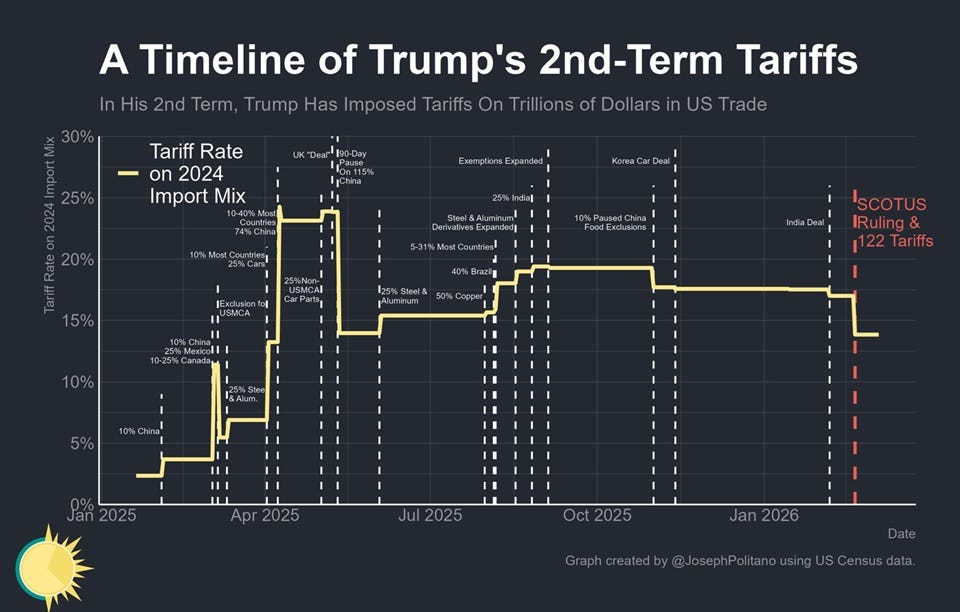
For now, all those other laws still stand, and Trump is going to use at least some of them. He immediately invoked one of the other laws, called Section 122, to put a 10% tariff on all imports from all countries, and then raised that to 15% a day later. This means the overall statutory tariff rate on U.S. imports (or at least, on the mix of imports from 2024), which would have fallen to around 9% after the SCOTUS ruling, will actually fall only a tiny bit:
But tariffs are very complex, and there are a ton of exemptions. Because these tariffs are more blanket than the ones SCOTUS
...This excerpt is provided for preview purposes. Full article content is available on the original publication.