Seven Contemporary Insights on the State of the War in Ukraine
Deep Dives
Explore related topics with these Wikipedia articles, rewritten for enjoyable reading:
-
Infiltration tactics
16 min read
The article describes Russia's '1,000 bites' approach using small teams to find gaps in Ukrainian lines—a modern application of infiltration tactics developed in WWI. Understanding this historical military doctrine illuminates why small-unit infantry tactics remain essential even in drone-saturated battlefields.
-
Glide bomb
20 min read
Glide bombs are mentioned as a key Russian weapon for creating gaps in Ukrainian defenses. These precision-guided munitions with extended range have become increasingly important in the conflict, and understanding their capabilities explains why they pose such a significant threat to fixed positions.
It is very likely that Russian efforts to “learn how to learn better” in the past three years have achieved critical mass and are now paying dividends at the tactical and strategic levels.
As many of you know, I recently returned from another research visit to Ukraine, my second of 2025. I posted a few insights here as a result of the trip.
My first dispatch, which covered Ukrainian military training as well as a certain incident with a snake, is available to read at this link. My second one is available here. My third dispatch, an interview with Nataliie Lutsenko, is available at this link. The fourth dispatch is here. My fifth dispatch, about Ukraine’s assault forces, can be read at this link. The sixth dispatch, on air defence, is available here.
I have now written a white paper, published by the Center for Strategic and International Studies in Washington DC, which provides seven strategic insights that are based on knowledge gained on my recent visit as well as previous visits and other research.
The war in Ukraine remains a rapidly evolving conflict. The battlefield, strategic strike, information operations, and industrial production campaigns remain crucial to both Ukraine’s and Russia’s war efforts. In all of these endeavors, there is an ongoing adaptation spiral occurring that is spinning out innovative techniques and technologies. At the same time, this is providing insights for Western strategists and force structure planners.
This white paper provides contemporary insights into the war and offers assessments on what they mean for possible conflict trajectories in the coming months. These insights are based on the author’s multiple visits to Ukraine, including one in October 2025. The seven key findings offer external observers not only an update on this rapidly changing war, but a view from the ground into how the character of war itself is evolving.
1. Drone Issues: Saturation and Russian Evolution
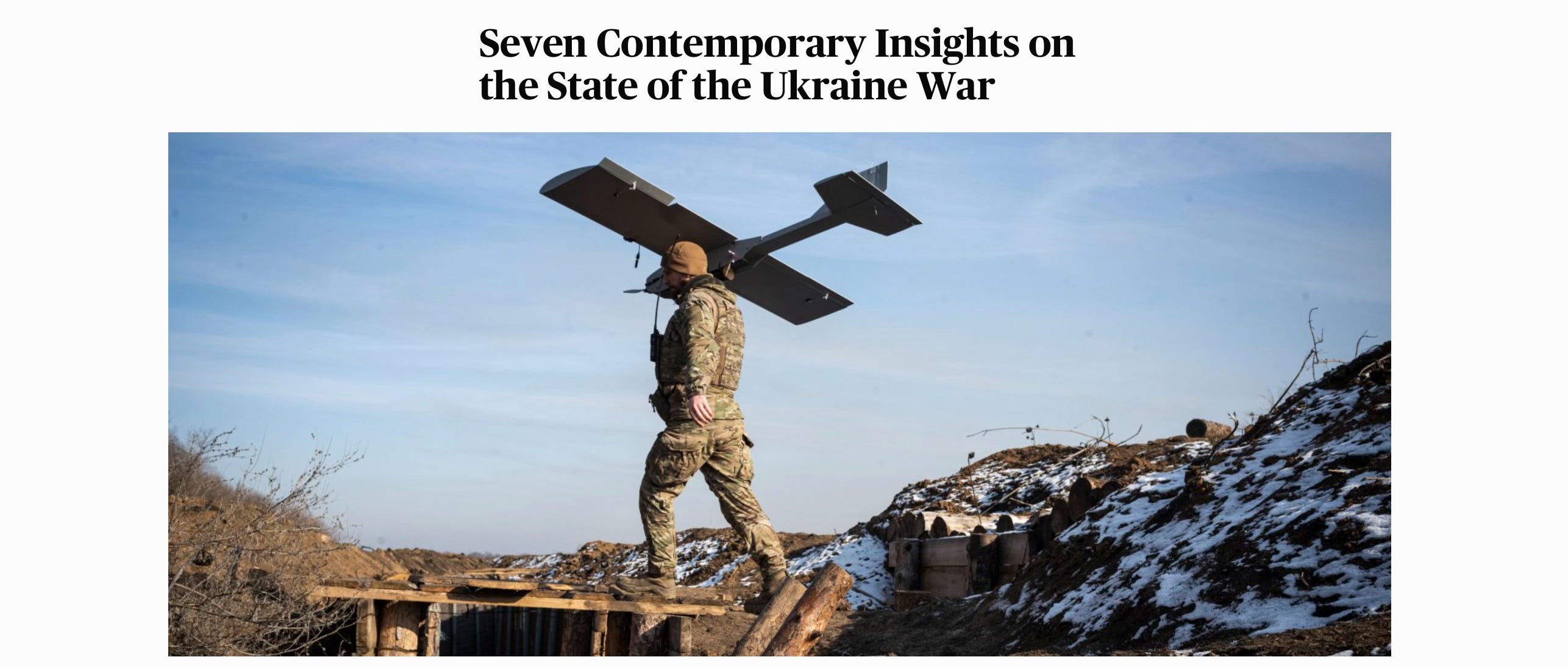
The eastern front line continues to be saturated with drones. As a result, within 15 kilometers (km) of the front line, vehicle movement is difficult to impossible. Infantry soldiers must instead march to their positions for 10–15 km.1 Where armored vehicles and artillery are deployed, they can be subject to dozens of attacks per platform per day.2 Ukraine has invested in decoys and deception activities, and headquarters are being built deep underground. The question is whether
...This excerpt is provided for preview purposes. Full article content is available on the original publication.